How grip orientation shifts elbow flexor recruitment — and what that means for your training
Most lifters know what a hammer curl does in broad terms: you use a neutral grip, and the exercise shifts emphasis toward the brachialis and brachioradialis. The biomechanical reasoning for reduced biceps dominance is sound. But the evidence is more specific than the common shorthand suggests — clearer for reduced biceps emphasis than for universally higher activation elsewhere.
The reason grip matters comes down to a single anatomical fact worth following to its conclusion: the biceps brachii does not just flex the elbow. It also supinates the forearm. That second job is the central reason grip orientation matters, and understanding it changes how you think about every curl you do.
One flexes and supinates. One just flexes. One pulls toward neutral.
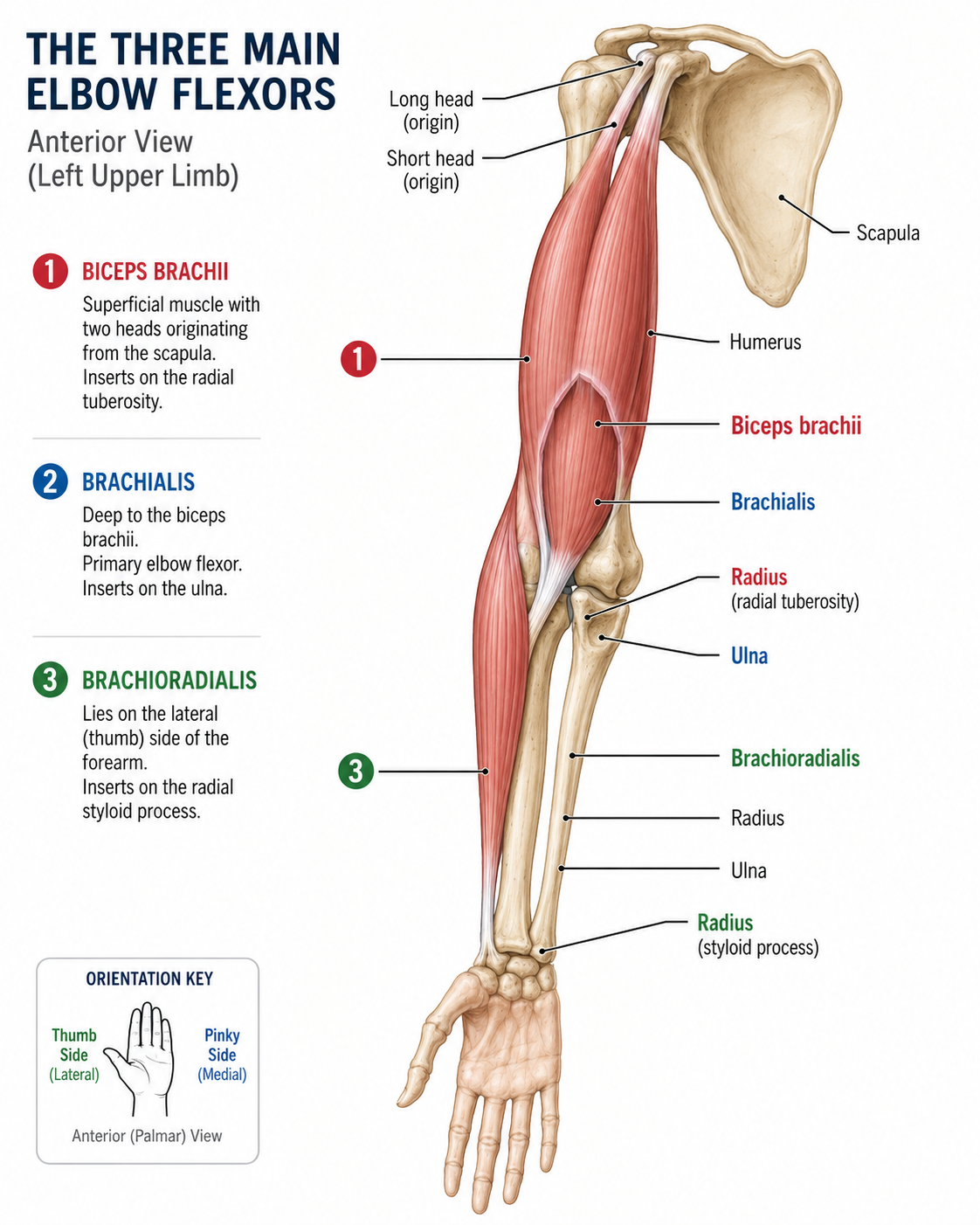
The three main muscles that flex the elbow share the job, but they do not share their secondary functions, and those secondary functions are what makes grip matter.
The biceps brachii is the most visible of the three. It has two heads — one long, one short — both originating on the scapula and inserting on the radial tuberosity. It flexes the elbow and supinates the forearm. Those are two separate mechanical functions served by the same muscle.
The brachialis sits directly beneath the biceps brachii on the anterior surface of the humerus. It inserts on the ulna — the forearm bone that does not rotate during pronation or supination. Because of that insertion, the brachialis is a pure elbow flexor. It has no role in rotating the forearm in any direction. It has a large cross-sectional area, and in non-supinated forearm positions it is generally regarded as the strongest elbow flexor (Physiopedia; StatPearls). When the forearm is fully supinated, the biceps brachii regains mechanical advantage and can match or exceed the brachialis’s contribution.
The brachioradialis originates on the lateral supracondylar ridge of the humerus and inserts near the styloid process of the radius. It flexes the elbow, and its flexion action is classically described as strongest when the forearm is in a mid-pronated (neutral, thumb-up) position, though EMG studies do not uniformly confirm neutral grip as producing the highest brachioradialis excitation. It also returns the forearm toward neutral from either full pronation or full supination — it cannot rotate the forearm beyond neutral in either direction.
These three muscles all flex the elbow. But the biceps also supinates, the brachialis does nothing but flex, and the brachioradialis pulls the forearm toward neutral. Those differences are the mechanism.
The brachialis doesn’t care about your grip
In a supinated curl — palms up — the biceps brachii is held in the forearm position where its supination role and elbow-flexion mechanics are most favored. Both of its mechanical roles remain relevant. It has more favorable mechanics, and it dominates the movement.
In a hammer curl, the forearm stays in neutral. Dynamic supination is mostly removed from the movement. The biceps brachii can still flex the elbow, but the demand on its supination function is greatly reduced. Its relative mechanical contribution to the curl drops — not because it stops working, but because the conditions that favor it are removed.
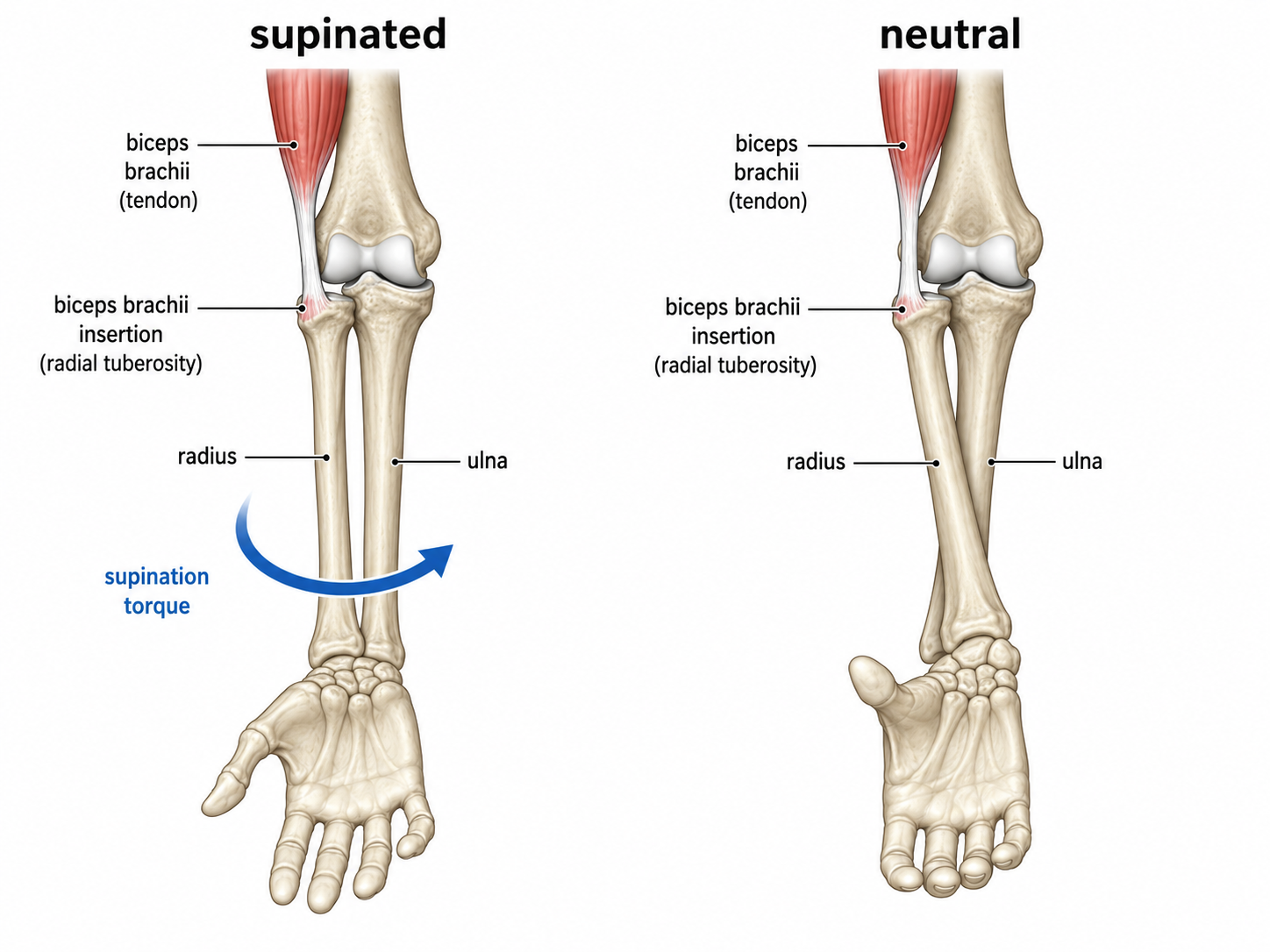
The brachialis is unaffected by any of this. It has no supination function to lose. Its basic action is not meaningfully changed by forearm rotation. It was always contributing to elbow flexion during a supinated curl, and it is still contributing during a hammer curl. What changes is the balance: with the biceps less mechanically favored, the brachialis likely accounts for a greater share of the total flexion force. It does not “take over.” It was always there. The biceps stepped back.
The brachioradialis, meanwhile, is well-positioned to assist elbow flexion in a neutral grip and can help stabilize the forearm in neutral, especially when the load or grip creates rotational demand. This is one reason hammer curls are often used for forearm-focused arm training, particularly because the brachioradialis is prominent on the thumb-side forearm.
It is worth noting what the research actually shows. A 2023 study by Coratella et al. examined muscle excitation patterns across different handgrip positions during curls in competitive bodybuilders. The study found that during the ascending phase, both biceps brachii and brachioradialis excitation were actually greater with the supinated grip than with the neutral grip. The brachialis was not directly measured — it sits too deep for reliable surface electromyography. This does not invalidate the biomechanical reasoning that removing supination reduces biceps dominance, but it does mean the common claim that hammer curls produce higher brachioradialis activation is not consistently supported by the available EMG data. The principle that different grips produce different muscle recruitment patterns is supported; the direction of those differences is more nuanced than most articles acknowledge.
Thickness comes from underneath
The mechanism has practical consequences for how your arms develop, even where the EMG picture is incomplete.
The brachialis sits beneath the biceps brachii. When it develops, it pushes the biceps up and outward, adding thickness to the upper arm when viewed from the front. The visible biceps “peak” — the bulge at the top of a flex — is primarily a biceps brachii feature and is often associated with the long head, though individual anatomy strongly affects it. Hammer curls are commonly used to emphasize thickness from the brachialis. Supinated curls more directly emphasize the biceps brachii, which contributes to the visible peak. Both contribute to complete arm development.
The brachioradialis is the most superficial muscle on the radial (thumb) side of the forearm. It is the muscle most visible when the arm hangs in a natural neutral position — which is how arms look most of the time. Developing it changes the visual taper from elbow to wrist and contributes to the forearm width that many trainees are after.
This is not a “which curl is better” question. The mechanism shows that the two grip orientations change the relative emphasis on the elbow flexors. Doing only one may leave some elbow-flexor roles less directly emphasized. A program that includes both addresses the full set.
Where the burn sits matters
Your body gives you information about what is working during hammer curls, if you know what to pay attention to. These are training observations — not diagnostic tools. Individual anatomy, leverages, and movement habits vary. Persistent pain or discomfort in any location warrants professional assessment, not self-managed exercise changes.
Where you feel fatigue after a set of hammer curls tells you something. If the fatigue concentrates on the outer face of the upper arm, between the deltoid and the elbow, the brachialis is likely doing meaningful work. If fatigue runs along the thumb side of the forearm, the brachioradialis may be contributing prominently.
Speed matters. Slow, controlled reps — particularly a deliberate eccentric (lowering) phase — increase time under tension for all the muscles involved. Eccentric loading is a well-established stimulus for muscle growth generally. Fast or momentum-assisted reps tend to shift more of the work into acceleration, inertia, and body English rather than sustained elbow-flexor tension. Slower reps make it easier to keep the target muscles loaded through the full range.
Coaches sometimes vary grip position on the dumbbell handle itself — centering the hand, or shifting it toward the thumb end so the pinky side of the dumbbell is heavier. Some trainees report that offset loading changes where they feel the exercise. This is a coaching observation, not a verified biomechanical claim, and individual responses vary.
Why you actually pin your elbows
(Each standard cue protects something specific in the mechanism)
The standard form cues for hammer curls exist for good reasons, but understanding the mechanism gives them more meaning than “do this for safety.”
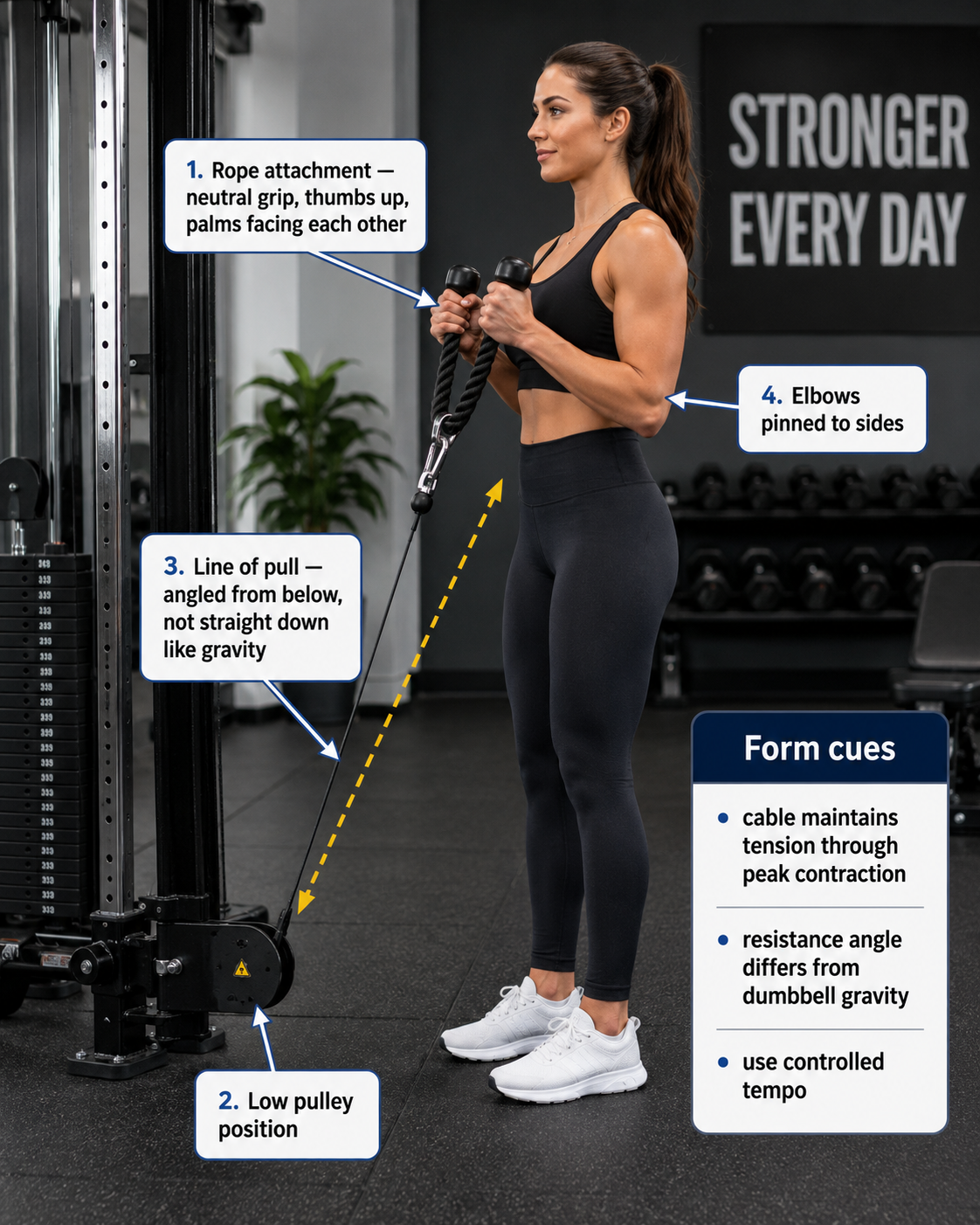
Keep the elbows pinned to your sides. When the elbow drifts forward, the anterior deltoid begins assisting with the movement. This changes the flexion angle at the elbow and shifts demand away from the elbow flexors — particularly the brachialis, which does its work purely through elbow flexion. Pinning the elbows keeps the work where the exercise is designed to put it.
Do not rotate the wrist during the curl. Even a small turn toward supination during the upward phase begins to restore the conditions that favor the biceps brachii. That partially reverses the grip change that defines the exercise. If you find your wrist drifting into supination under load, the weight may be too heavy for strict form.
Control the lowering phase. Eccentric loading is valuable for all the muscles involved in the curl. Dropping the weight quickly wastes the phase of the rep where the muscles are working to resist lengthening under load. A two-to-three-second lowering phase is a reasonable starting point.
Some variations change the mechanics. Others mostly change execution.
Most articles list hammer curl variations without explaining what each one actually alters. The mechanism helps.
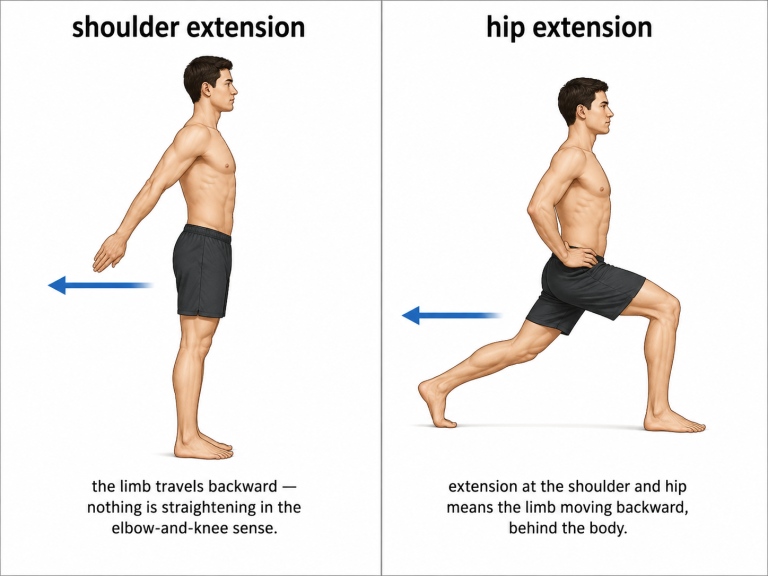
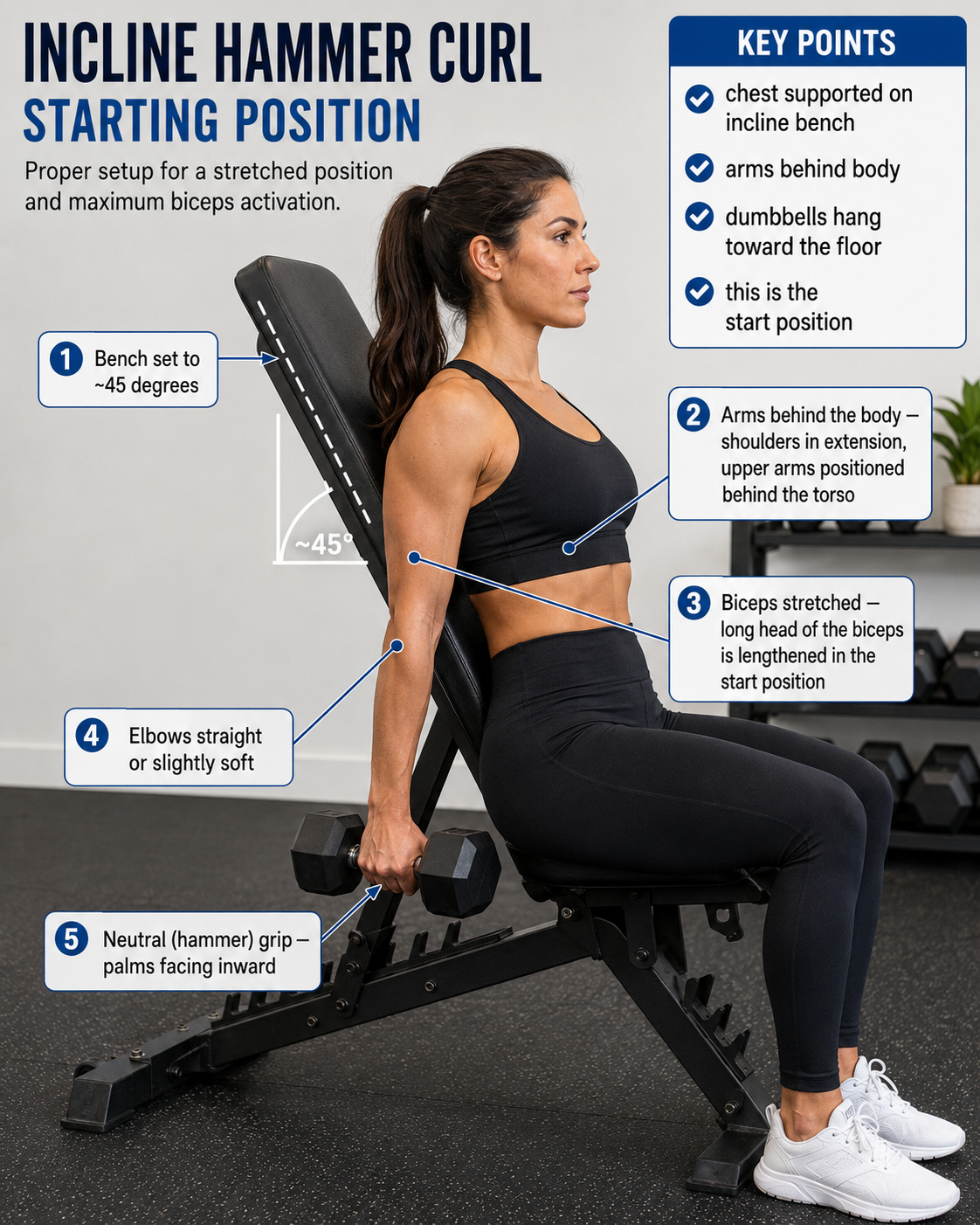
Incline hammer curl. Setting a bench to an incline and curling from that position places the shoulder in extension at the start of the rep. The long head of the biceps brachii crosses the shoulder joint, so starting with the arm behind the body increases the stretch on the long head at the bottom of the movement. The brachialis contribution is likely similar to a standing hammer curl — it does not cross the shoulder — but the biceps works through a longer effective range. This is a widely used bodybuilding approach for emphasizing the long head, though direct EMG comparison studies for incline vs. standing hammer curls were not found during the research for this article.
Cross-body (pinwheel) hammer curl. The dumbbell is curled diagonally toward the opposite shoulder instead of straight up. This changes the movement path and involves more horizontal adduction at the shoulder, which alters the feel of the exercise. Some sources suggest it may slightly emphasize the long head of the biceps brachii due to the shoulder position. However, the brachialis does not cross the shoulder joint, and the brachioradialis acts primarily at the elbow and forearm position, not the shoulder — so neither should be significantly affected by the change in shoulder position. The evidence for meaningful differences in muscle activation between cross-body and standard hammer curls is limited.
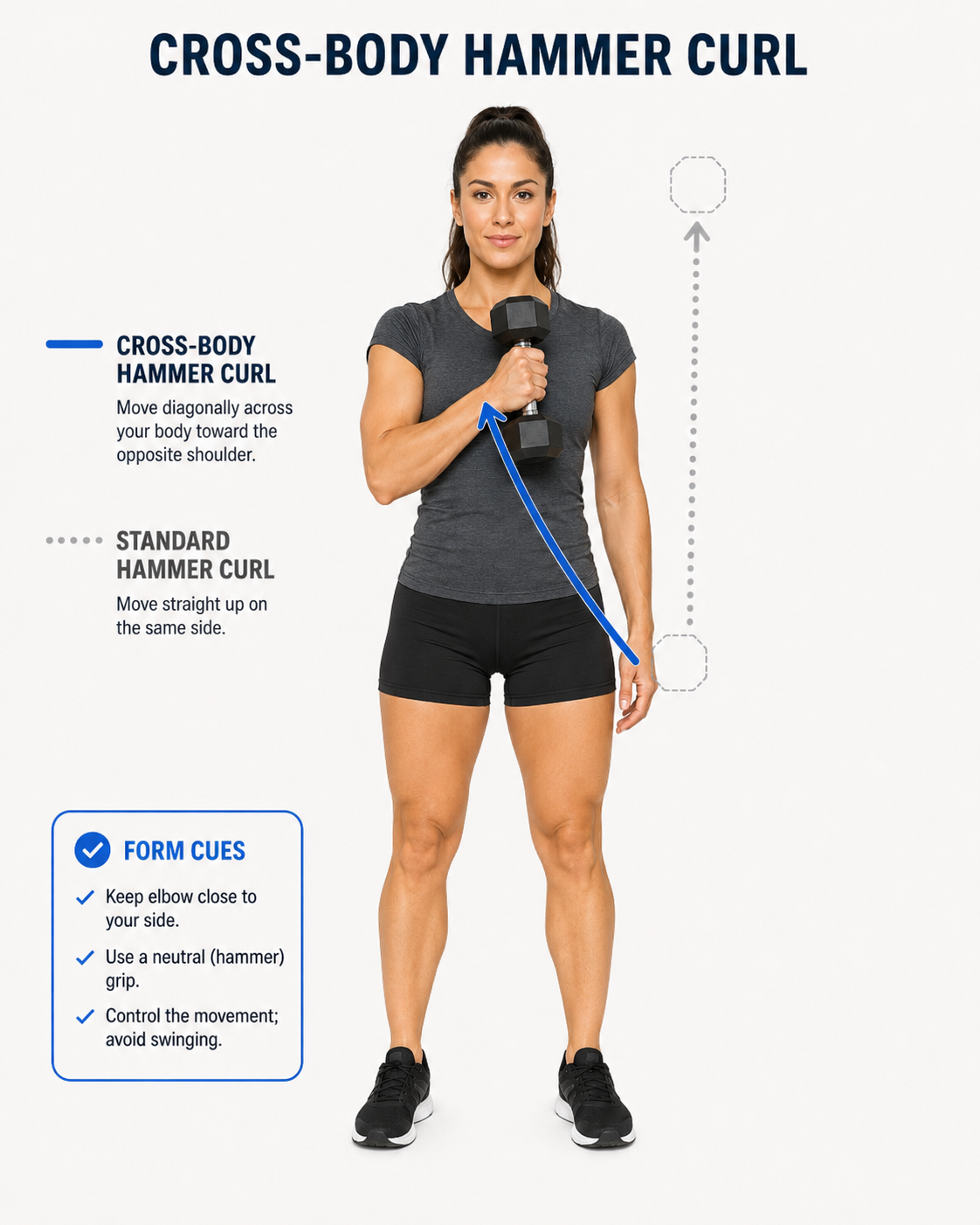
Rope hammer curl (cable). Cable resistance can maintain useful tension through more of the range than a dumbbell, depending on pulley setup and line of pull. This can keep the elbow flexors loaded through peak contraction where a dumbbell’s resistance decreases as the forearm approaches vertical.
Seated hammer curl. Sitting removes the ability to use lower-body momentum to initiate the curl. It forces stricter adherence to the elbow-only flexion pattern described above and may be useful for trainees who find themselves swinging during standing sets.
Usually after pulls, not before
(Where hammer curls fit in a session, and why both grips belong in the program)
Hammer curls fit naturally after compound pulling movements — rows, pull-ups, lat pulldowns — where the elbow flexors have already been working as synergists. Direct isolation work after compound work allows focused attention on the brachialis and brachioradialis without needing to pre-fatigue them.
Two to four sets of eight to twelve reps is a standard hypertrophy range. The elbow flexors generally respond well to moderate loads with controlled tempo rather than heavy, momentum-driven sets.
One to two sessions per week is sufficient for most trainees. Pairing hammer curls with supinated curls — either in the same session or on different training days — covers both grip orientations and addresses the full set of elbow flexors.
If wrist or elbow discomfort limits supinated curls, hammer curls can serve as the primary curl variation. The neutral grip eliminates the sustained supination demand, which many trainees find more comfortable at the wrist and elbow. Persistent discomfort in any curl variation is worth discussing with a qualified professional rather than managing solely through exercise selection.
These are starting points. Programming should be adjusted to individual training history, recovery capacity, and goals.
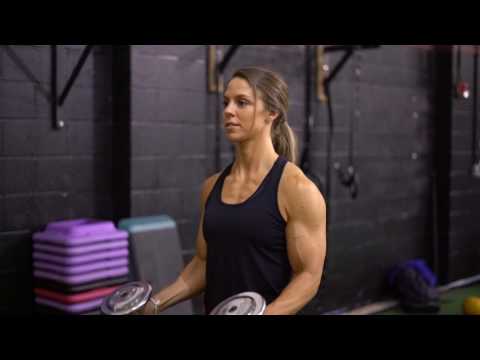

Hammer curls are a popular exercise in the fitness world, known for their effectiveness in building arm strength and size. Visualizing the way you hold a hammer is the easiest way to remember how to do it.
This versatile exercise targets multiple upper body muscles and is a staple in many workout routines. In this article, we’ll delve into hammer curls, the muscles they work, how they compare to traditional bicep curls, and the proper technique for performing them.


What Are Hammer Curls?
This is a variation of the traditional bicep curl, distinguished by the grip used on the dumbbells. Instead of the supinated grip (palms facing up) used in bicep curls, hammer curls employ a neutral grip, with the palms facing each other. This grip changes the dynamics of the exercise, engaging different muscles and providing a unique challenge for your arms.
Muscles Used
Hammer curls primarily target the following muscles:
- Brachialis: Located underneath the biceps brachii, the brachialis is a key player in elbow flexion. Hammer curls are particularly effective in isolating and developing this muscle.
- Biceps Brachii: While the biceps brachii are more heavily engaged during traditional bicep curls, they still play a significant role in hammer curls. The neutral grip shifts some of the focus away from the biceps, but they remain actively involved.
- Brachioradialis: This muscle of the forearm works prominently during hammer curls. It aids in elbow flexion and contributes to the overall strength and size of the forearm.
- Forearm Muscles: In addition to the brachioradialis, other muscles in the forearm, including the extensors and flexors, are engaged during hammer curls, enhancing grip strength and forearm size.
Hammer Curls vs. Bicep Curls
Similarities
- Both exercises target the upper arm muscles, particularly the biceps brachii, although to different extents.
- Both exercises involve elbow flexion, which is the primary movement in curling the weights toward the shoulders.
- Both exercises can be performed with dumbbells, making them accessible and easy to incorporate into various workout routines.
Differences
- Grip: The most significant difference between hammer curls and bicep curls is the grip. Hammer curls use a neutral grip, while bicep curls use a supinated grip. This difference in grip alters the muscle activation patterns.
- Muscle Focus: Bicep curls place more emphasis on the biceps brachii, making them ideal for those looking to maximize bicep development. In contrast, hammer curls distribute the load more evenly across the brachialis, brachioradialis, and biceps brachii, promoting overall arm strength and size.
- Forearm Activation: Hammer curls engage the forearm muscles more intensely than bicep curls, making them beneficial for improving grip strength and forearm development.
How to Do Hammer Curls
Equipment Needed
- Dumbbells: Choose a pair of dumbbells with a weight that allows you to perform the exercise with proper form.
- Bench (Optional): A bench can be used for seated hammer curls, although they can also be performed standing.
Step-by-Step Guide
- Starting Position: Stand with your feet shoulder-width apart, holding a dumbbell in each hand. Your arms should be fully extended at your sides, with your palms facing your torso (neutral grip).
- Curling Motion: Keeping your upper arms stationary, exhale and curl the dumbbells toward your shoulders. Focus on moving only your forearms, keeping your elbows close to your torso. Your palms should remain facing each other throughout the movement.
- Peak Contraction: Continue to curl the dumbbells until they reach shoulder level, fully contracting your biceps and forearms. Hold this position briefly, squeezing the muscles at the top of the movement.
- Lowering Phase: Inhale and slowly lower the dumbbells back to the starting position, maintaining control throughout the descent. Avoid using momentum or letting the weights drop quickly.
- Repetition: Repeat the curling motion for the desired number of repetitions, typically 8-12 for muscle hypertrophy.
Tips for Proper Form
- Maintain a Neutral Grip: Your palms should face each other throughout the exercise to maintain proper muscle engagement.
- Control the Movement: Avoid using momentum to lift the weights. Focus on slow, controlled movements to maximize muscle activation and reduce the risk of injury.
- Keep Your Elbows Close: Prevent your elbows from flaring out to the sides. Keeping them close to your torso helps isolate the target muscles.
- Engage Your Core: Maintain a stable core to support your upper body and prevent excessive swinging or leaning during the exercise.