Extension, Defined: The Joint Movement That’s Trickier Than “Straightening”
Every glossary says extension means increasing the angle at a joint. That’s true — until you get to your shoulder, your ankle, and the machine at the gym called a “leg extension.” Here’s the definition, and the three places it gets slippery.
You already know the definition, more or less. Extension increases the angle at a joint. It’s the opposite of flexion. Straighten your bent elbow — that’s extension. Stand up from a chair and your knees extend. Simple.
And for the elbow and the knee, it really is that simple. But the word starts misbehaving the moment you leave those two joints. Someone says “shoulder extension” and points behind their back. At the ankle, the terminology gets so tangled that anatomy gave up on “extension” and “flexion” entirely and uses different words. And then your training program lists “leg extensions,” “triceps extensions,” and “back extensions” as if they were all the same kind of thing, when they’re really not.
This article gives you the definition that’s actually correct, and then does the part the glossary entries skip: it shows you the three specific places where “extension equals straightening” stops working, so the word still helps you after you close the tab.
The Core Definition — What Extension Actually Means
Extension is a movement that increases the angle between two bones at a joint. Flexion, its partner and opposite, decreases that angle. If you bend your elbow to bring your hand toward your shoulder, the angle at the elbow shrinks — that’s flexion. Straighten it back out and the angle grows — that’s extension.
These movements happen in the sagittal plane: the front-to-back plane that divides your body into left and right halves. Flexion and extension occur in that plane, rotating about a side-to-side (frontal) axis. This matters because it’s a common point of confusion — side-to-side movements away from and toward the body’s midline are abduction and adduction, which happen in a different plane (the frontal or coronal plane). For the limbs and trunk, extension is a sagittal-plane movement. The thumb is a notable exception — because of how the thumb is rotated relative to the other fingers, its extension and flexion occur in the plane of the palm rather than the sagittal plane. If you ever see extension described as a coronal-plane movement for other joints, that’s likely an error.
The cleanest mental model: find the joint, watch the angle between the two bones it connects. Bigger angle, extension. Smaller angle, flexion. Hold onto that tool — it’s what survives when the memorized examples run out.
Extension and Flexion — The Pair That Only Makes Sense Together
You can’t really understand extension without flexion, because they’re defined against each other. It helps to walk through the joints where the pair behaves itself before meeting the ones where it doesn’t.
At the elbow, flexion curls the forearm up toward the shoulder; extension straightens it back down. At the knee, flexion bends the leg to lower you into a chair; extension straightens it to stand you back up. At the finger joints, flexion closes your hand into a fist; extension opens it flat. In every one of these, the “watch the angle” tool works perfectly: flexion closes the angle, extension opens it, and extension genuinely looks like straightening.
These are the hinge joints — the elbow, the knee, the interphalangeal joints of the fingers and toes — and hinge joints are the home turf of flexion and extension. They move along essentially one axis, so the two movements are nearly the whole story of what they do. The ankle is technically a hinge joint too, but the naming of its movements is confusing enough that it deserves its own section below. If every joint were as clean as the elbow, the simple definition would be all you’d ever need.
But not every joint is a hinge.
Where “Straightening” Stops Working — The Shoulder and Hip
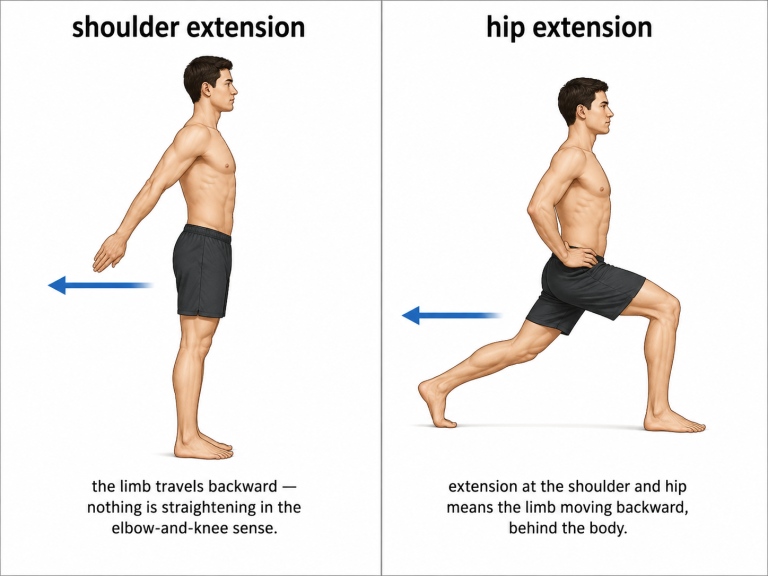
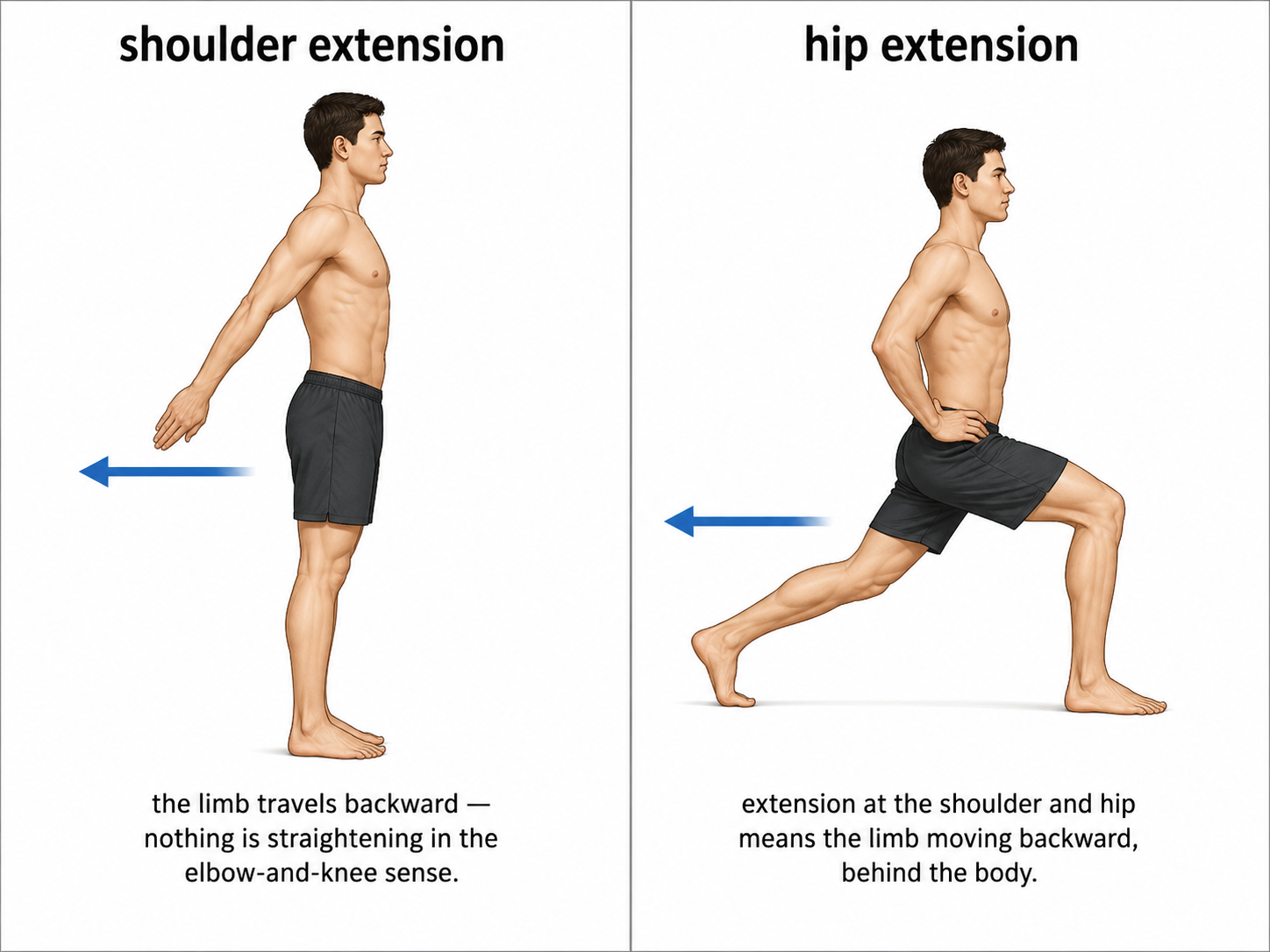
The first complication shows up at the shoulder and the hip, which are ball-and-socket joints rather than hinges. They move in many directions, and at these joints extension does not mean straightening at all. It means moving the limb backward, behind the body.
Swing your arm backward behind you, past your torso — that’s shoulder extension. Drive your thigh backward in a glute kickback, or think of the trailing leg pushing off behind you in a lunge — that’s hip extension. Nothing is straightening in the elbow-and-knee sense. The limb is traveling to the rear.
The “increasing angle” rule does still technically hold, if you measure the angle on the front of the body between the limb and the torso — sweeping the arm back opens that front angle. But almost nobody’s intuition measures it that way, which is exactly why shoulder and hip extension trip people up. The honest move here isn’t to force the straightening image onto these joints; it’s to swap in a better one. At the shoulder and hip, think of extension as the limb traveling backward.
One practical note on the hip: extension past a neutral standing position is fairly small, limited by the capsular ligaments at the front of the joint — particularly the iliofemoral and pubofemoral ligaments. That’s why exercises that train hip extension — hip thrusts, glute bridges, deadlifts — are mostly about driving powerfully to a neutral, fully-open hip position from a flexed one, not about forcing the thigh far behind you.
The Ankle — Where Extension and Flexion Seem Backward
The second complication is the strangest, and it’s the ankle.
At the ankle, the terminology breaks down. Some sources call pointing the toes (toes down, away from the shin) the extension-type movement, while others call pulling the toes up toward the shin the extension-type movement. The disagreement is real — it exists across educational references, not just informal sources — and it makes applying “extension” and “flexion” to the ankle genuinely unreliable.
Because of this, anatomy uses two dedicated terms for the ankle instead, and you should too. Pulling the toes up toward the shin is dorsiflexion (named for the dorsum, the top surface of the foot). Pointing the toes down is plantarflexion (named for the plantar surface, the sole). These terms exist precisely because trying to map extension and flexion onto the ankle creates more confusion than clarity.
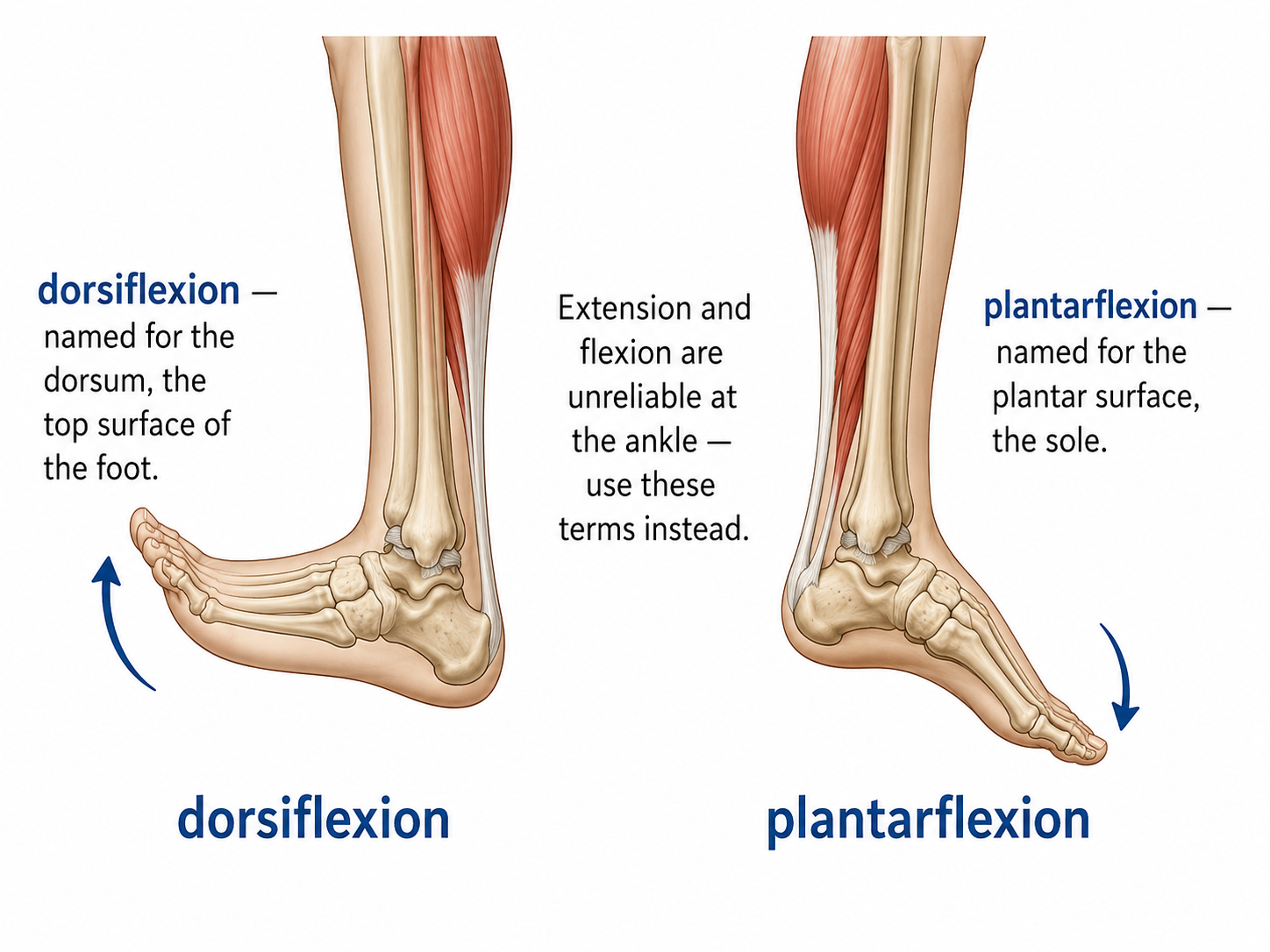
I’ll be straight about something here, because there’s a folk explanation floating around that’s worth not repeating: you’ll sometimes see it claimed that plantarflexion is called “flexion” because it flexes the plantaris muscle. That’s almost certainly not the real reason — the naming refers to the plantar surface of the foot, not the small plantaris muscle. The practical takeaway is cleaner than any origin story anyway: at the ankle, drop “extension” and “flexion” entirely and use dorsiflexion and plantarflexion. They’re unambiguous.
The Other Confusion — “Extension” the Movement vs. “Extension” the Exercise
Here’s the distinction that trips up more gym-goers than any anatomical quirk, and that the glossary pages tend to skip: the word “extension” does double duty. It’s an anatomical movement — what a joint does — and it’s also baked into the names of exercises. Those two uses overlap, but they are not the same thing, and the names can mislead.
Sometimes the exercise name and the movement line up cleanly. A leg extension (the seated machine where you straighten your legs against a pad) trains knee extension — the name and the joint movement match. A triceps extension (pressing a weight overhead or down to straighten the elbow) trains elbow extension — again, a match. In both, “extension” the exercise really does train “extension” the movement, at the joint you’d expect.
But the parallel breaks fast. A back extension (the bench where you hinge at the hips and raise your torso) primarily trains extension of the hips and spine — a completely different region from the limbs the other two exercises work, even though the name sounds parallel. And watch the trap in the opposite direction: a leg curl trains knee flexion, the exact opposite movement, even though “leg curl” sits right next to “leg extension” in the exercise list and sounds like its sibling. The names are a vocabulary of their own, layered on top of the anatomy. When you want to know what an exercise actually trains, ignore the label and ask the real question: which joint is moving, and is the angle opening or closing?
Hyperextension — When Extension Goes Too Far (and When the Word Is Misused)
One more term rides along with extension in nearly every glossary: hyperextension. It has a precise meaning, and it also has a confusing second life as an exercise name.
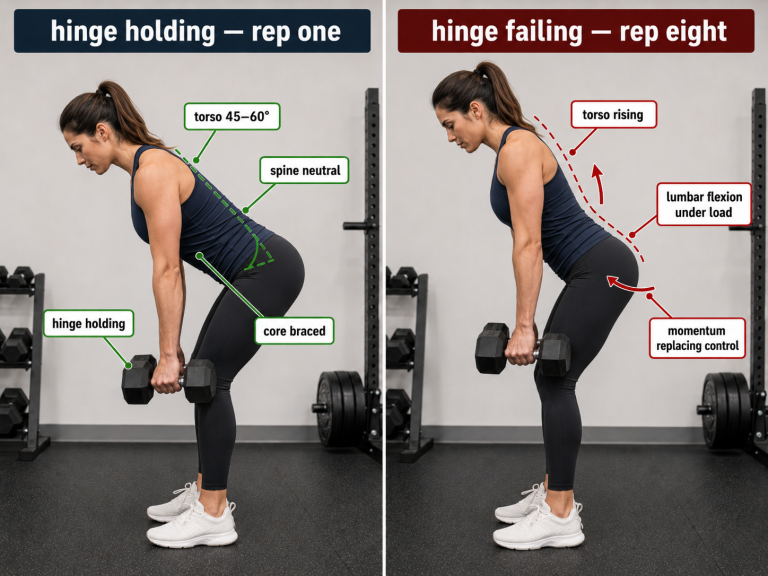
Strictly, hyperextension is extension of a joint beyond its normal extension range. At the knee and elbow, that means pushing past straight; at the spine, it means arching backward past the joint’s safe limit. Lock your knee out hard and shove it backward past straight, or do the same to your elbow, and you’ve hyperextended it. This stresses the ligaments that are supposed to limit the joint, and it’s a genuine injury mechanism, especially under load — though not every hyperextension causes a tear. One caveat: some people naturally rest with their elbows or knees slightly past straight — that’s joint hypermobility, and their “straight” is simply a different neutral, not an injury. The concern is forcing a joint past its own normal end range, particularly under load. The lumbar spine is another place this matters: excessive extension of the low back under load — at the top of a heavy deadlift, for instance — is worth avoiding, especially for people with back pain or spinal conditions.
Confusingly, “hyperextension” is also the gym name for the back-extension bench described above. As an exercise, a well-performed “hyperextension” usually shouldn’t involve actual hyperextension of the spine at all — it’s controlled spinal and hip extension within a safe range. The name oversells the movement. So the word points at two different things: an injury mechanism (a joint forced past its limit) and a piece of equipment (where, done right, you stay within the limit). Keep them separate.
The safety thread running through all of this: extension doesn’t become risky just because it reaches end range — controlled end-range work is part of many training and rehab programs. The risk is forced, uncontrolled, or loaded movement beyond what the joint can tolerate. Locking out and shoving a joint past its limit under heavy load — knees, elbows, the lower back — is where a normal, healthy movement becomes a way to hurt yourself.
If you experience pain, instability, a popping sensation, numbness, or radiating symptoms during any extension movement, stop and get it evaluated. People with prior joint injuries, disc issues, spinal conditions, or symptomatic hypermobility need individualized guidance from a clinician or qualified trainer — not a general article.
How to Actually Use This
The thing worth keeping isn’t a memorized list of joints. It’s a small procedure plus a short list of exceptions.
The procedure: find the joint, identify the two segments it connects, and watch the angle. Opening up is extension; closing down is flexion. That single tool handles the elbow, the knee, the fingers, and most of the body cleanly.
The exceptions, so the tool doesn’t fail you:
At the shoulder and hip, don’t look for straightening — look for the limb traveling backward, behind the body.
At the ankle, abandon “extension” and “flexion” altogether and use dorsiflexion (toes up) and plantarflexion (toes down).
With exercise names, don’t trust the label. A “back extension” and a “leg extension” work different regions; a “leg curl” is the opposite movement from a “leg extension.” Ask which joint is moving and which way the angle goes.
The Point
“Extension increases the angle at a joint” is a true sentence, and a good place to start. It’s just not the finish line. The people who actually understand movement — therapists, coaches, the lifter who never tweaks their lower back — aren’t the ones who memorized the sentence. They’re the ones who know where it stops being enough: at the shoulder and hip, where extension goes backward; at the ankle, where the terminology breaks down and gets replaced; and in the gym, where the exercise on the label isn’t always the movement at the joint.
That’s not more to memorize. It’s the difference between reciting a definition and knowing what your body is doing.