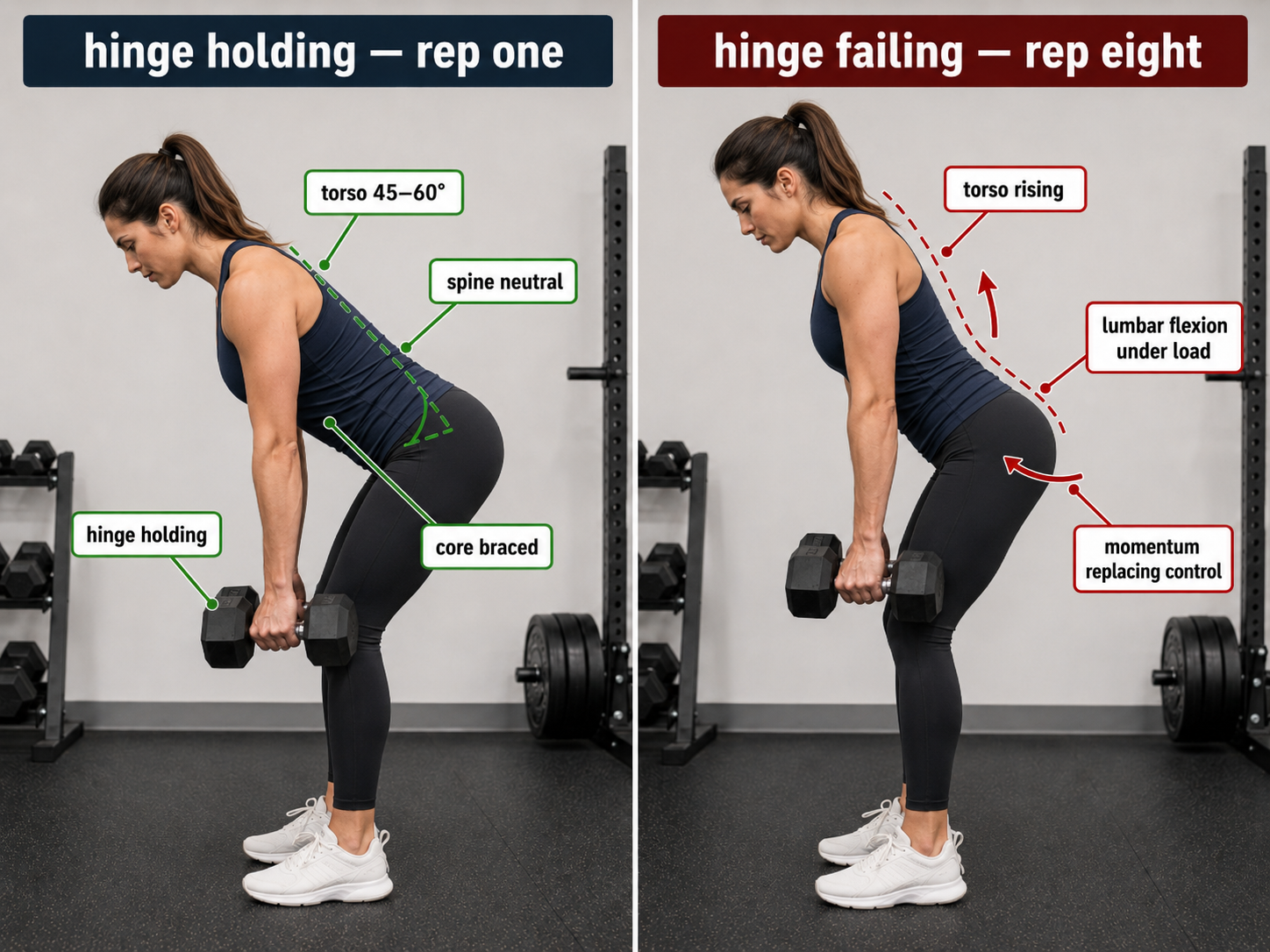
The bent-over row is two exercises at once — an isometric hinge hold and a dynamic pull — and for many people, the hinge fails first
You finish a set of bent-over dumbbell rows and your lower back is on fire. Your lats feel like they barely worked. You’ve been told this is a back exercise — lats, rhomboids, traps — but the thing that’s exhausted is your spine. You tighten your form, focus on squeezing your shoulder blades, try again. Same result. The lower back burns out before the back muscles you’re trying to train ever fatigue.
You’re not doing it wrong. You’re experiencing the fundamental tension at the center of this exercise, and understanding it changes how you approach every set.
Two Exercises at Once — The Hinge and the Pull
Here is a useful way to understand what’s actually happening during a bent-over dumbbell row: your body is performing two exercises simultaneously, and they place competing demands on the same structures.
The first is an isometric hip-hinge hold. Your erector spinae, core musculature, glutes, and hamstrings are all working to keep your torso in position — bent forward, spine neutral, ribcage braced. This hold doesn’t rest between reps. It runs continuously for the entire set, under load, without a break.
The second is the dynamic pull. Your lats, rhomboids, middle traps, rear delts, and biceps are rowing the dumbbells — the visible exercise, the one you came to do.
These two demands draw from the same structural foundation: your spine, your core, your capacity to hold position under fatigue. The hinge doesn’t pause while the pull works. It holds and holds and holds, and somewhere in the set — for many people, sooner than they expect — it runs out.
What Happens When the Hinge Fails
When the isometric hold fatigues before the pulling muscles do, the exercise doesn’t stop. It degrades. And every common form fault that articles warn about is the same event seen from different angles.
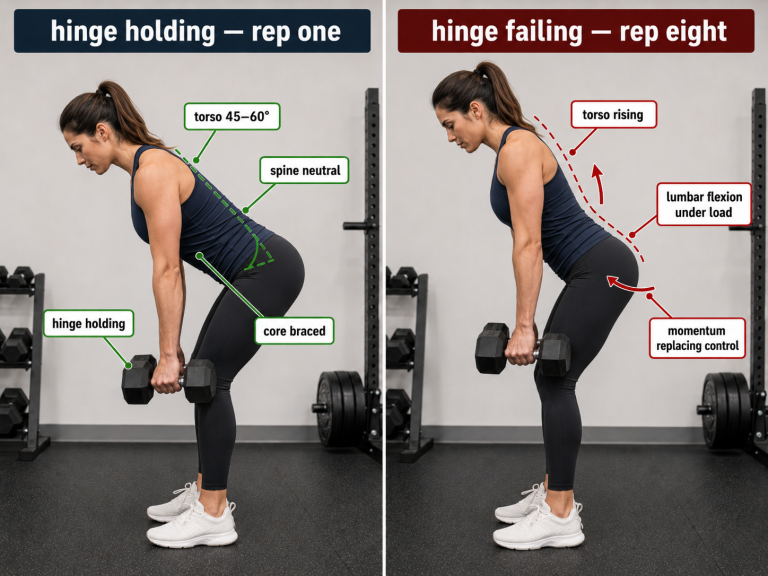
The torso rises during the set. You started at a 45-degree angle; by rep eight, you’re nearly upright. This isn’t laziness — it’s the erector spinae losing the ability to hold the angle, and the body finding a more vertical position where gravity’s demand on the hinge is lower.
The lower back rounds. The core loses its brace. The neutral spine you set on rep one drifts into flexion under load — and the combination of flexion, load, and fatigue increases the demands on the lumbar tissues, especially as the set progresses.
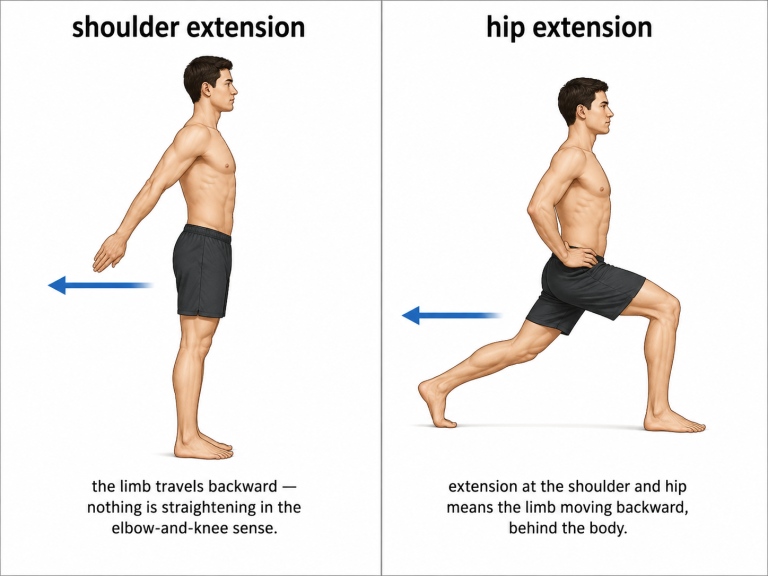
Momentum appears. Instead of a controlled pull from a stable platform, each rep starts with a subtle hip-extension pulse — a small body heave that gets the weight moving because the hinge can no longer hold still while the arms do the work. The pull hasn’t failed. The platform it’s pulling from has collapsed.
Every “common mistakes” article warns against these things — rising torso, rounded back, momentum. None of them explain that they often share a common driver: the hinge fatiguing before the pull.
What the Research Shows
A 2009 study by Fenwick, Brown, and McGill compared three rowing exercises — the inverted row, the standing bent-over row, and the one-arm cable row — measuring trunk muscle activation, lumbar spine motion, and spinal loading. The study used a barbell for the bent-over row, not dumbbells. Both versions require an unsupported hip hinge, but load distribution and technique differ — the core demand of holding the torso in position against gravity applies to both.
Two findings matter here. First, the standing bent-over row produced the largest lumbar spine load of the three exercises tested. Second, the inverted row produced the highest activation of the lats and upper-back muscles while imposing the lowest spine load.
This doesn’t mean the bent-over row is a bad exercise. It means it imposes a real cost on the spine — the cost of the unsupported hinge — and that cost is worth understanding. If your goal is lat development and your hinge consistently fails before your lats fatigue, you’re paying a high spine cost for a low training return on the muscles you’re targeting.
What Changes When You Change the Angle, the Grip, and the Elbow
The bent-over dumbbell row is not one exercise. It’s a family of variations, and small changes in position shift who does the work. These aren’t secrets — they’re physics — but knowing them lets you match the variation to the goal rather than doing the same default version every time.
Torso angle changes the demand on both the hinge and the target muscles. A more horizontal torso — closer to parallel with the floor — emphasizes the upper back and rear delts but demands more from the lower back and core to hold the position. A more upright torso — closer to 45 degrees — shifts emphasis toward the traps and reduces spine load. Start around 45 to 60 degrees and adjust based on your lower back’s tolerance and the muscles you’re trying to reach.
Elbow position determines which back muscles do the most work. Elbows pulled tight to the body emphasize the lats — the large muscles running down the sides of the back. Elbows flared to roughly 45 degrees shift emphasis toward the upper back — rhomboids and middle traps. Elbows flared wider, closer to 90 degrees, target the rear delts primarily. Based on biomechanical principles and common coaching practice, elbow path is one of the most effective variables for directing where the training stimulus lands.
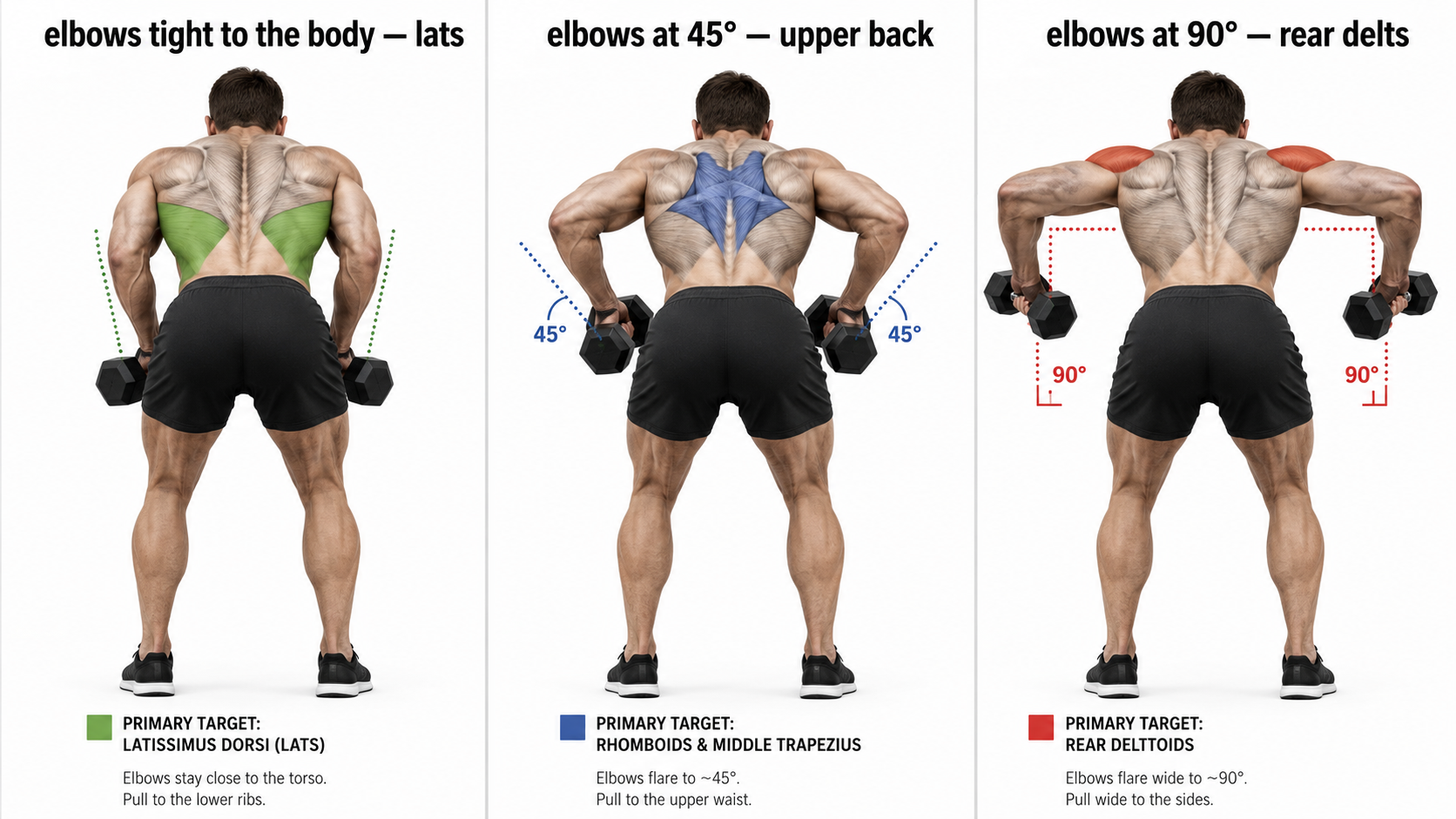
Grip follows elbow position. A neutral grip — palms facing each other — is the natural dumbbell position and allows the elbows to stay close or flare freely. A pronated grip — palms facing backward — tends to encourage a wider elbow flare and more upper-back emphasis. A supinated grip — palms facing forward — tends to keep the elbows tighter to the body and involve the biceps more. These are directional tendencies from biomechanics and coaching convention, not rigid rules.
How to Actually Perform the Bent Over Dumbbell Row
The order matters: set the hinge before the first rep, and do not let it move during the set.
Stand with feet roughly shoulder-width apart, holding a dumbbell in each hand with a neutral grip. Push your hips back and hinge forward until your torso is between 45 and 60 degrees from vertical — the angle where your lower back can hold a neutral spine without strain. Knees slightly bent, not locked. Core braced — the same “about to take a punch” tension from any heavy hinge movement. The hinge is now set. It does not change from rep one to the final rep. If it does, the set is over.
Let the dumbbells hang at arm’s length, directly below your shoulders. Pull them toward your lower ribs if you’re targeting the lats, or toward your upper waist if you’re targeting the upper back. Drive the elbows back, not up — “pull with the elbows” is the cue that shifts emphasis from the biceps to the back. At the top, retract the scapulae — pull the shoulder blades together — and hold briefly. Lower under control.
With lighter loads, exhale on the pull and inhale on the lower. With heavier loads, holding the brace through the rep and exhaling near the top can increase trunk rigidity and stability. A note: this breath-holding pattern (the Valsalva maneuver) temporarily raises blood pressure. If you have hypertension or cardiovascular risk factors, use the exhale-on-exertion pattern or consult a clinician about what’s appropriate for you.
The critical self-check: if your torso angle rises during the set, the weight is too heavy for your hinge, regardless of what your lats can handle. Lower the weight until the hinge can hold for the full set. In a bent-over row, the lats can’t outwork a failing hinge.
Strengthening the Hinge — So the Pull Can Do Its Job
If the hinge is the bottleneck, lighter rows alone may not fix the problem — they can help if used strictly to practice holding position, but they don’t build the hinge capacity you need for heavier loads. Building the hinge independently closes the gap faster.
Deadbugs and bird-dogs train core bracing endurance — the ability to hold a stable trunk while the limbs move, which closely parallels the demand of the bent-over row.
Romanian deadlifts build hip-hinge strength under load. They teach the erector spinae, glutes, and hamstrings to hold a neutral spine while moving heavy weight through the hip-hinge pattern — the same pattern the row demands isometrically.
Forearm planks build isometric trunk endurance — holding a braced position for time, which trains the same endurance capacity the hinge must sustain during a set of rows.
Back extensions (on a 45-degree bench or a GHD) strengthen the erector spinae through their range of motion in a supported position. These are a good starting point for someone whose lower back currently limits their rows, because the bench provides stability the free-standing hinge does not.
These build the platform the row needs. Without the platform, the pull never gets to do its job.
When to Take the Hinge Out Entirely
If your goal is lat and upper-back development, and your hinge consistently fails before those muscles fatigue, consider removing the hinge from the equation.
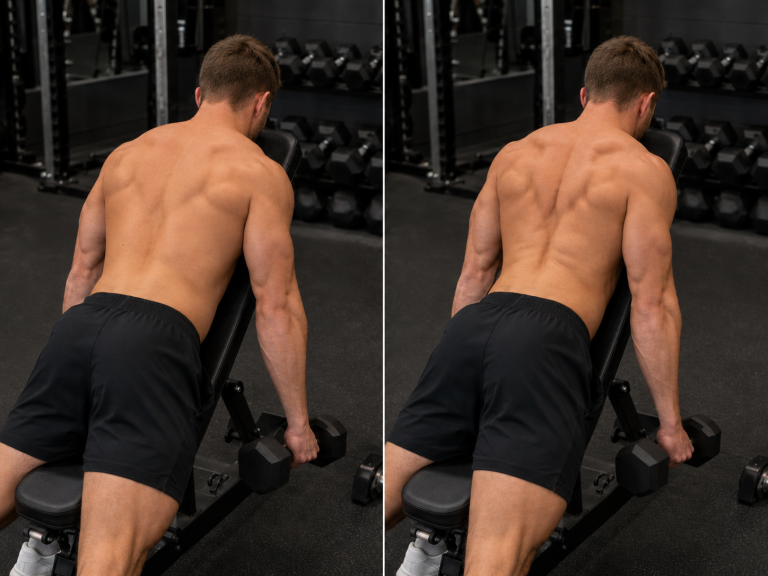
The chest-supported incline dumbbell row does exactly this. Set an adjustable bench to roughly 30 to 45 degrees, lie face down with your chest against the pad, and row from there. The bench supports your torso, removing the unsupported hinge demand. The pulling muscles — lats, rhomboids, traps, rear delts, and biceps — do the work without the lower back competing for your energy and attention.
This is not a lesser exercise. It’s a more targeted one. The bent-over row trains the hinge and the pull together. The chest-supported row isolates the pull. Which one serves you better depends on what’s actually limiting you. If the hinge is strong and the lats are the weak link, the bent-over row is the better exercise. If the hinge gives out first, the chest-supported row delivers more back training for less spine cost — and building the hinge separately until it catches up is the path back to free-standing rows.
When to Stop
The bent-over dumbbell row is a high-spine-load exercise. That’s not a warning label — it’s a mechanical fact. Respect it.
Lower back pain that sharpens during or after rows — not the general fatigue of muscles working, but a sharp, localized, or radiating sensation — is a reason to stop the exercise. The cause may be hinge overload, but it may also be something else entirely. Reduce the weight, check your torso angle and bracing, and switch to the chest-supported variation while you assess. If pain persists for more than a week or two, see a clinician before returning to free-standing rows.
People with disc issues, acute lower back pain, recent spinal surgery, or chronic lumbar conditions should use the chest-supported variation or get clearance from a physical therapist or physician before free-standing bent-over rows.
If you are pregnant or postpartum, resistance training is generally encouraged in uncomplicated pregnancies, but exercises that load the spine in a hinged position may need modification — work with a qualified provider to determine what’s appropriate for your situation. Older adults benefit from resistance training, and the bent-over row is not inherently off-limits — but if you are deconditioned or managing a spine condition, start with supported variations and progress with guidance. If you have uncontrolled hypertension or cardiovascular conditions, get clearance before exercises involving heavy strain or breath-holding under load.
One broader point: exercise should not delay medical evaluation. If you have persistent pain, radiating symptoms, numbness, or tingling in the lower back or legs, see a healthcare provider rather than training through it. Seek prompt evaluation if you experience bowel or bladder changes, progressive weakness, saddle-area numbness, fever, or severe neurological symptoms — these are red flags that require urgent clinical attention.
The Bottleneck
The bent-over dumbbell row is an excellent exercise — when the hinge can support it.
The problem is that most programming treats it as a back exercise with a side note about lower-back safety, when the reality is closer to the reverse: it’s a full-torso exercise where the hinge determines whether the lats ever get trained. The back muscles you’re trying to develop can only work as hard as the platform they’re pulling from allows. When the platform fails, the training stimulus goes with it.
Understand the bottleneck. Build the hinge. Choose the right variation for the right goal. And when the hinge is strong enough to hold for the full set, the exercise finally does what you came for — it trains your back.