Seated Forward Bend (Paschimottanasana): The Pose That Stretches What You Can’t See
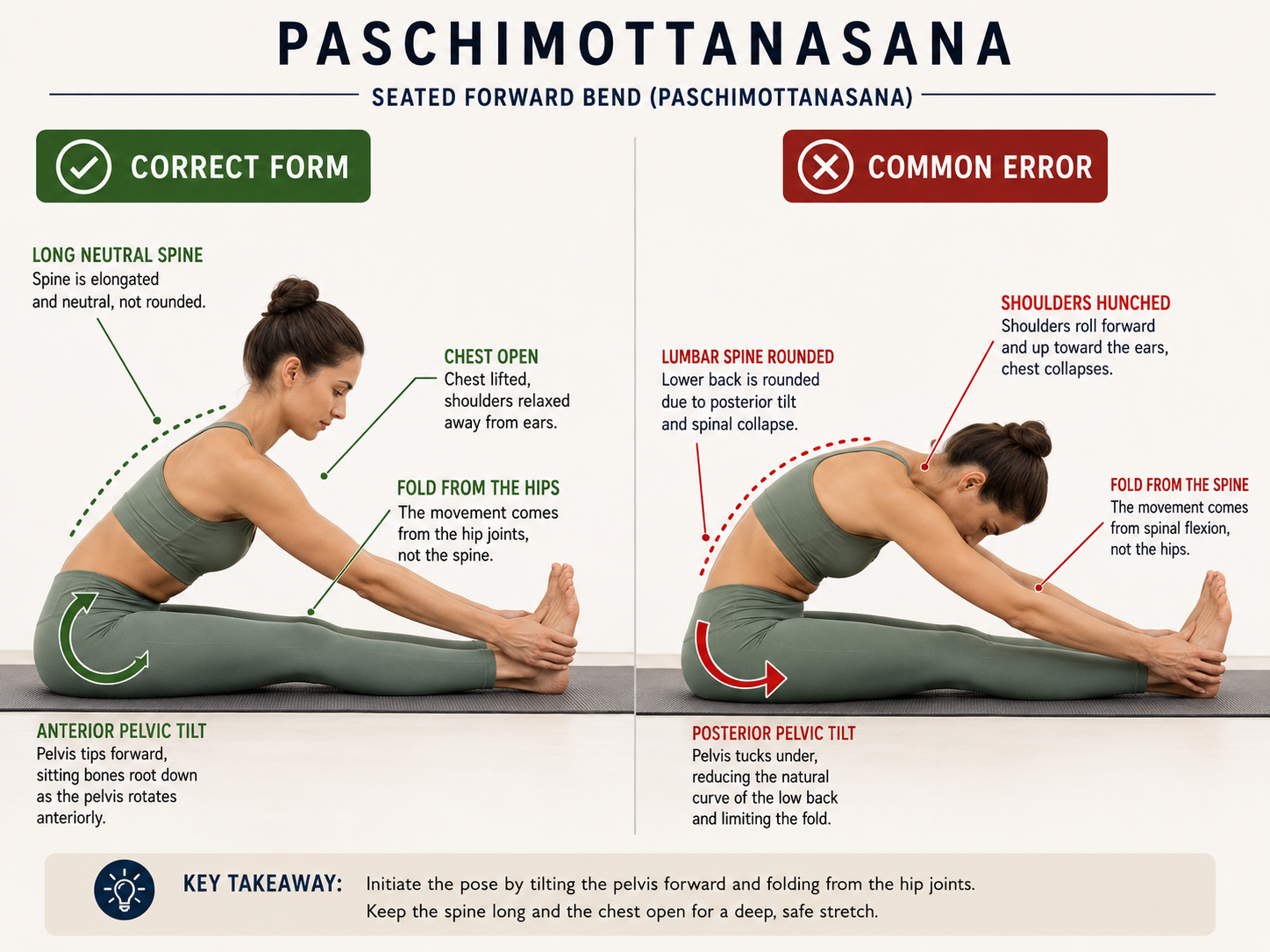
Table of Contents
ToggleSEO Title: Seated Forward Bend (Paschimottanasana): A Safer Way to Practice the Fold Subtitle: Why the pose depends on pelvic motion, hamstring extensibility, breath, and restraint Meta Description: Paschimottanasana is more than reaching for your toes. Learn how pelvic position, hamstrings, spinal motion, props, and breath shape a safer seated forward bend. Permalink: /seated-forward-bend-paschimottanasana
Seated Forward Bend (Paschimottanasana): A Safer Way to Practice the Fold
Why the pose depends on pelvic motion, hamstring extensibility, breath, and restraint
You sit down, extend your legs, and reach forward. The hamstrings tighten. The lower back may round. Your hands may stop at your thighs, shins, ankles, or feet.
That does not mean the pose is wrong. It means the pose is giving information.
Paschimottanasana is often described as a hamstring stretch, but that is incomplete. The posture involves the hips, pelvis, spine, knees, ankles, and posterior tissues of the legs and trunk. When those parts coordinate well, the fold feels steady. When one area has less available motion, another area may compensate. [C2, C3]
The goal is not to force the torso flat against the legs. The goal is to understand where the movement is coming from and choose a version of the pose that your body can perform without strain.
This article is educational yoga guidance, not medical diagnosis or treatment. If you have pain, neurological symptoms, osteoporosis, recent injury, recent surgery, pregnancy-related concerns, or a known spinal condition, get individualized guidance from a qualified clinician.
What the Name Tells You
The Sanskrit name is commonly explained through three components:
- Paschima: west, often interpreted in yoga practice as the back side of the body
- Uttana: intense stretch or stretched out
- Asana: posture or seat
In traditional orientation, the practitioner faces east, toward the rising sun, so the back body faces west. In that sense, Paschimottanasana is often understood as an intense stretch of the back body. [C1]
The posture, or a closely related forward-bending form, is described in the Hatha Yoga Pradipika, commonly cited around 1.28–29 depending on edition. The exact Sanskrit naming and transliteration should be verified against the edition used before publication. [C1, C11]
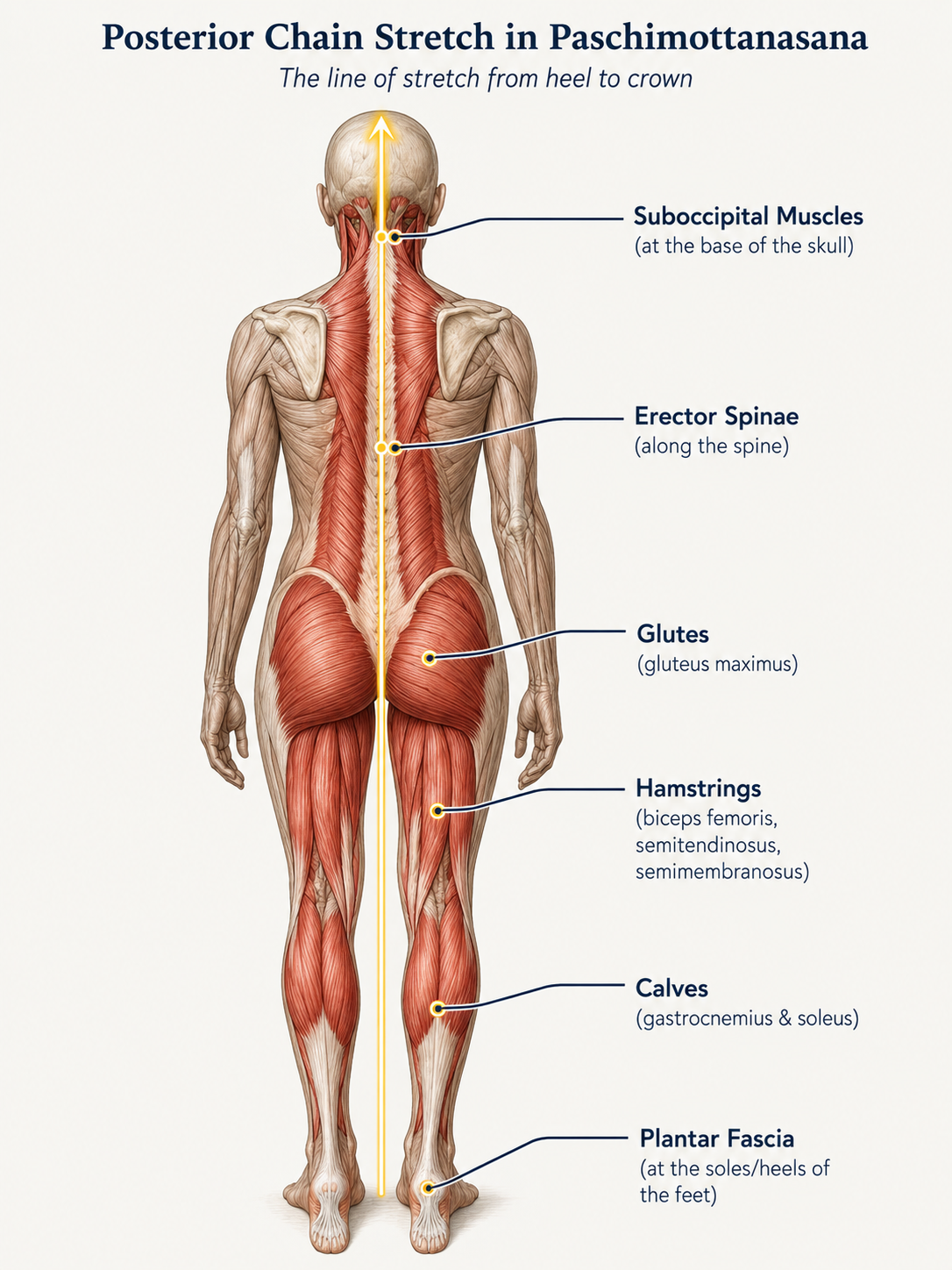
That image of the “back body” is useful, but it should not be taken too literally. The pose does not stretch every posterior structure equally. Many people feel it most clearly in the hamstrings, calves, lower back, or behind the knees. Others may feel it in the hips, spine, or soles of the feet.
Anatomically, the back body is connected through muscles, tendons, fascia, nerves, and joints. These connections can influence how tension is distributed, but the body should not be imagined as one single mechanical rope. Different tissues respond differently. [C2, C4]
Where the Fold Actually Comes From
A seated forward bend ideally includes hip flexion, pelvic motion, and some spinal motion. The pelvis needs to rotate forward over the sitting bones so the torso can move toward the legs without requiring the lumbar spine to do all the work. [C3]
This forward rotation of the pelvis is often called anterior pelvic tilt. In practice, it feels as if the sitting bones move slightly back while the pubic bone moves forward and down. When this happens, the spine can lengthen forward from the pelvis instead of collapsing only from the waist.
If the pelvis cannot rotate forward easily, the body usually finds another way to make the shape. One common compensation is increased lumbar flexion: the lower back rounds, the chest drops, and the shoulders pull toward the legs. [C3]
Some spinal rounding is not automatically dangerous. The spine is built to move, including into flexion. The issue is context: how much force is applied, whether symptoms are present, how often the movement is repeated, whether relevant medical conditions exist, and whether the person can control the position. [C10]
A relaxed, supported forward fold is different from aggressively pulling the torso forward while the pelvis is fixed and the lower back is under strain.
For many students, the safest and most useful instruction is:
Fold only as far as the pelvis can participate without pain or breath-holding.
That may mean the hands rest on the thighs. It may mean the knees bend. It may mean sitting on a folded blanket. These are not lesser versions of Paschimottanasana. They are often the versions that make the posture clearer.
Why the Body Resists
Hamstring tightness is one common reason the pelvis does not tilt forward easily. The hamstring group includes semitendinosus, semimembranosus, and biceps femoris. Most two-joint hamstring components originate near the sitting bones and cross the knee; the short head of biceps femoris is an exception because it does not cross the hip. [C2]
When the knees are straight and the hips flex, the two-joint hamstrings are placed under stretch. If they have limited extensibility, they can restrict how far the pelvis rotates over the thighs. [C2, C3]
Research on forward bending supports this general relationship: hamstring extensibility can influence pelvic tilt and lumbar motion during trunk flexion. When pelvic motion is limited, the lumbar spine may contribute more motion to complete the forward bend. This supports a relationship, not a universal rule. [C3]
But hamstring “tightness” is not always simple shortening. Range of motion can be affected by several factors:
- passive muscle-tendon stiffness
- stretch tolerance
- neural sensitivity
- hip position
- pelvic control
- previous injury
- pain sensitivity or guarding
- habitual movement patterns
The response is not to pull harder. A better approach is to improve setup, reduce unnecessary effort, and let the body adapt gradually. [C5]
Sensation should be clear but tolerable. A strong stretch in the back of the thighs is common. Sharp pain, tingling, numbness, burning, or increasing pain behind the knee is not something to push through. [C7]
How to Practice It
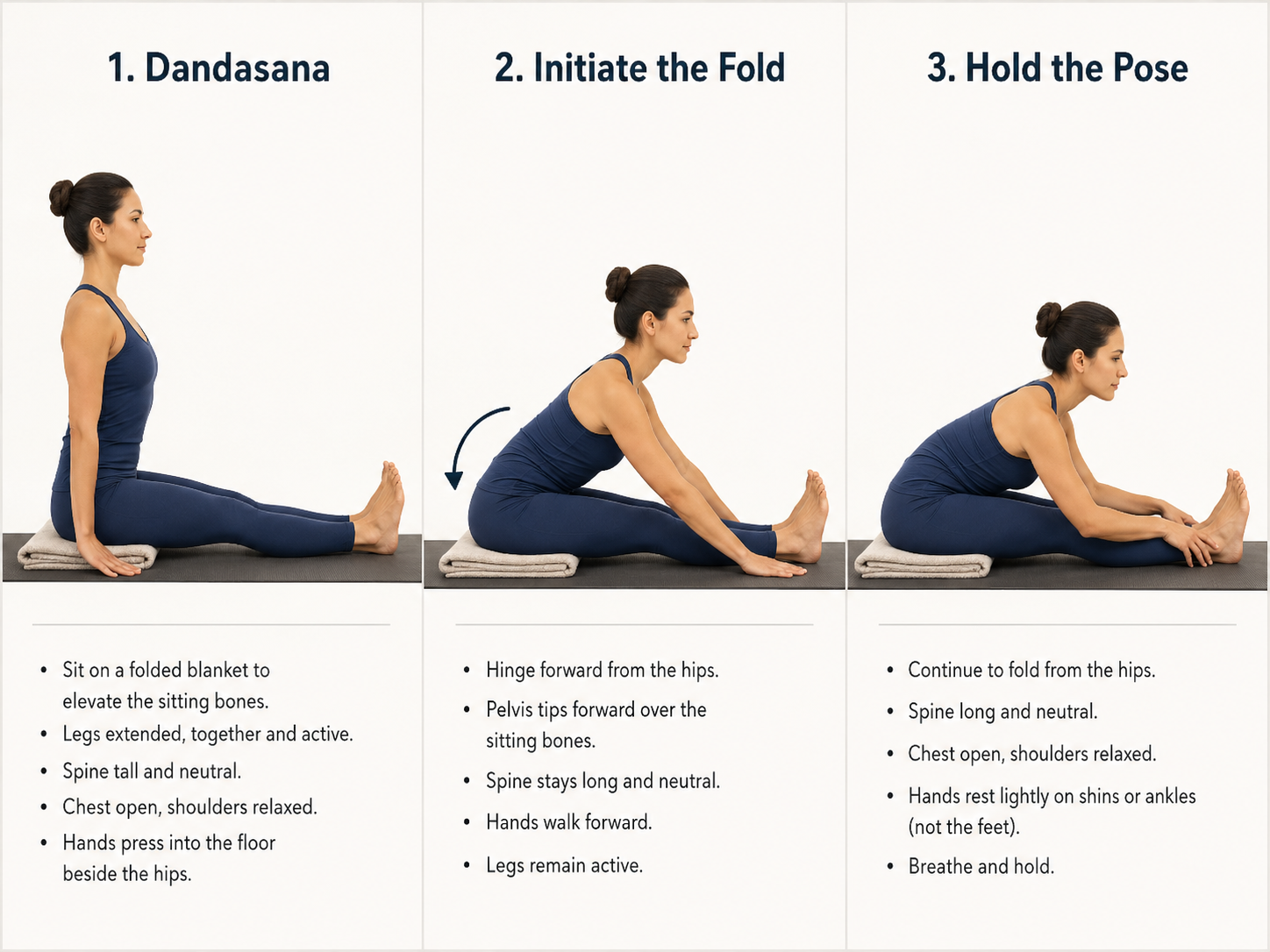
Start in Dandasana, staff pose.
Sit with both legs extended forward. Place your hands beside your hips and press lightly into the floor to help lengthen the spine.
Before folding, notice your starting position. If sitting upright already makes your lower back collapse backward, the full version of the pose may not be the best starting point. Use support first.
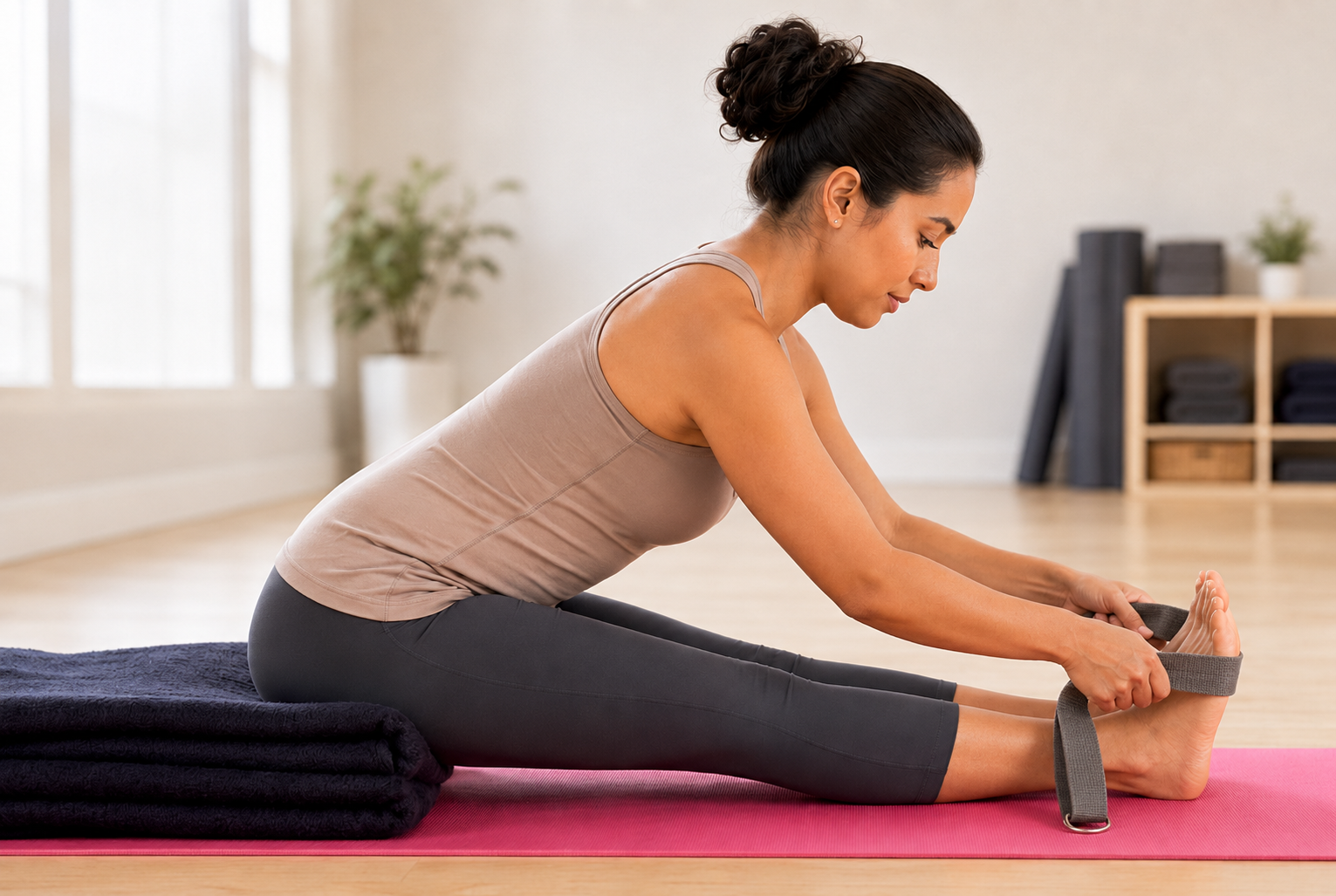
1. Sit on a folded blanket
Place one or two folded blankets under the sitting bones. The lift can help the pelvis rotate forward. For many bodies, this one change makes the fold clearer immediately.
The lift is not a concession. It is a way to create the movement the pose requires.
2. Bend the knees
Bending the knees reduces tension through the two-joint hamstrings because they cross the knee joint. It does not move the hamstring origin away from the sitting bones. What changes is the total length demand on the muscle across the hip and knee. [C2]
A small knee bend often gives the pelvis more room to rotate forward. The torso may not come as low, but the fold is usually better organized.
3. Use a strap without pulling
Loop a strap around the balls of the feet and hold one side in each hand. Keep the elbows soft. The strap gives the arms somewhere to rest, but it should not become a tool for dragging the torso forward.
Press the feet gently into the strap as you lengthen through the spine. This may make the posture feel more stable and controlled.
4. Fold from the pelvis
On an inhale, lengthen upward through the crown of the head.
On an exhale, begin to rotate the pelvis forward. Let the torso follow. Stop when the lower back begins to collapse, when the breath becomes strained, or when the stretch becomes too intense to stay relaxed.
Your hands may land on the thighs, shins, ankles, strap, or feet. The location of the hands is not the measure of the pose.
5. Breathe steadily
Once in the fold, keep the breath steady. Do not hold the breath to endure the stretch.
With each inhale, feel the spine lengthen slightly. With each exhale, allow unnecessary effort to soften. The posture may deepen, or it may not. Depth is not required for the pose to be useful.
Stay for 30 seconds to three minutes depending on your experience, symptoms, and comfort. Come out slowly by leading with the chest and returning the pelvis to upright.
What You Should Feel
A useful version of Paschimottanasana may create:
- stretch in the hamstrings
- stretch in the calves
- mild sensation in the lower back
- gradual softening with steady breathing
- a sense of length through the spine
You should not feel:
- sharp pain
- numbness
- tingling
- burning pain down the leg
- increasing pain behind the knee
- pressure that worsens with each breath
- a need to clench the jaw, shoulders, or abdomen to stay in the pose
If sensation travels down the leg, especially with tingling, numbness, or burning, come out of the pose. That may suggest nerve sensitivity rather than ordinary muscle stretch. [C7]
Seek urgent medical care for progressive leg weakness, loss of bowel or bladder control, saddle numbness, severe radiating pain, unexplained neurological symptoms, or pain after trauma. [C7]
What Happens When You Stay
Many people experience seated forward bends as quieting. That effect is real as an experience, but the mechanism should be described carefully.
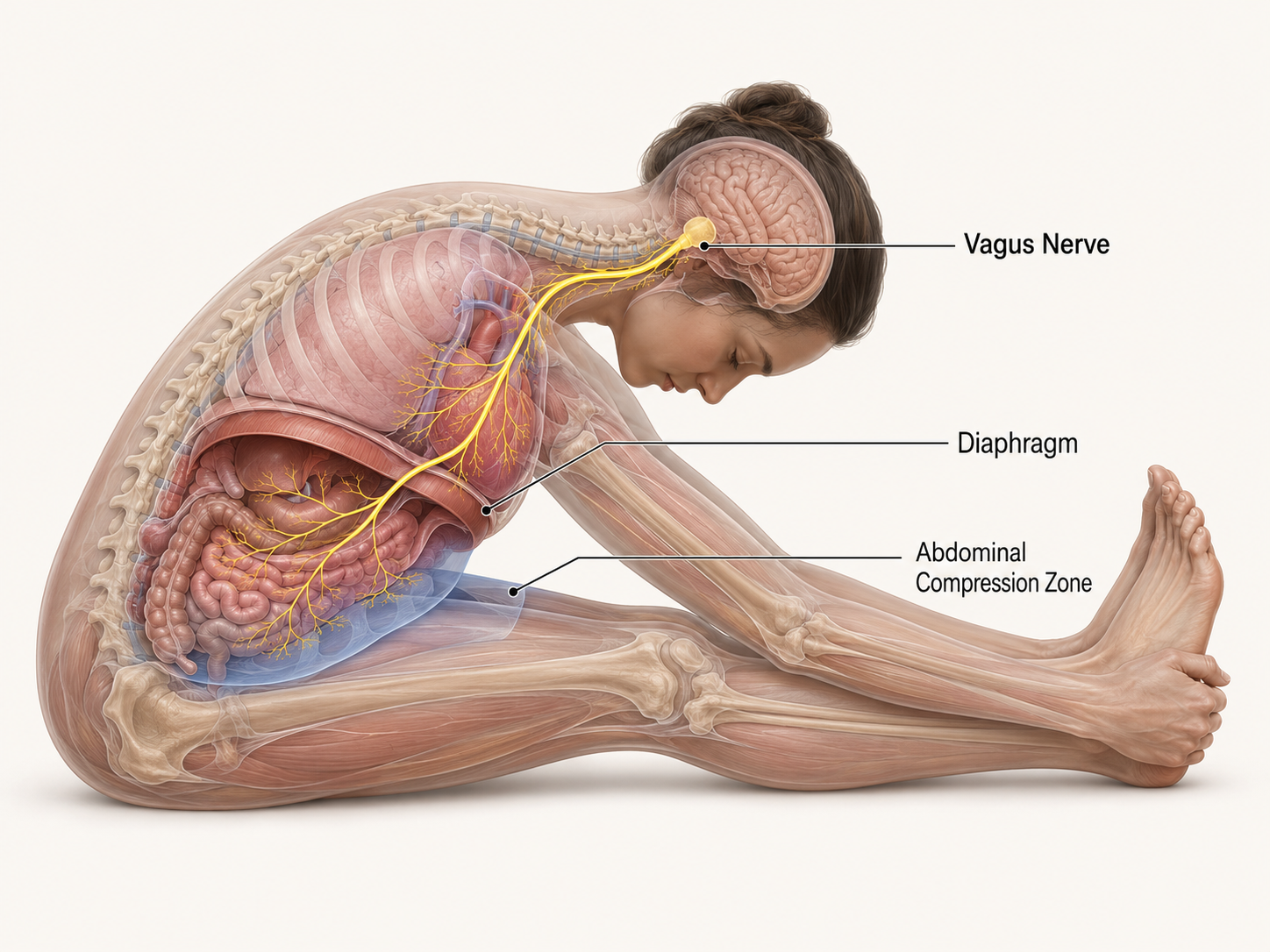
The calming quality may be related to several overlapping factors: stillness, slower breathing, reduced visual stimulation, inward attention, and a supported body position. Slow-paced breathing has evidence for short-term effects on heart rate and some heart-rate-variability measures related to autonomic regulation. [C8]
It is less accurate to say that Paschimottanasana directly “stimulates the vagus nerve” through abdominal compression. That explanation is too specific for the available evidence. A safer statement is that slow, steady breathing during a supported forward fold may help the body shift toward a calmer state. [C8]
The head also does not always drop below the heart in this pose. In a moderate or supported version, especially with props or bent knees, the head may remain above the heart. The calming effect should not depend on that claim.
The posture does not need exaggerated physiology to be useful. When practiced with patience, support, and steady breath, it can reduce unnecessary muscular effort and make the body feel less braced.
Common Mistakes
Pulling with the arms
If the hands grip the feet and yank the torso forward, the pose becomes a contest. This often increases spinal rounding and shoulder tension.
Use the arms for support, not leverage.
Locking the knees
Straight legs are not required. Locked knees can intensify the stretch and may create discomfort behind the knee. A slight bend often improves the relationship between the pelvis and spine.
Chasing the shape
Touching the toes is not the goal. A person with long arms, mobile hips, or a rounded spine may reach the feet easily without practicing the movement well. Another person may stop at the shins and be doing the pose with better organization.
Treating discomfort as progress
Intensity is not the same as benefit. Stretching should be tolerable enough that the breath remains steady and the body does not brace against the pose.
Variations
Supported Paschimottanasana with bent knees
Sit on a folded blanket. Bend the knees enough that the belly can move toward the thighs. Rest the hands on the legs or floor. This is often the best version for students with tight hamstrings or a rounded lower back.
Strap-assisted Paschimottanasana
Loop a strap around the feet. Hold the strap lightly and keep the spine long. Use the strap to maintain orientation, not to pull deeper.
Bolster-supported forward fold
Place a bolster or folded blankets over the thighs and rest the torso on the support. This version reduces effort and may be useful for a quieter, restorative practice.
Chair-supported variation
Sit with the legs extended or slightly bent. Place a chair over the legs and rest the forearms or forehead on the chair seat. This reduces the demand on the hamstrings and back.
Who Should Modify or Avoid the Pose
Modify the pose, use props, or seek professional guidance if you have:
- current low back pain
- sciatica-like symptoms
- numbness, tingling, or burning down the leg
- recent hamstring strain
- pain behind the knee
- disc-related symptoms
- osteoporosis, low bone density, or vertebral fracture history
- pregnancy-related abdominal compression discomfort
- recent surgery, with timing defined by the treating clinician
- physician-directed limits on spinal flexion
- significant joint hypermobility or a tendency to collapse into end-range positions; focus on active control rather than maximum depth
People with osteoporosis, low bone density, or vertebral fracture history should avoid loaded, forced, deep, sudden, or repeated spinal flexion unless cleared by a qualified clinician. [C6]
Avoid forcing the posture if symptoms increase. If you have persistent pain, nerve symptoms, recent injury, recent surgery, pregnancy-related concerns, or a known spinal condition, work with a qualified clinician or experienced teacher.
What the Pose Teaches
Paschimottanasana is not a test of flexibility. It is a test of honesty.
The pose shows whether the pelvis can move, whether the hamstrings can lengthen, whether the spine can remain supported, and whether the breath can stay steady when the body meets resistance.
The useful version may not look dramatic. It may be a small fold with bent knees, a blanket under the pelvis, and the hands resting nowhere near the feet.
That is still the pose.
Paschimottanasana does not ask you to win against your body. It asks you to notice where movement is available, where it is not, and how much force you add when patience would work better.
The shape is secondary. The quality of attention is the practice.
Citation Placeholders Before Publication
[C1] Classical yoga source for Paschimottanasana or related naming in the Hatha Yoga Pradipika, with exact edition, verse number, Sanskrit term, transliteration, and translation verified.
[C2] Anatomy source for hamstring anatomy, including semitendinosus, semimembranosus, long head of biceps femoris, and short head of biceps femoris.
[C3] Biomechanics source on hamstring tightness, pelvic tilt, lumbar motion, and forward bending; identify the exact study or studies used.
[C4] Review source on myofascial continuity, used cautiously and not as proof of a single mechanical chain.
[C5] Source on stretch tolerance, range of motion, and determinants of flexibility.
[C6] Clinical source on osteoporosis, low bone density, vertebral fracture risk, and spinal-flexion precautions.
[C7] Clinical source for radicular symptoms, neurological red flags, and low-back-pain referral guidance.
[C8] Review source on slow breathing, heart rate, and heart-rate-variability effects.
[C9] Expert review by a qualified physical therapist, physiatrist, sports medicine clinician, or clinically trained yoga therapist for biomechanics, cueing, hypermobility, and safety.
[C10] Source for flexion tolerance and the claim that spinal rounding is not automatically dangerous; for example, evidence-based spine-care literature such as Caneiro et al. or O’Sullivan’s work.
[C11] Sanskrit scholar, Indologist, or qualified textual source reviewer for the Hatha Yoga Pradipika naming, transliteration, and verse references.
Introduction to Seated Forward Bend (Paschimottanasana)
Seated Forward Bend (Paschimottanasana) is a classic yoga pose known for its calming effects and flexibility benefits. It primarily stretches the hamstrings, lower back, and spine while promoting relaxation. Practicing this pose regularly can enhance your flexibility, relieve tension, and promote overall well-being. Whether you’re a beginner or an experienced yogi, Seated Forward Bend offers a way to connect with your breath and body.
Instructions for Seated Forward Bend (Paschimottanasana)
- Start in a Seated Position: Sit on the floor with your legs extended straight out in front of you. Flex your feet to keep them active.
- Engage Your Core: Lengthen your spine and engage your core muscles to maintain an upright posture.
- Inhale and Reach Forward: On an inhale, raise your arms above your head to lengthen your spine further.
- Exhale and Fold Forward: Slowly hinge at the hips, reaching your hands towards your feet. If your hamstrings are tight, rest your hands on your shins or a yoga strap.
- Hold and Breathe: Relax into the pose and take deep breaths, aiming to lengthen with each inhale and deepen the fold with each exhale.
Performance Tips
- Use Props: If you cannot reach your toes, use a yoga strap or towel around your feet to assist in the stretch.
- Bend Your Knees: If your hamstrings are tight, slightly bend your knees to prevent straining the lower back.
- Focus on Lengthening: Avoid rounding your back. Focus on keeping the spine long and extending forward from your hips.
- Breathe Deeply: Breathing helps deepen the stretch and relax the muscles, enhancing flexibility over time.
- Go Slowly: Move into the pose gently to avoid injury without forcing your body.
Pros
- Improves Flexibility: Stretches the hamstrings, calves, and spine, promoting overall flexibility.
- Relieves Stress: Calms the mind and helps reduce anxiety and fatigue.
- Boosts Digestion: Gently massages internal organs, aiding digestion.
- Reduces Lower Back Tension: Helps alleviate tension in the lower back.
Cons
- Potential for Lower Back Strain: Incorrect posture or overextension can strain the lower back, especially for beginners.
- Tight Hamstrings: Individuals with tight hamstrings may find the pose challenging and should proceed cautiously.
- Not Suitable for Back Injuries: Those with existing back injuries or herniated discs should avoid this pose or modify it under expert guidance.