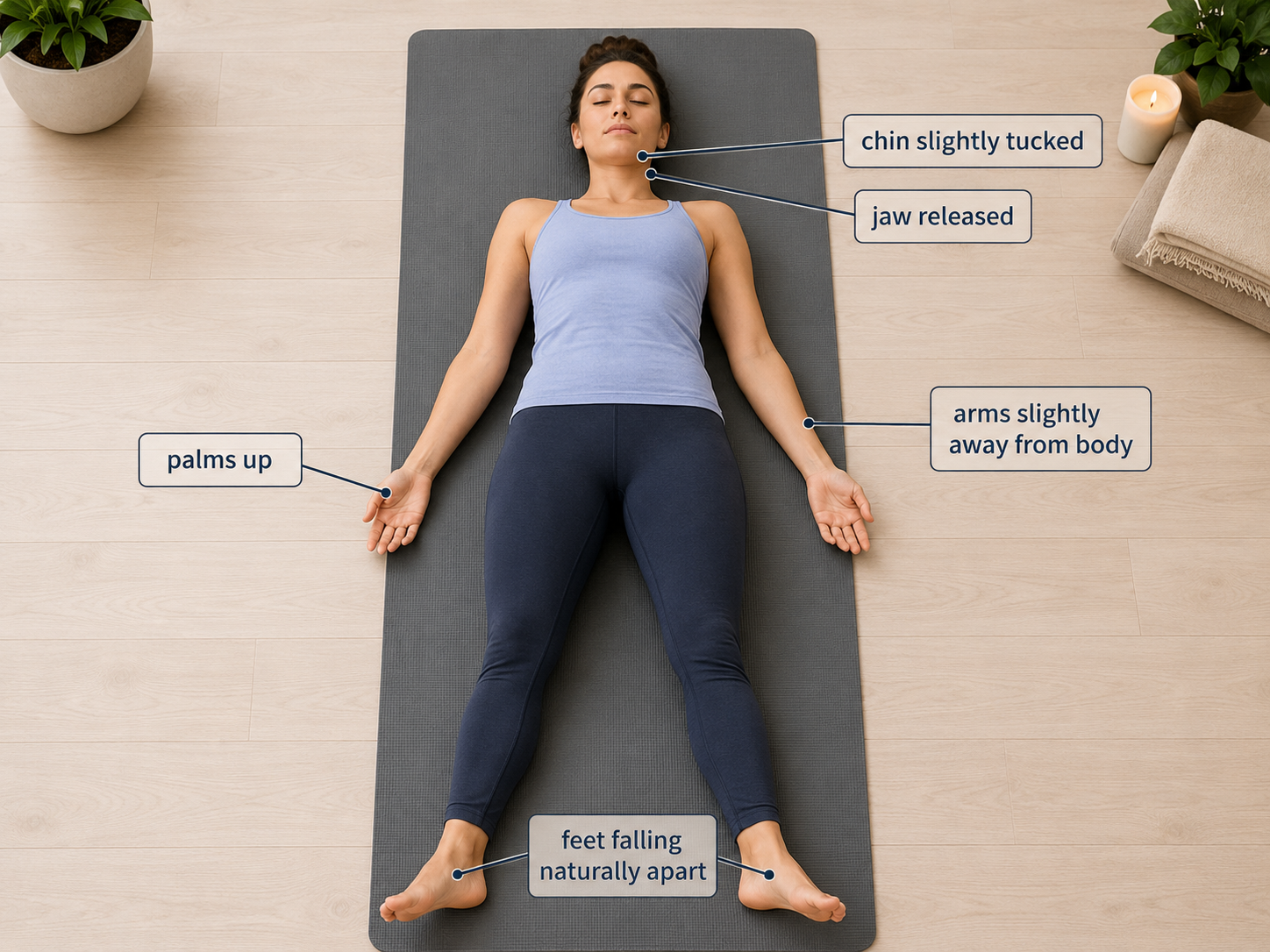
The pose looks like rest. It’s a nervous system intervention — and every detail of it is engineered.
You’ve just finished an hour of yoga. The teacher tells you to lie down. And then one of three things happens: your mind races through tomorrow’s meeting and the email you forgot to send, you fall asleep within thirty seconds and wake up to the sound of everyone sitting up, or you land somewhere in between — not quite asleep, not quite thinking, in a state you couldn’t name if someone asked.
Most articles on Savasana tell you how to do it. Lie flat. Palms up. Close your eyes. Relax each body part. Most of them also tell you why it’s important — it reduces stress, lowers blood pressure, activates the parasympathetic nervous system. What none of them explain is what’s actually happening in your body during those minutes. Why the pose is constructed the way it is. Why your nervous system fights it. And what makes this measurably, physiologically different from collapsing on the couch.
Savasana — from the Sanskrit shava, meaning corpse, and asana, meaning posture — is the oldest documented relaxation pose in yoga, appearing in the fifteenth-century Hatha Yoga Pradipika. But its value has nothing to do with tradition. It has to do with what it does to your autonomic nervous system when every detail is understood and applied.
Why the Pose Is Built the Way It Is
Savasana looks simple because the effort is invisible. But every physical detail of the pose removes a specific holding pattern that keeps the sympathetic nervous system — the fight-or-flight branch — engaged. None of it is arbitrary.
Palms face upward. This externally rotates the shoulders and opens the chest, directly counteracting the internal rotation pattern that hours of sitting, driving, and phone use lock into the upper body. It also sends a signal: open hands, exposed forearms, unguarded chest. The body reads this posture as the opposite of defensive bracing. When the palms face down or the arms cross the body, the nervous system stays in a low-grade guard position. Turning them up releases it.
The feet fall apart. This isn’t laziness — it’s a release of the hip flexors, primarily the psoas and iliacus. These muscles grip when the body is under stress. They shorten when you sit for hours. In fight-or-flight, the psoas contracts to prepare you to run. Letting the legs rotate outward and the feet drop to the sides allows these deep muscles to unclench, and the nervous system registers the release.
Arms rest a few inches from the body. This creates space at the armpits — the axillary region — where lymph nodes, nerve bundles, and blood vessels concentrate. Pressing the arms against the torso traps heat and compresses these structures. Spacing them out allows circulation and reduces sensory input that could keep the brain in monitoring mode.
The chin tucks slightly and the back of the neck lengthens. This decompresses the cervical spine and releases the suboccipital muscles — the small, deep muscles at the base of the skull that tighten in response to screen use, forward head posture, and mental tension. These muscles are densely packed with proprioceptors and have a direct relationship with eye movement and balance. Releasing them sends a cascade of quieting signals down the spinal cord.
The eyes close. This is sensory withdrawal — what the yogic tradition calls pratyahara. Vision is the most metabolically expensive sense. Shutting it off reduces the brain’s processing load immediately and allows attention to shift inward.
And the jaw. Releasing the clench, letting the tongue drop from the roof of the mouth, softening the space between the teeth. The jaw muscles are innervated by the trigeminal nerve — the largest cranial nerve — which feeds directly into the brainstem. A clenched jaw tells the brainstem that the threat is still active. A released jaw tells it the threat has passed. This single release can shift the entire tone of the nervous system.
Each of these details isn’t a suggestion for comfort. It’s removing a lock that holds the sympathetic nervous system in place. Remove enough of them, and the system begins to tip.
What Happens in Your Nervous System
The shift from sympathetic dominance to parasympathetic dominance is not a switch. It’s a gradient — a tipping point that requires enough conditions to align before the balance changes. Savasana creates those conditions simultaneously.
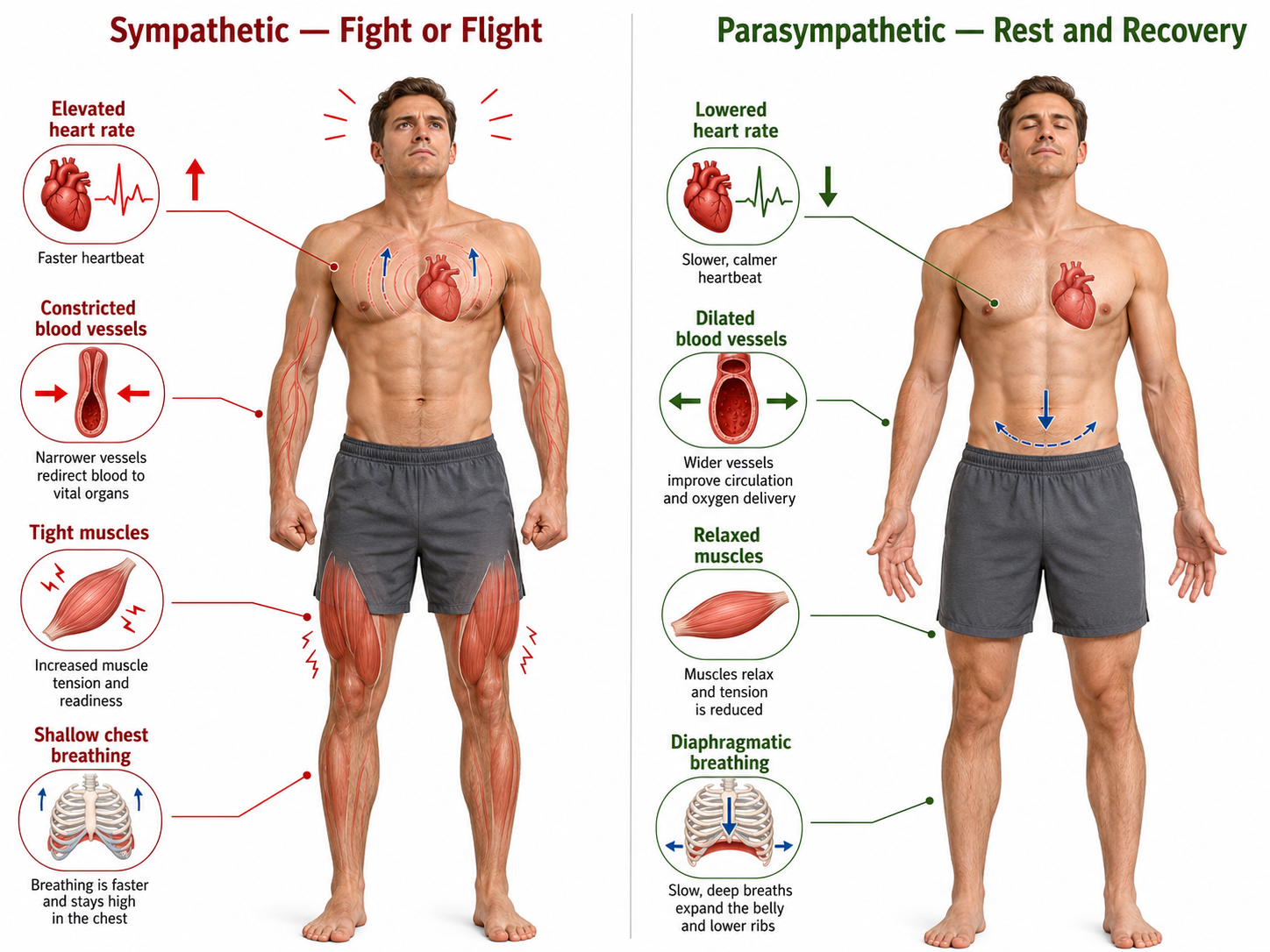
Here is what has been measured during Savasana: heart rate variability shifts. The high-frequency component — a marker of parasympathetic activity — increases. The low-frequency component — a marker of sympathetic activity — decreases. Oxygen consumption drops. Breath volume increases. The body uses less energy while breathing more efficiently.
The critical distinction that separates Savasana from ordinary rest is this: guided relaxation produces a different autonomic profile than simply lying down. A study by Vempati and Telles compared yoga-based guided relaxation with supine rest in 35 adult males. Both conditions reduced heart rate and skin conductance — the surface-level signs of relaxation looked similar. But only the guided relaxation shifted the heart rate variability spectrum toward parasympathetic dominance. Lying on the couch reduces some stress markers. Savasana changes the ratio of which branch of the nervous system is running the show.
Herbert Benson’s research at the Benson-Henry Institute at Massachusetts General Hospital identified this as the “relaxation response” — a reproducible physiological state that is the functional opposite of fight-or-flight. It requires two conditions: attention directed at something repetitive, sustained without judgment. The body scan in Savasana — systematically moving awareness through each region of the body, releasing without forcing — provides exactly this. It gives the mind something to do that isn’t thinking, and that sustained, non-judgmental attention is the mechanism that tips the gradient.
This is why Savasana is not the same as a nap. Sleep involves a loss of consciousness. Savasana aims for the opposite — conscious relaxation, where awareness remains while effort withdraws. The nervous system learns something different in each state. Sleep restores. Savasana retrains.
Why It’s Hard — And Why That’s the Point
If Savasana is so beneficial, why does it feel like a struggle? Because the difficulty is the diagnosis.
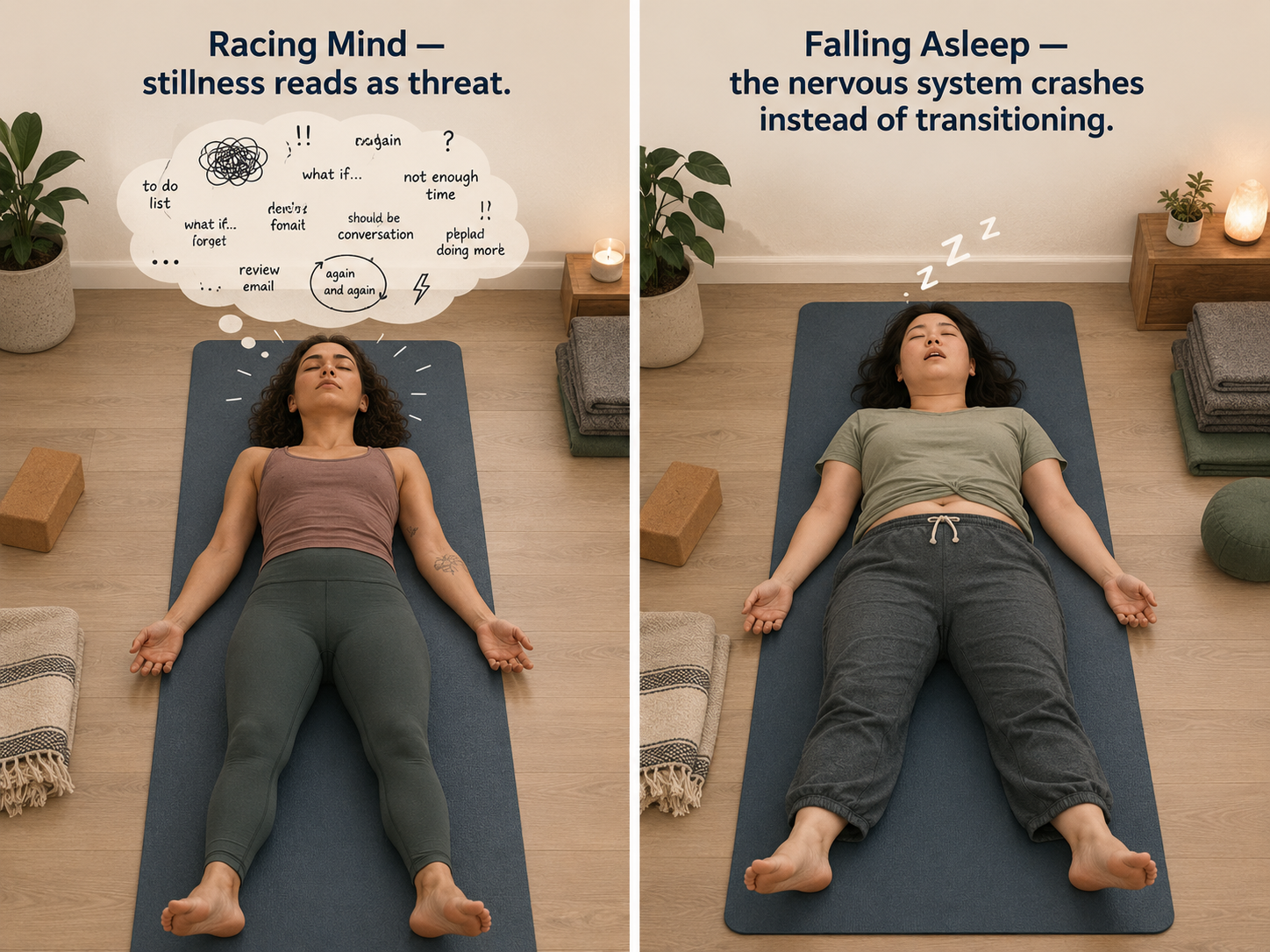
There are two common failure modes in Savasana, and they look like opposites. One person lies down and their mind immediately accelerates — thoughts multiply, the body fidgets, five minutes feel like twenty. Another person lies down and is unconscious within a minute, waking up disoriented when the class moves on.
These aren’t different problems. They’re two expressions of the same underlying pattern: a nervous system that has lost the middle ground between high alert and collapse.
The racing mind happens because the nervous system reads stillness as vulnerability. If you’ve been living in a chronic stress state — and most people working desk jobs, managing responsibilities, and underslept are in some degree of sympathetic overdrive — lying down with your eyes closed in a room full of people does not automatically register as safe. The brain scans for threats because that’s what it has been doing all day. Asking it to stop scanning without gradually shifting the conditions is like asking someone to fall asleep by trying harder. The effort defeats the purpose.
Falling asleep happens because the nervous system has been running so hot for so long that the first moment parasympathetic conditions arrive, it doesn’t transition — it crashes. The body doesn’t know how to be relaxed and awake simultaneously because it hasn’t practiced the in-between. It only knows two modes: on and off.
Both responses are information. They tell you where your system lives most of the time. The practice of Savasana isn’t to force either one away. It’s to slowly teach the nervous system that a third state exists — alert rest, conscious stillness, awake without effort — and to widen the window where that state is accessible.
For some people, the difficulty goes beyond restlessness or sleepiness. For those with PTSD, trauma history, or severe anxiety, lying flat on the back with eyes closed in a room of other people can trigger a sympathetic spike — not a gradual resistance to relaxation, but an acute sense of exposure and danger. The standard pose creates exactly the vulnerability their nervous system is organized to prevent. This doesn’t mean Savasana isn’t for them. It means the pose needs modification to stay within the window where the nervous system can learn rather than defend. Keeping the eyes softly open with a lowered gaze gives the brain enough visual input to confirm safety without full sensory engagement. Placing the hands on the belly provides physical grounding — the weight and warmth of the hands on the abdomen activate interoceptive awareness and give the nervous system a tactile anchor. Lying on the side in a fetal position, with a bolster between the knees, can feel protective in a way that supine positioning does not. These aren’t compromises. They’re meeting the nervous system where it actually is, which is the only place the work can begin.
Why It Comes at the End
Savasana is placed at the end of a yoga class for a reason that goes deeper than tradition or sequencing convention.
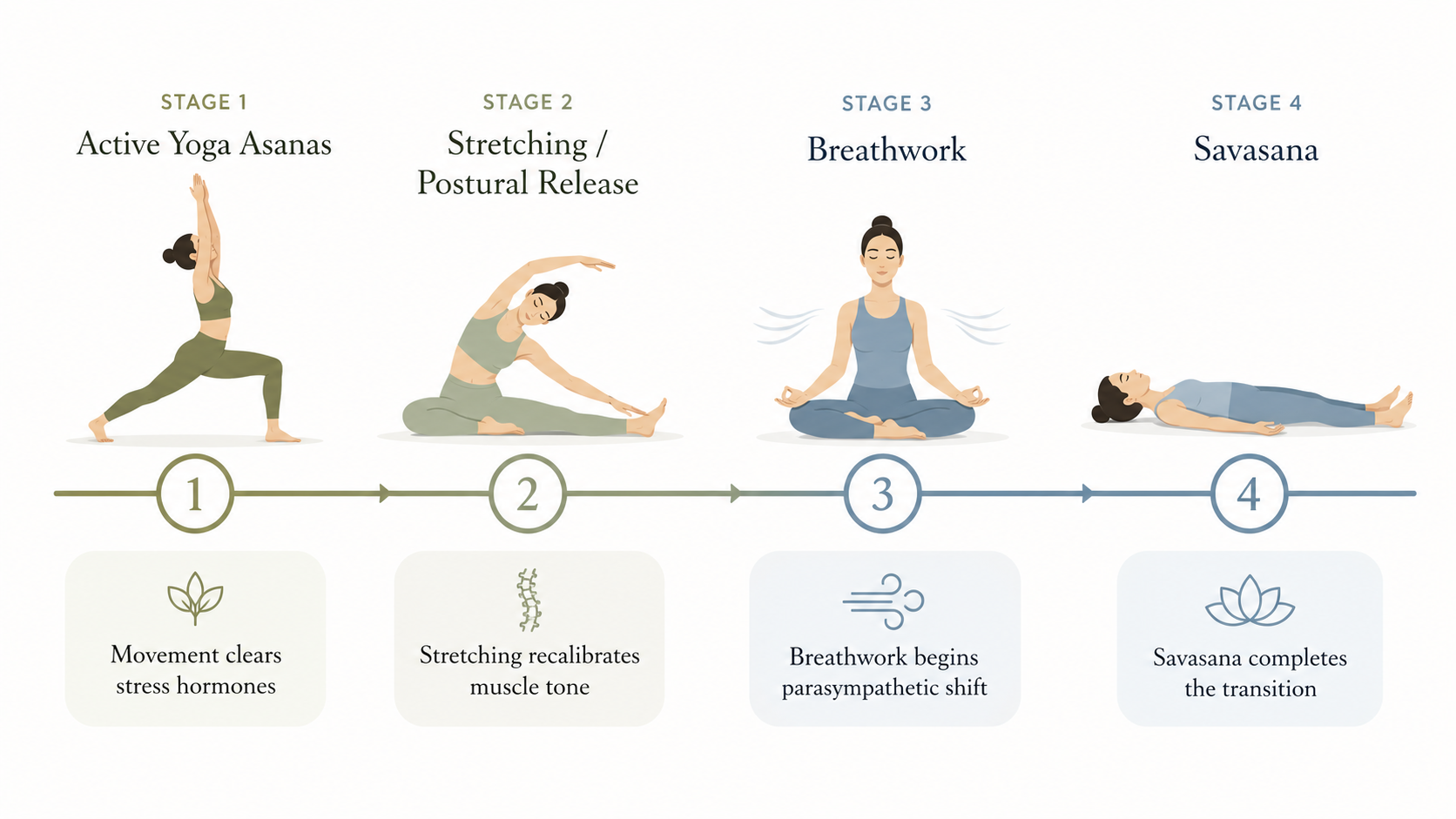
Active asanas serve as preparation. Movement metabolizes circulating stress hormones. Cortisol and adrenaline don’t simply dissipate when you decide to relax — they need physical effort to clear. If you attempt Savasana while those chemicals are still active in your bloodstream, your body carries the signal to stay alert even as you lie still. The movement preceding the pose burns through that signal.
Stretching and loading muscles under controlled conditions activates proprioceptors — sensory receptors in the muscles and tendons that report position and tension to the brain. After an hour of asanas, those proprioceptors have recalibrated. Baseline muscle tone is lower. The body has less to release in Savasana because the release has already begun.
Breathwork during practice initiates the parasympathetic shift. Slower, deeper, more controlled breathing during asanas begins tipping the autonomic gradient before you ever lie down. Savasana doesn’t start the shift. It completes it.
This is why Savasana after a full practice feels different from Savasana cold — you’ve set the preconditions. Both work. But the one after practice has a head start that makes the descent into deep relaxation faster and more complete.
How to Practice Savasana
Understanding the mechanism changes how you approach the practice.
The body scan is not a ritual. It’s a systematic withdrawal of motor cortex activation. Each time you bring awareness to a body part and consciously release it — the toes, the calves, the thighs, the pelvis, up through the torso, through the arms, the neck, the face — you reduce the signal running from the brain to that muscle group. You’re not relaxing by willpower. You’re dimming the neural volume, region by region.
Breathing: stop controlling it. This is the single most important instruction and the one most people resist. The moment the breath shifts from voluntary control — driven by the cortex — to autonomous rhythm — driven by the brainstem — you’ve crossed a physiological threshold. That shift is the signature of parasympathetic dominance. As long as you’re directing the breath, you’re still in voluntary mode, and voluntary mode is sympathetic territory. Let the breath do whatever it does. Watching it without shaping it is the practice.
Duration matters. Five minutes is the minimum for any measurable effect. But teachers and researchers consistently point to ten to fifteen minutes as the threshold where deeper shifts begin. The relaxation response does not deepen linearly — it takes time for the autonomic gradient to fully tip, and cutting it short is like pulling bread from the oven before it’s done.
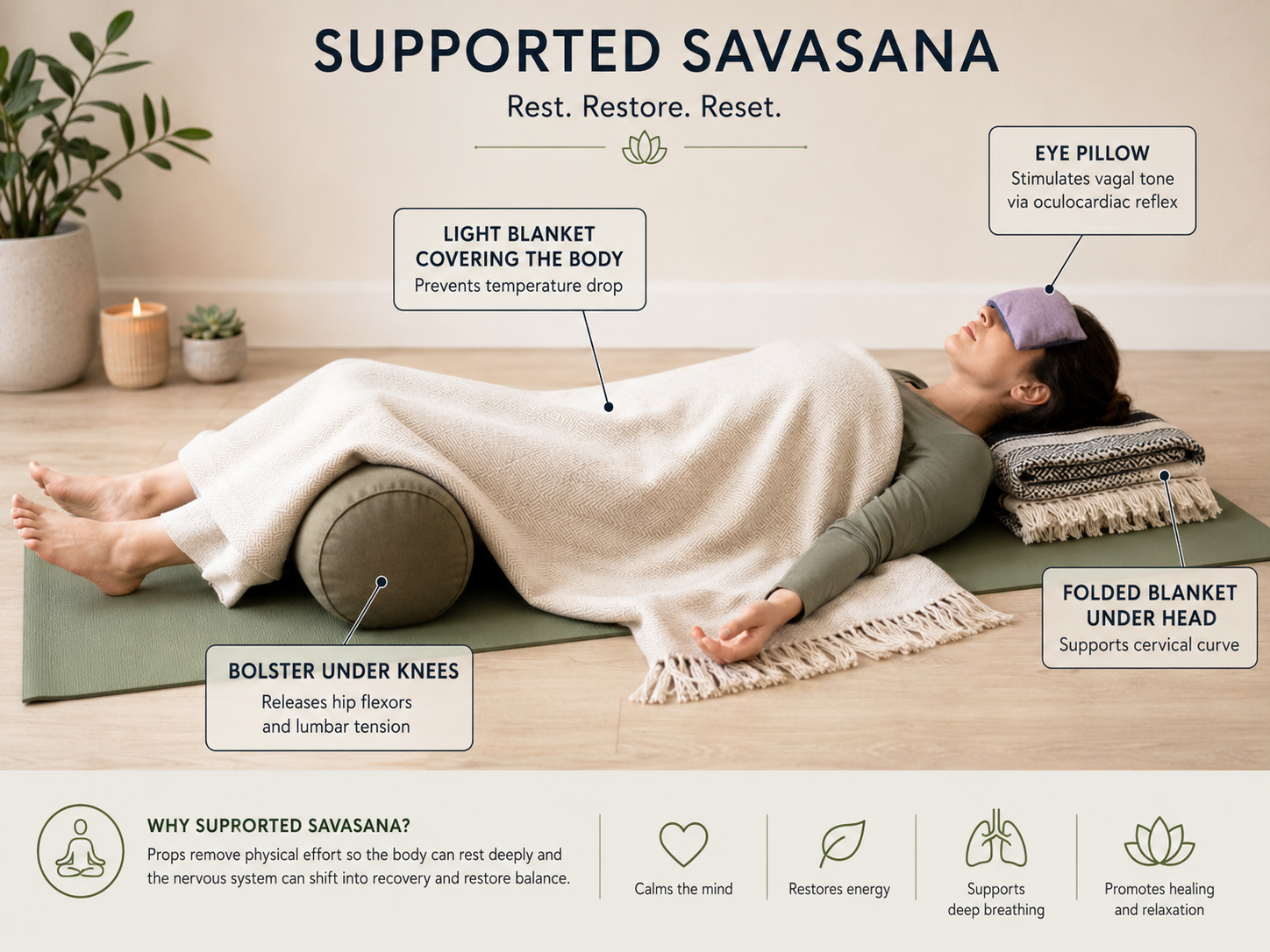
Props deserve a word, because they’re often treated as optional comfort accessories. They’re not. They’re removing sources of discomfort that keep the nervous system on alert. A bolster under the knees takes tension off the lumbar spine and the hip flexors — two areas that hold stress patterns and will keep sending alarm signals to the brain if they’re strained. A folded blanket under the head supports the cervical curve and prevents the neck from hyperextending. A light blanket over the body prevents the drop in core temperature that naturally occurs as the metabolism slows — and temperature drops trigger sympathetic activation, pulling you out of the parasympathetic state you’re trying to reach. An eye pillow adds gentle pressure over the closed eyes, stimulating the oculocardiac reflex — a vagal nerve pathway that directly slows heart rate. Each prop isn’t making Savasana easier. It’s making it more effective.
How you come out of Savasana matters as much as how you enter it. The nervous system you’ve spent ten minutes shifting into parasympathetic dominance can spike back into sympathetic mode in seconds if the transition is abrupt. The exit is graduated for the same reason the entry is — you’re managing a nervous system state, not ending a nap. Begin by deepening the breath — a few slow, deliberate inhales signal the brainstem to begin increasing arousal without slamming it into gear. Bring small movements to the fingers and toes first, then the wrists and ankles. Draw the knees toward the chest to gently re-engage the core. Roll to one side — traditionally the right side, which keeps the heart above the organs and avoids compressing it — and pause there for two or three breaths. Press up to sitting only when the body feels ready, and let the head come up last. Rushing this sequence undoes the work. The transition is the final part of the practice, not the cleanup after it.
Savasana Outside a Yoga Class
Nothing about the mechanism of Savasana depends on a preceding yoga practice. The pose works as a standalone nervous system intervention.
Ten to fifteen minutes of Savasana with a deliberate body scan — on a bedroom floor, on a mat in a quiet room, even on a carpeted office floor with the door closed — can produce the same parasympathetic shift. The preconditions that yoga provides (hormone clearance, proprioceptive recalibration, breathwork) make the descent faster, but they are not required. The body scan and the physical positioning do the essential work on their own.
For people who don’t practice yoga and have no interest in starting, this may be the single most accessible entry point into deliberate nervous system recovery. No flexibility required. No special clothing. No instruction beyond the position and the scan. Much of the published research on Savasana’s effects on blood pressure, cortisol, and heart rate variability was conducted with the pose as the primary or sole intervention — not as a footnote to a vigorous class.
If you sleep poorly, if your baseline state is wired, if you carry tension that massage temporarily relieves but never resolves — Savasana practiced daily for ten minutes may change your nervous system’s resting point more effectively than any supplement, app, or evening routine. Not because it’s magic. Because it’s the specific set of conditions under which your nervous system is willing to let go.
When you practice matters. Mid-day Savasana — between meetings, during a lunch break, in the gap between morning intensity and afternoon demands — acts as a genuine system reset. The nervous system has been accumulating sympathetic load for hours, and a ten-minute intervention at that point interrupts the accumulation before it compounds into evening tension, poor digestion, and fragmented sleep. Savasana right before bed, on the other hand, works differently. If the body is already exhausted, the pose will likely accelerate the crash into sleep rather than train the intermediate state of conscious relaxation that makes Savasana distinct from rest. That’s not useless — falling asleep faster has its own value — but it’s not building the skill. If the goal is to teach the nervous system a new resting point, the mid-day window is where the training happens.
The Pose That Looks Like Nothing
Savasana doesn’t look impressive. It doesn’t photograph well. It doesn’t build muscle or burn calories or improve your flexibility. It looks like lying on the floor doing nothing.
That’s what makes it work. Every detail — the upturned palms, the open hips, the released jaw, the closed eyes — removes a signal that keeps the nervous system in alert mode. The body scan gives the mind a task that isn’t thinking. The stillness creates the conditions for a physiological shift that rest alone doesn’t produce.
The difficulty isn’t a design flaw. It’s information. How hard it is to lie still tells you how far your system has drifted from its ability to recover. And the practice — repeated, patient, unremarkable — is the way back.