Most form mistakes in the shoulder press are compensations — here’s what your body is actually telling you and how to fix it
You’ve watched the tutorials. You know the cues: sit tall, brace your core, press up. But something doesn’t feel right. Your lower back arches as the weight goes overhead. Your shoulders creep toward your ears. There’s a pinch in the front of your shoulder that wasn’t there a month ago. And the more you focus on correcting it, the worse everything feels.
You’re not doing it wrong because you’re careless. You’re doing it wrong because your body is solving a problem you can’t see.
The dumbbell shoulder press is one of the most common exercises in any gym. It’s also one of the most demanding on your body’s ability to get an arm safely overhead. The tutorials show you the movement. What they don’t show you is what the movement requires from your skeleton, your shoulder blade, your thoracic spine, and half a dozen muscles you’ve never trained — before your deltoids even begin to work.
This article is about what that demand actually involves, why your body compensates when the demand isn’t met, and what to do about the cause rather than the symptom.
What the Dumbbell Shoulder Press Actually Asks of Your Body
Most exercise guides treat the shoulder press as a deltoid exercise. It is. But before the deltoids can do their job, a chain of mechanical prerequisites has to be met — and for many people, at least one of them isn’t.
The arm needs to reach full overhead flexion, roughly 180 degrees of elevation. But the glenohumeral joint — the ball-and-socket where the arm bone meets the shoulder blade — contributes only about two-thirds of that range (Inman, Saunders & Abbott, 1944). The rest comes from the scapula moving on the ribcage — a combination of upward rotation, posterior tilt, and external rotation that collectively tilt the socket of the shoulder joint to track the arm as it rises.
This coordinated movement between the arm bone and the shoulder blade is called scapulohumeral rhythm. The classical ratio cited in biomechanics is approximately 2:1 — for every two degrees of arm elevation at the glenohumeral joint, the scapula contributes roughly one degree of upward rotation. More recent in vivo research has found the ratio is closer to 2.3:1 during arm raising, and it varies across the arc of motion and between individuals. The exact number matters less than the principle: without adequate scapular upward rotation, the arm cannot get fully overhead. The body will find a way to get it there anyway, and that’s where the problems start.
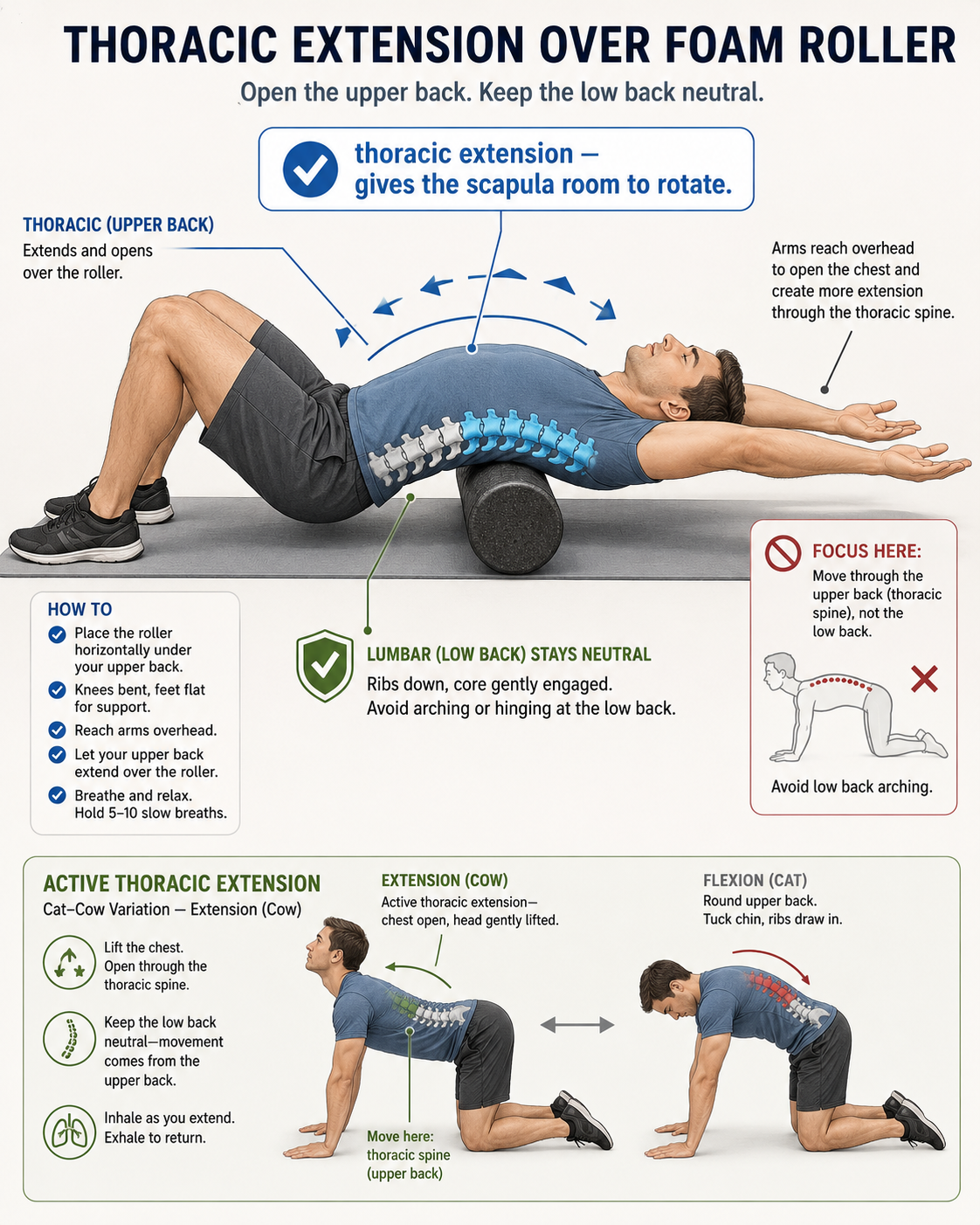
But the scapula doesn’t rotate in a vacuum. It sits on the ribcage, and the ribcage is shaped by the thoracic spine. If the upper back is stiff or excessively rounded, the scapula loses the surface it needs to rotate on. The thoracic spine has to extend slightly to give the scapula room to tilt and turn.
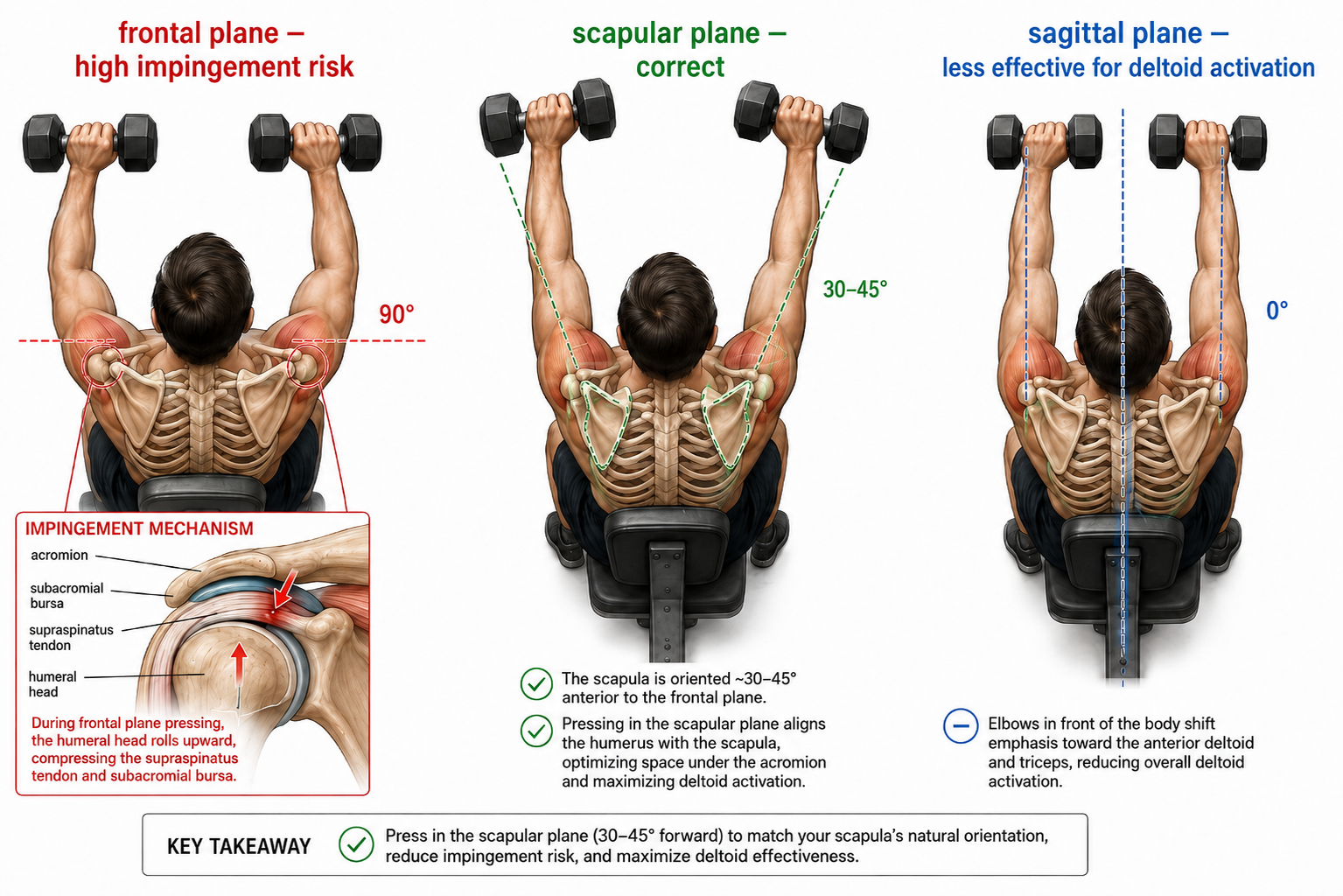
Meanwhile, the core has to stabilize the ribcage so the scapula has a stable platform to move against. And the pressing motion should happen in or near the scapular plane — roughly 30 to 45 degrees in front of the frontal plane (Johnston, 1937) — because that’s the angle the shoulder blade sits at on the curved ribcage, and pressing in that plane reduces the risk of impingement.
All of this has to happen before the deltoids, triceps, and upper traps even begin the visible work of moving weight.
The Muscles That Make It Work — And the Ones That Break It
The muscles most people associate with the shoulder press are the ones they can see working: the anterior deltoid does the heavy lifting, the lateral deltoid contributes significantly — particularly through the middle of the range — the triceps extend the elbow, and the upper trapezius helps stabilize the shoulder girdle at the top.
But the muscles that determine whether the press goes well or goes wrong are the ones nobody thinks about.
The serratus anterior — a broad muscle that runs from the lateral surfaces of ribs 1 through 8 to the inner border of the scapula, wrapping around the side of the ribcage — is the primary driver of scapular protraction and upward rotation. Without it, the shoulder blade can’t rotate enough to let the arm go overhead without impingement.
The lower trapezius works with the serratus anterior to produce upward rotation while pulling the scapula downward and preventing the shrugging pattern that the upper trap would otherwise create.
The rotator cuff — four small muscles that wrap around the head of the humerus — doesn’t press the weight. It centers the ball in the socket during elevation, preventing the deltoid from pulling the humeral head straight upward into the acromion. Without a functioning rotator cuff, the deltoid’s pull becomes a grinding force against bone.
When these muscles are strong and the shoulder has adequate mobility, the press is smooth and the load stays where it belongs — on the deltoids. When they’re weak, tight, or poorly coordinated, the body recruits whatever is available: the upper traps take over stabilization, the lumbar spine substitutes for thoracic extension, the pec minor holds the scapula down when it should be rotating up. The most common form mistakes are the visible surface of this invisible deficit.
Why Your Form Breaks Down — The Compensations and What They Mean
If you’ve ever read a “common mistakes” article about the shoulder press, you’ve seen the same list: don’t arch your back, don’t flare your elbows, don’t shrug, don’t press forward. The advice is correct. But none of those articles explain why these compensations happen in the first place — which is the only information that actually helps you fix them.
Lower back arching can result from several things — a weak core, tight hip flexors, too much weight, or anterior pelvic tilt. But one of the most common and underrecognized causes is insufficient thoracic extension. The upper back lacks the range needed for the scapula to rotate fully upward, so the brain finds extension somewhere else — the lumbar spine. The lower back arches because the upper back won’t move. In these cases, telling someone to “brace harder” when the issue is thoracic mobility is treating the symptom while the cause remains unchanged.
Elbows flaring wide — pressing with the elbows directly out to the side, forming a T with the torso — places the shoulder in the frontal plane. The shoulder blade doesn’t sit in the frontal plane. It sits at 30 to 45 degrees forward, on the curve of the ribcage. Pressing in the frontal plane forces the humeral head against the acromion and the rotator cuff gets caught between them — subacromial impingement. This is often not a lapse in attention — it’s the default position many people were taught, and it’s wrong for the anatomy.
Shoulder shrugging happens when the upper trapezius takes over the job of getting the arm overhead because the lower trapezius and serratus anterior can’t produce enough upward rotation force. The shoulder hikes to create the space that the scapula should be creating by rotating. If you find yourself shrugging despite actively trying not to, the issue is not discipline — it’s that the muscles responsible for upward rotation aren’t strong enough to do the work at the load you’re using.
The weight drifting forward instead of going straight up indicates that the person lacks the thoracic extension or shoulder flexion to press vertically. The press becomes a steep incline press instead of a true overhead movement, shifting load forward and increasing stress on the front of the shoulder joint.
Head jutting forward is another compensation for insufficient thoracic extension. The cervical spine extends to move the head out of the path the arm can’t clear because the upper back isn’t opening up. It strains the neck and reinforces the forward head posture that made the problem worse in the first place.
Each of these compensations makes mechanical sense. The body is not failing — it’s problem-solving with the resources it has. The job is to give it better resources.
What Pressing in the Scapular Plane Actually Means
This concept appears in the better clinical articles but rarely gets explained in a way that a person holding dumbbells in a gym can use.
The scapula doesn’t sit flat against the back like a book on a table. It wraps around the curved ribcage, angled roughly 30 to 45 degrees forward from the frontal plane. This angle varies slightly between individuals, but the principle is consistent: the shoulder blade faces forward and outward, not directly to the side.
When you press with your elbows in that same plane — roughly 30 to 45 degrees in front of your torso, not pinned to your sides and not flared straight out — the humeral head moves through the path the socket is designed for. The ball tracks cleanly in the socket. The subacromial space stays open. The rotator cuff has room.
When you press with elbows directly to the side, in the frontal plane, the humeral head rolls against the underside of the acromion. The supraspinatus tendon and the subacromial bursa get compressed between two bones. Do this under load, repeatedly, for months, and you get subacromial impingement, rotator cuff irritation, or worse (Flatow et al., 1994).
The fix is simple: elbows at about a 45-degree angle in front of your torso when you press. Not directly to the side, not directly in front. The scapular plane. But understanding why this matters is what makes the cue survive fatigue — because when you’re grinding through the last two reps of a heavy set, cues without reasons are the first thing to go.
The Prerequisites — What to Fix Before You Press Heavier
If the compensations above sound familiar, adding weight is not the answer. Fixing the prerequisites is.
Thoracic mobility is often the first bottleneck. If the upper back is locked in flexion, the scapula can’t rotate and the arm can’t get overhead without the lumbar spine stepping in. Foam rolling the thoracic spine may help acutely — the evidence for lasting ROM improvements is limited, but the short-term effect can make a meaningful difference in a pressing session. Thoracic extension over a bench or roller targets extension directly. Cat-cow variations emphasizing the extension phase work the same range through active movement. Open book rotations mobilize thoracic rotation, which also affects scapular mechanics but addresses a different axis than extension. A pressing warm-up benefits from both. This isn’t a warm-up luxury — it’s a mechanical prerequisite for the press to happen in the right place.
Scapular stability fills the gap the compensations are covering for. The serratus anterior needs direct work — serratus punches (lying face-up, pressing a weight straight toward the ceiling with an extra protraction at the top) and the push-up plus (a push-up with an additional push at the top that rounds the upper back, emphasizing scapular protraction). Lower trapezius activation — prone Y-raises on a bench, wall slides with a focus on pulling the scapulae down as the arms go up — restores the depressive and upward rotation force that prevents shrugging. These aren’t corrective exercises in the clinical sense. They’re the muscles the shoulder press needs, trained directly.
Rotator cuff work keeps the humeral head centered in the socket. External rotation with a band or light dumbbell at zero degrees of abduction (elbow by your side) and at 90 degrees (elbow at shoulder height) strengthens the infraspinatus and teres minor, part of the cuff that helps keep the humeral head seated as the deltoid pulls upward during the press. This is not rehab. It’s the stabilization the shoulder joint requires under load, and neglecting it is a common thread in pressing programs that end in shoulder pain.
How to Actually Perform the Dumbbell Shoulder Press
Now, with the prerequisites understood, the how-to. Form cues land differently when you know what they’re protecting.
Sit on a bench set to 80 to 85 degrees — vertical enough to be a true overhead press, angled just enough to give the lower back support. Plant your feet flat on the floor, roughly shoulder-width apart. Brace your core — not by sucking in, but by tightening the muscles around your midsection as if you were about to take a punch.
Getting the dumbbells into position matters more as the weight gets heavier. Rest the dumbbells on your thighs, one on each leg. Use your knees to kick them up to shoulder height as you lean back into the bench. Trying to curl heavy dumbbells from your sides to your shoulders is a bicep tendon injury waiting to happen. To put them down after the set, reverse it: guide them back to your thighs, then to the floor — don’t just drop them from shoulder height. If the weight is heavy enough that you can’t get it into or out of position cleanly, use a spotter or start lighter.
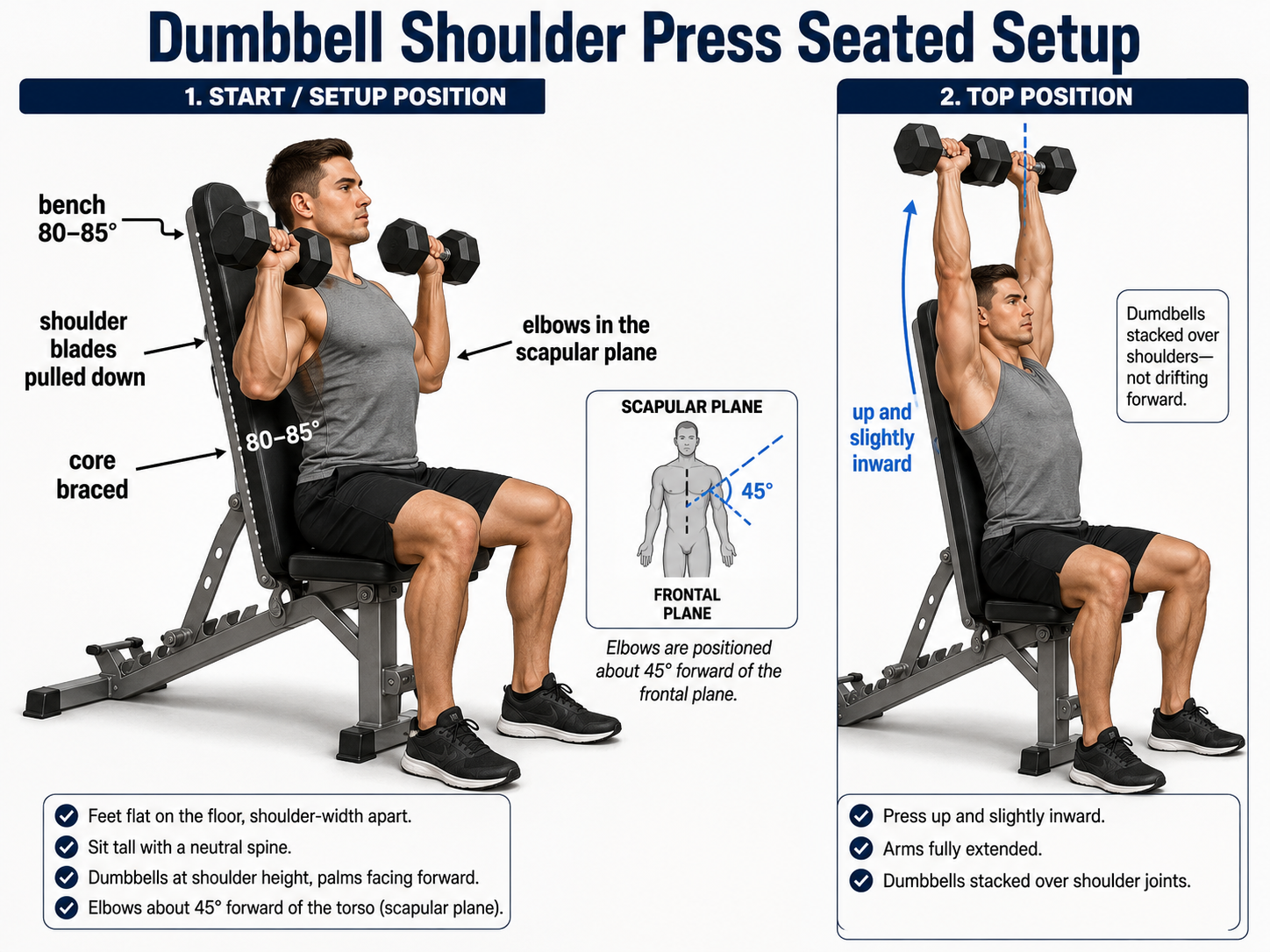
Bring the dumbbells to shoulder height. Position your elbows roughly 45 degrees in front of your torso — in the scapular plane. Palms face forward or angle very slightly inward, whichever feels more natural to your shoulder.
Press the dumbbells up and slightly inward. At the top, your arms are fully extended but the elbows are not aggressively locked. The dumbbells should be nearly over your shoulder joints, not out in front of your face.
Lower under control to at least shoulder height — the eccentric portion of the press matters. Dropping the weight removes half the rep and the controlled lengthening that contributes to both strength and muscle development. With lighter loads, exhale as you press and inhale as you lower. With heavy loads, holding the brace through the hardest part of the press and exhaling near the top gives the spine more stability.
If your lower back arches, the weight is too heavy or your thoracic spine isn’t ready. If your shoulders shrug, your lower traps and serratus anterior are getting outworked by your upper traps. If there’s a pinch in the front of your shoulder, check your elbow position — you may have drifted into the frontal plane.
The cues are simple. The reasons behind them are what make them stick.
Seated vs. Standing — Which One and Why
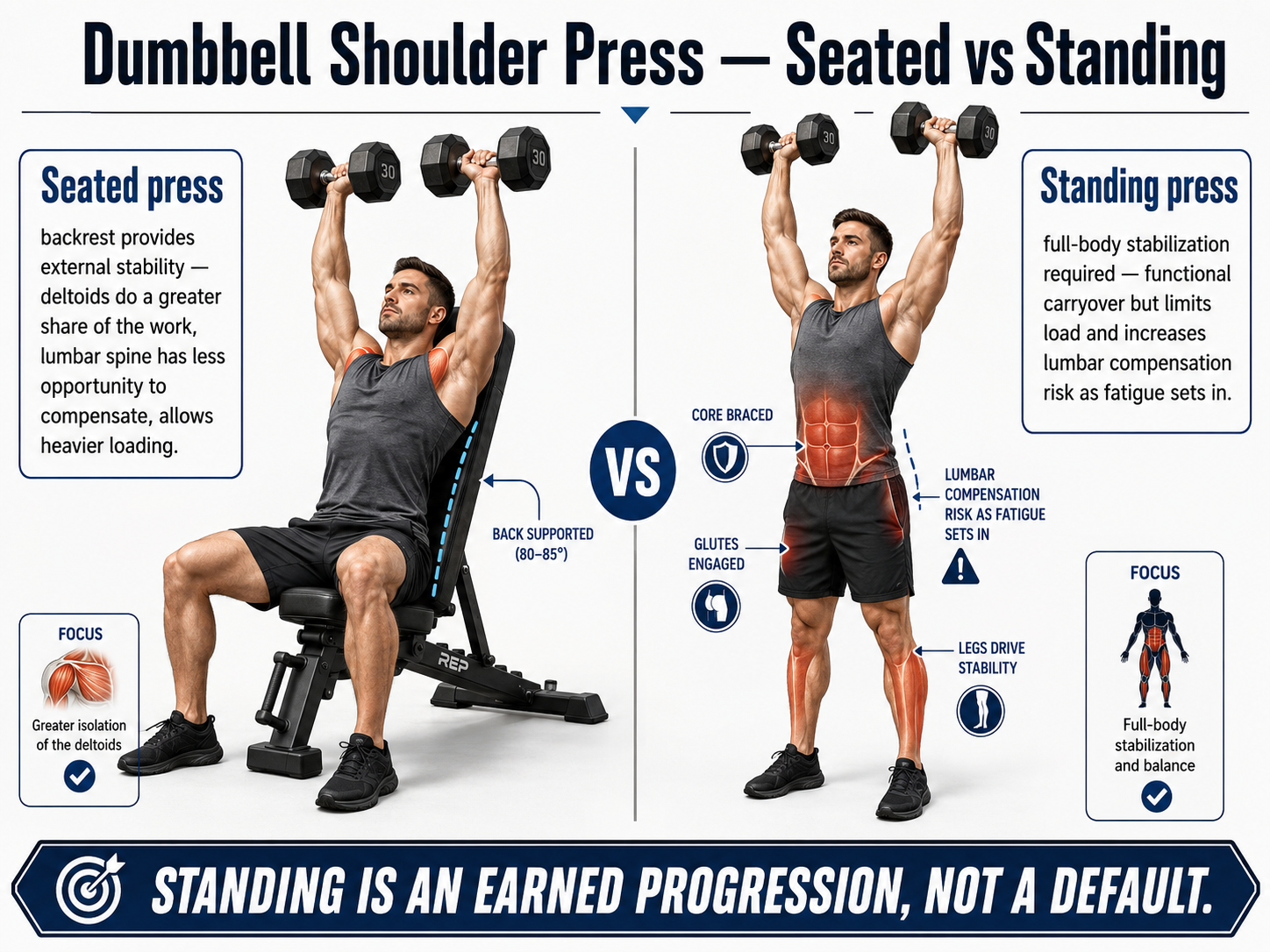
Seated dumbbell shoulder press reduces the demand on the core and lower back, isolates the shoulder musculature more effectively, and allows heavier loading. The backrest provides external stability, which means the deltoids do a greater share of the work and the lumbar spine has less opportunity to compensate. For most people training for shoulder strength and size, seated is the better starting point.
Standing dumbbell shoulder press demands full-body stabilization. The core, glutes, and legs all work to keep the torso upright under load. This has functional carryover — real-world overhead tasks happen on your feet — but it limits the weight you can press and increases the chance of lumbar compensation, especially as fatigue sets in.
Standing is not better or worse. It’s more demanding. If you can’t perform the seated version with clean form through a full range of motion, the standing version will amplify every deficit rather than fix it. Standing is an earned progression, not a default.
When to Stop and Reassess
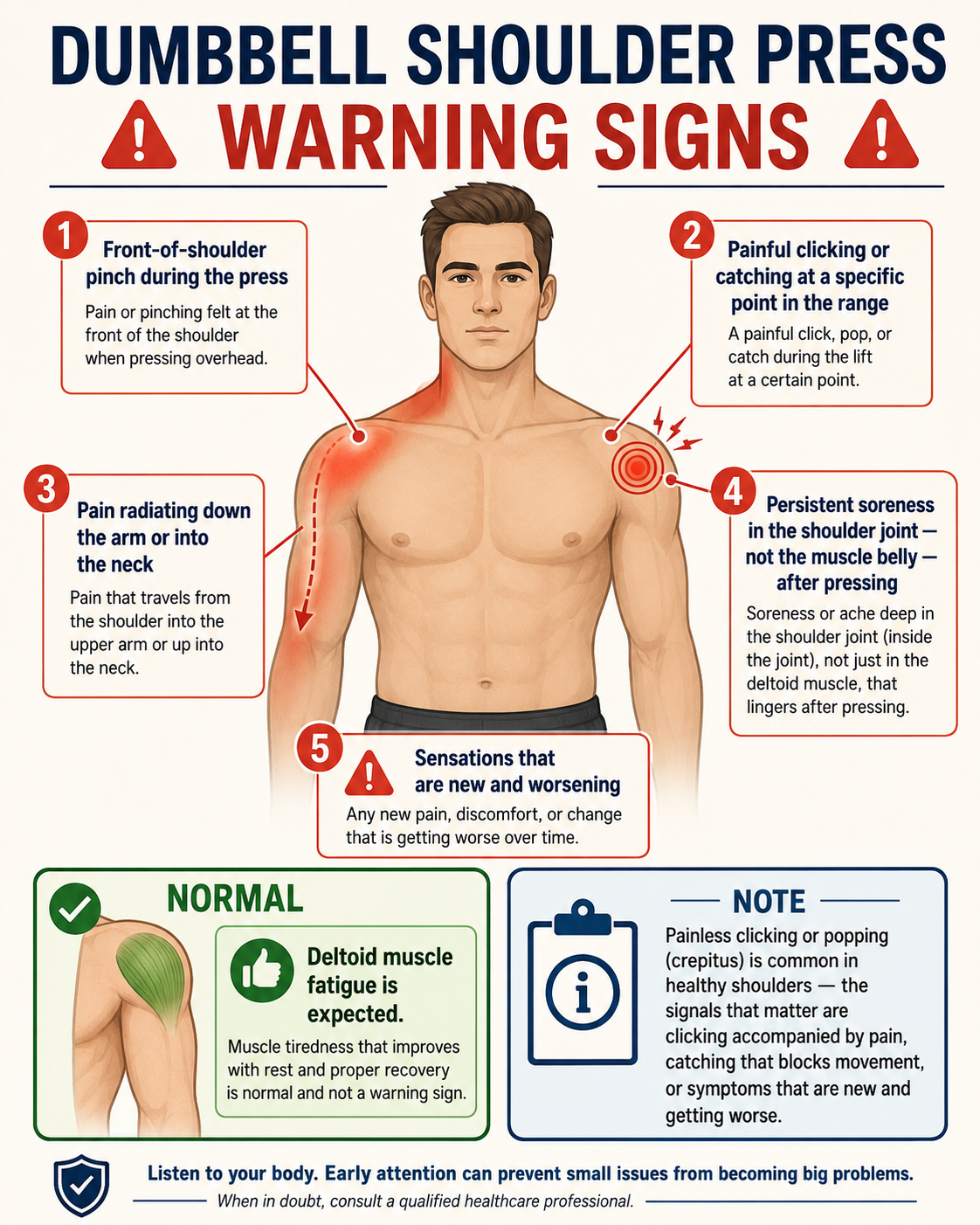
A shoulder press that causes deltoid fatigue is working. A shoulder press that causes joint pain is not.
If there’s a pinch in the front of the shoulder during the press, a sharp sensation at a specific point in the range, pain that radiates down the arm or into the neck, clicking or catching that wasn’t there before, or persistent soreness in the shoulder joint itself — not the muscle belly — after pressing, the exercise is not the problem. The shoulder is telling you it doesn’t have what the movement requires. A note: some painless clicking or popping (crepitus) is normal and common in healthy shoulders. The signals to pay attention to are clicking accompanied by pain, catching that blocks the movement, or sensations that are new and worsening.
Reduce the weight. Check the prerequisites: thoracic mobility, scapular stability, rotator cuff function. If the elbows have been flaring into the frontal plane, bring them forward. If the symptoms persist after these corrections, see a shoulder specialist — not a general practitioner, but someone who works with shoulder biomechanics. Pressing through shoulder pain doesn’t build resilience — it raises the risk of a labral tear or rotator cuff injury down the line.
It’s also worth knowing that some people are anatomically predisposed to impingement regardless of technique. The shape of the acromion — the bony shelf above the shoulder socket — varies between individuals. A hooked acromion (Type III in the Bigliani classification) narrows the subacromial space structurally, making overhead pressing riskier even with perfect form. This is not something you can stretch or strengthen away. If you’ve corrected everything in this article and the shoulder still hurts overhead, acromion morphology is one reason a specialist may want imaging.
Certain pre-existing conditions — prior shoulder dislocation, frozen shoulder, AC joint arthritis, significant glenohumeral osteoarthritis, or existing labral tears — may make overhead pressing inadvisable regardless of how well the prerequisites are addressed. If you have a known shoulder condition, get clearance before pressing overhead.
And regardless of your mobility and stability: warm up before pressing heavy. Even a shoulder with excellent prerequisites needs the rotator cuff and scapular stabilizers activated and the joint lubricated before it takes load. Light band work, scapular wall slides, and a few sets at lower weight are not optional.
The Movement You Earn
The dumbbell shoulder press is not a complicated exercise. But it is a demanding one.
It asks your scapula to rotate upward in coordination with your arm. It asks your thoracic spine to extend so the scapula has room to move. It asks your rotator cuff to center the humeral head in the socket while the deltoid pulls against it. It asks your core to anchor the ribcage so the whole system has a stable foundation. And it asks your deltoids, triceps, and traps to move weight through a range of motion that many people’s bodies are not mechanically prepared for.
When all of that is in place, the dumbbell shoulder press is one of the best shoulder-building exercises available — safe, effective, and progressively loadable for years.
When it’s not in place, the body compensates. The compensations become habits. The habits become injuries. And the injuries get blamed on the exercise instead of the gap that was there before the first rep.
The difference between a press that builds your shoulders and one that damages them is not the weight on the dumbbell. It’s whether your body has earned the right to put weight overhead.