Triangle Pose (Trikonasana): Why You Keep Collapsing — and What the Pose Is Actually Showing You
The reach for the floor isn’t the problem. It’s a symptom of where your hip runs out of lateral range and your spine takes over — and learning to feel that handoff is the whole practice
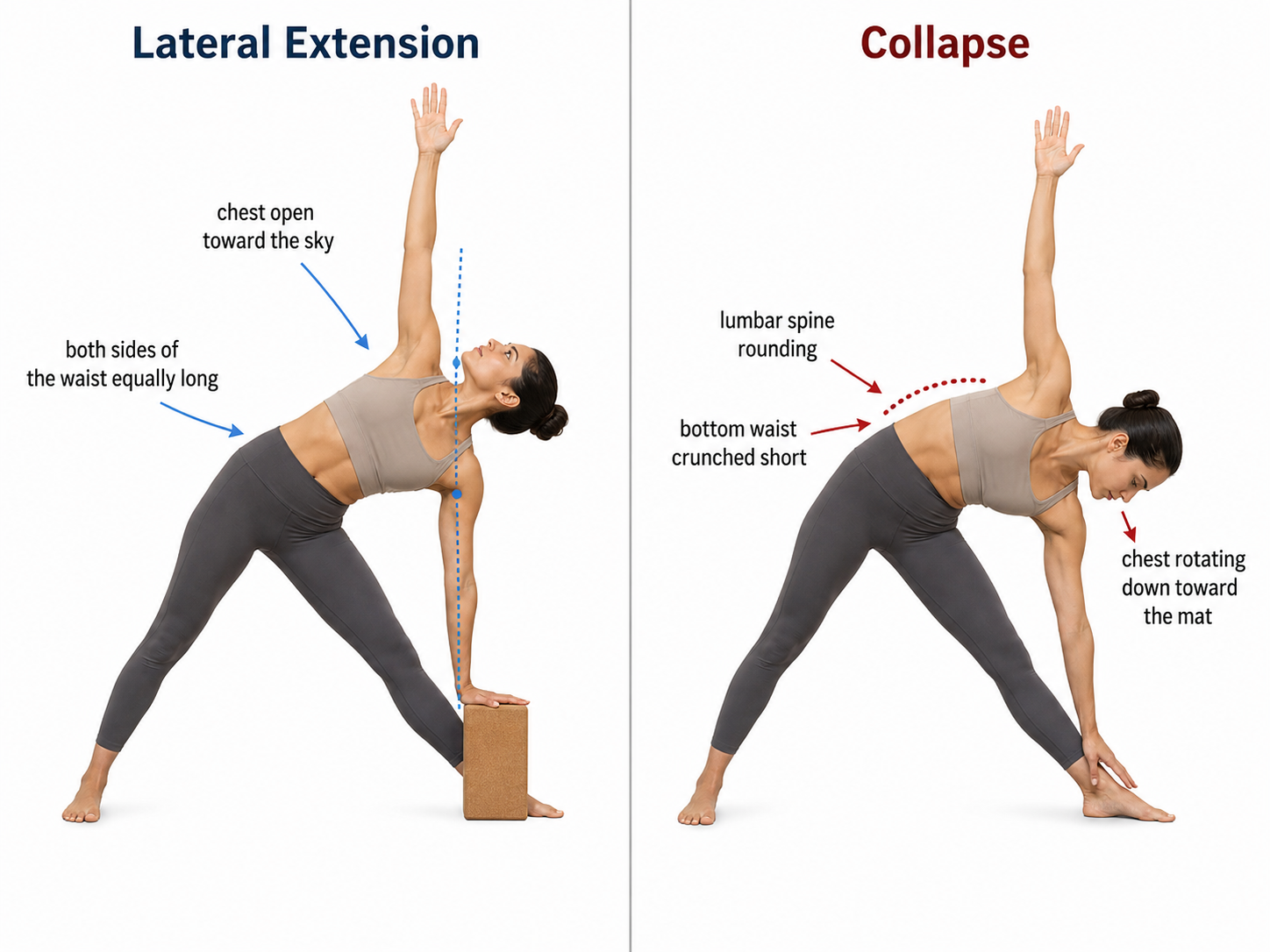
You’re in triangle pose. Your bottom hand is creeping toward the floor, and something feels off. Your chest, which is supposed to be opening toward the side wall, is rotating down toward the mat. The bottom side of your waist is crunched short. Your lower back is doing something it would rather not be doing. And your teacher has just said, for the third class in a row, “lengthen your spine” or “use a block.”
You use the block. It helps for a breath. Then you collapse again.
This is the most common experience in one of the most common standing poses in yoga, and almost every article written about it tells you the same two things: don’t reach for the floor, and use a block. Both are correct. Neither explains why the collapse keeps happening — which is the only information that would actually let you fix it.
The reason isn’t willpower. It isn’t only a matter of general flexibility. The collapse often begins when the chosen depth exceeds what the hip, pelvis, trunk, and balance can currently support — and for many people, the front hip is the easiest place to feel that limit first. This article is about learning to feel where that limit lives in your body: what triangle pose is actually testing, why collapsing is the logical thing your body does when it meets the test unprepared, and how to work with what the pose is showing you instead of fighting it.
What Triangle Pose Actually Is — A Lateral Extension Wearing a Forward Bend’s Disguise
The whole problem starts with what the shape looks like.
From the outside, triangle pose looks like you are bending down to reach your foot. The hand travels toward the floor. The body folds. So the brain, reasonably, files it under “reach for the floor” and goes to work getting the hand down there.
That instinct is the error, and most of what goes wrong in the pose flows from it. Trikonasana is not a forward bend. It is a lateral extension — a side bend. The torso lengthens out over the front leg and tips directly sideways, ideally staying in a single plane, as though your whole body were pressed between two panes of glass. The bottom hand lands wherever it lands as a consequence of that sideways tip. It was never the goal. The moment the pose becomes a fold toward the floor — chest rotating down, spine rounding — it has moved away from the intended shape of triangle pose and become something else.
The name carries the geometry honestly. “Utthita Trikonasana” comes from the Sanskrit utthita, extended, tri, three, and kona, angle: the extended three-angle pose. Your body and the floor form triangles — between the legs and the mat, between the front arm and the leg. The shape is the point.
One thing worth correcting, because nearly every guide repeats it: triangle pose is often described as ancient, sometimes traced to “the Vedic era.” It isn’t. Current scholarship on modern postural yoga — most notably Mark Singleton’s Yoga Body: The Origins of Modern Posture Practice (Oxford University Press, 2010) — treats the standing poses practiced today as products of the 20th century. Trikonasana is documented in Krishnamacharya’s 1934 Yoga Makaranda. The individual Sanskrit words are old; this specific arrangement of the body, presented as triangle pose, is modern. Knowing this changes nothing about the pose’s value, but it’s the kind of small accuracy a reader deserves over an inherited myth.
A Common Reason You Collapse — Where the Hip Runs Out of Range
Here is the mechanical heart of it, and the part almost no guide explains.
To tip sideways over the front leg while keeping both sides of the waist long, several things have to cooperate: the front hip needs enough external rotation, the hamstrings and adductors need enough length, the trunk needs the ability to rotate and extend laterally, and the whole system needs balance and motor control to hold the shape. When any of these fall short, the body compensates. For many practitioners, the front hip is where the limit shows up first — and it’s the most useful place to learn to feel it.
When you tip past the point where these structures can support the pose, your body does not stop. It still wants to get the torso down toward the leg, so it borrows the missing distance from the next structures in line. The lumbar spine rounds. The bottom side of the waist compresses. The chest rotates down toward the floor to let the bottom hand get lower.
That is the collapse. And notice what it actually is: not a cause, but a consequence. The “reaching for the floor” that every article warns you about is not the reason you collapse — it is what the collapse looks like from the outside. The real event is upstream, where available range ran out and the spine quietly took over the job.
This is also why “just use a block” so often fails. If the block is the only intervention — if nothing addresses where your available range actually ends — you don’t stop collapsing. You collapse onto the block instead of onto the floor. Same compensation, higher altitude.
Triangle as a Self-Check — Reading Your Own Body
Once you understand that the collapse happens at a specific point, something useful follows: triangle pose becomes a tool that tells you exactly where your available range begins to break down.
Teachers already use it this way. Five breaths in triangle shows more about a student’s body than ten minutes of conversation — where the range is, where the compensation starts, which side moves more freely, how the person negotiates effort. The pose is its own movement check. The hip either keeps allowing the lateral tip or it doesn’t; the chest either keeps rotating open or it turns toward the floor.
You can run this self-check on yourself. Come into the pose slowly — much more slowly than usual. Tip out over the front leg by degrees, and pay close attention to the exact moment something changes: the instant the bottom side of your waist begins to shorten, or the moment your chest starts to roll down toward the mat. Stop there. That point — that specific place in the range — is your edge. Not a failure. A reading. It is precise information about where your available range ends and your spine starts compensating.
Do it on both sides. They will often feel different, and that difference is information too — many people have one hip that opens more freely in this direction than the other. The asymmetry isn’t a problem to be ashamed of; it’s the map of where your practice actually is.
How to Actually Find the Pose — Length Before Depth
With the principle in hand, the instructions stop being a checklist and start making sense.
Set your stance with your feet about a leg-length apart. Turn your front foot out about 90 degrees so it points to the short edge of the mat, and turn your back foot in slightly, somewhere around 15 to 30 degrees. A common cue is to line up your front heel with the arch of your back foot — though if that feels unstable, widening the stance so your feet are more hip-distance apart side to side is a legitimate adjustment, not a compromise.
A note on that 90-degree front-foot turnout: the textbook version assumes your front hip can externally rotate enough to match it. Many hips can’t, and forcing the foot to 90 degrees when the hip won’t follow may send strain into the knee. Turn the foot out as far as the hip genuinely allows. A wider or shorter stance is a real fix for tight hips, not a lesser version of the pose.
Now the part that matters most: reach long before you reach low. Extend your arms out to the sides at shoulder height. Inhale and lengthen your whole torso out over the front leg — actively reaching the crown of your head away from your tailbone. Ask yourself the question that reorganizes the entire pose: can I get longer before I get lower?
Then tip — from the front hip, not from the waist. Lean sideways over the front leg, leading with length, and lower your bottom hand only as far as you can go while both sides of your waist stay equally long. That landing place might be the floor. It might be your shin. It might be a block. Where it lands is determined by where your hip’s range ends, not by how the pose is “supposed” to look.
Reach your top arm toward the ceiling, stacking your top shoulder over the bottom one, and rotate your chest open toward the sky. Keep your front knee active and very slightly bent — never locked, never hyperextended — to protect the joint and keep the leg muscles working. Let your neck stay neutral, or turn your gaze up toward your top hand only if your neck is comfortable doing so. Hold for five to ten slow breaths, lengthening on each inhale, rooting down through both feet. To come out, press into your feet, engage your legs, and rise with a long spine.
The Block, Used Correctly
The block deserves its own moment, because it is the most-given and least-understood cue in this pose.
A block is not a crutch for people with short arms. It does not exist to help you touch something when the floor is too far away. Its actual job is to raise the floor up to meet the point where your spine can still stay long — it buys you length, not depth.
Used correctly, you set the block at the height where both sides of your waist stay equal when your hand rests on it, and then you do not collapse onto it. If your bottom waist is still crunching with the block where it is, the block is too low. Raise it. A block at its tallest height, or even a chair seat, is completely valid.
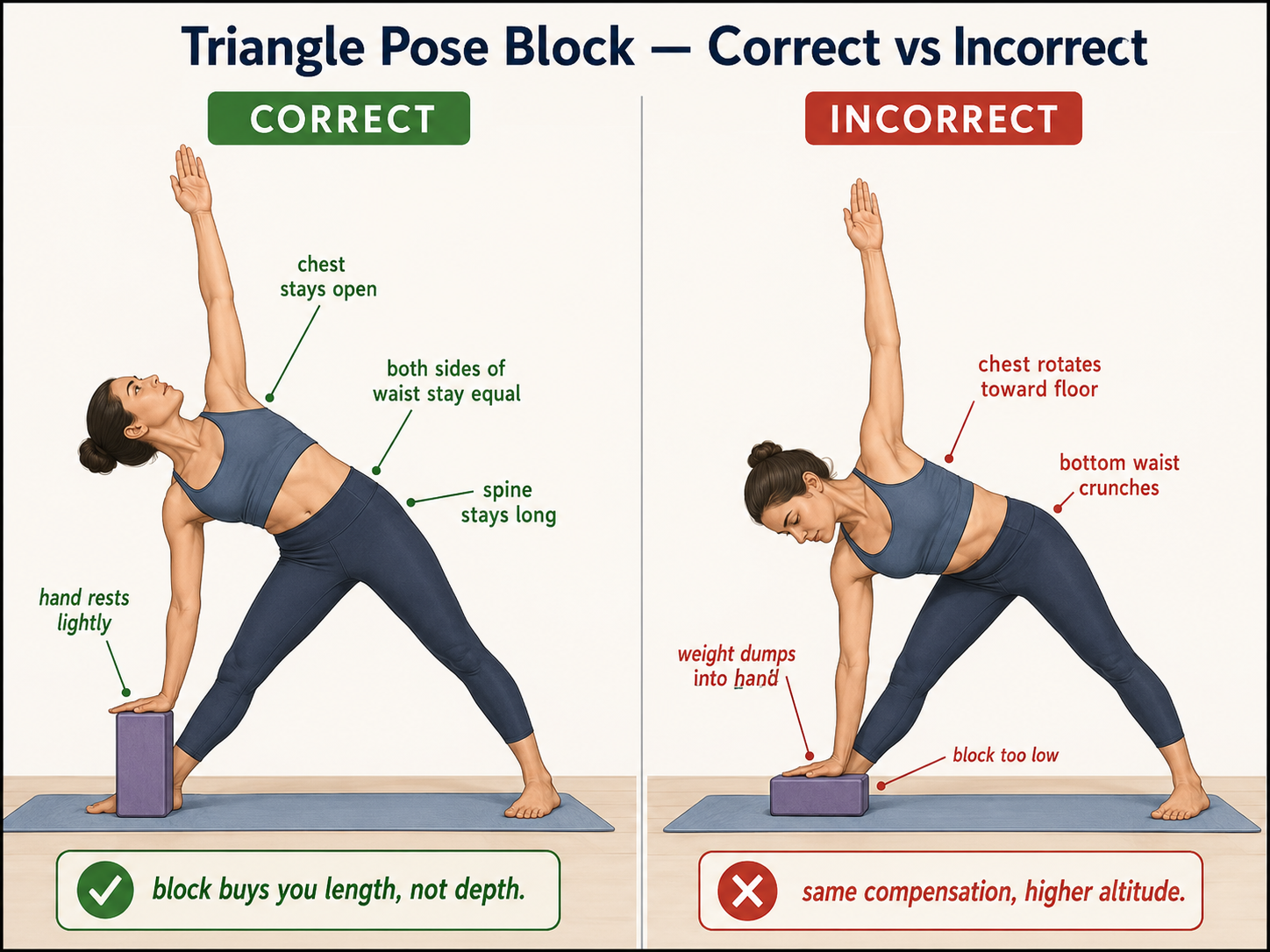
Most people reach for a block to get their hand lower. The entire point is to use it to stay long. Those are opposite intentions, and only one of them produces the pose.
What Triangle Pose Works — The Measured Version
Stripped of inherited claims, here is what triangle pose reliably does.
It stretches the side body — the obliques, the intercostals, the muscles running from the bottom hip up through the side waist to the top fingertips. It stretches the hamstrings and inner-thigh adductors of the front leg and works the hips through their range. It builds standing balance and the proprioceptive sense of where your body is in space, because holding the shape demands constant small adjustments. And it trains the simultaneous qualities of effort and ease — grounding down hard through the legs while expanding openly through the chest and arms — that standing yoga poses are built to develop.
When the pose has been examined with motion capture and musculoskeletal modeling, the muscle groups it recruits to hold the shape include the obliques, the rectus abdominis and psoas major on the front-leg side, and the gluteus maximus and gluteus medius on the rear-leg side. That is a measured account of what the pose asks the body to do.
You will see other claims attached to triangle pose across the internet — that it improves digestion, detoxifies organs, stimulates the liver, relieves acid reflux. These descriptions come from tradition, not from established evidence, and this article leaves them out rather than present inherited belief as physiological fact. The pose does enough that is real and observable. It doesn’t need the embellishments.
When to Back Off, and Who Should Modify
Triangle pose is accessible, but a few situations call for care, and the general rule is simple: pain that is sharp, centered in a joint, or located in the lower back is a stop signal, not an edge to push through.
If your lower back sharpens or strains in the pose, that is the signature of side-bending from the spine instead of tipping from the hip. Come up, shorten your stance, raise your hand higher, and rebuild from length. If you have neck problems, do not turn your gaze up toward your top hand — keep your head neutral and your eyes forward, with both sides of the neck equally long.
Several traditional teaching sources advise that people with high blood pressure or heart conditions keep the top arm down or the gaze level rather than reaching and looking overhead, and some recommend practicing the pose with the back body against a wall for additional stability. That guidance is widely repeated; whether it applies to you is a question for your clinician, and worth asking if either condition is yours. If you are pregnant or working around a recent injury, practice the pose with a qualified teacher who can see your body and adjust in real time.
People with glaucoma should consult a clinician about any yoga positions that involve inversions or head-lowered positions — while triangle does not always place the head below the heart, deeper versions of the pose can approach that territory. Older adults and anyone with balance concerns may benefit from practicing near a wall or with a chair for hand support. If you have lumbar spine disease, disc issues, or sciatica, the lateral flexion in this pose may need to be significantly reduced or avoided — a clinician or qualified yoga therapist can help you decide.
One broader point: yoga practice, including triangle pose, is not a substitute for medical evaluation. If you have persistent pain, radiating symptoms, numbness, tingling, dizziness, or chest symptoms, see a healthcare provider rather than working through them on the mat.
None of this is meant to make triangle sound dangerous. It is a stable, grounded pose. But it is also a pose that will happily let you side-bend from your spine if your hip won’t cooperate, and knowing the difference between a healthy edge and a warning sign is part of practicing it well.
What the Pose Is Really For
The floor was never the point.
Triangle pose is not something you pass or fail by how close your hand gets to the ground. It is a pose that shows you, every single time you enter it, exactly where your available range ends and your spine begins to compensate. That information is the gift. The hand creeping toward the floor, the waist crunching short, the chest rotating down — these aren’t your failures. They’re the pose doing precisely what it does: revealing the edge of your range with total honesty.
So the practice isn’t forcing the hand down. It’s learning to feel that handoff point — the exact moment the available range runs out — and working right there, at the edge, breath after breath. Depth may change over time as the body adapts. It comes as an output of the work. It is never the goal of it.
The triangle holds its shape because of its base. So do you.
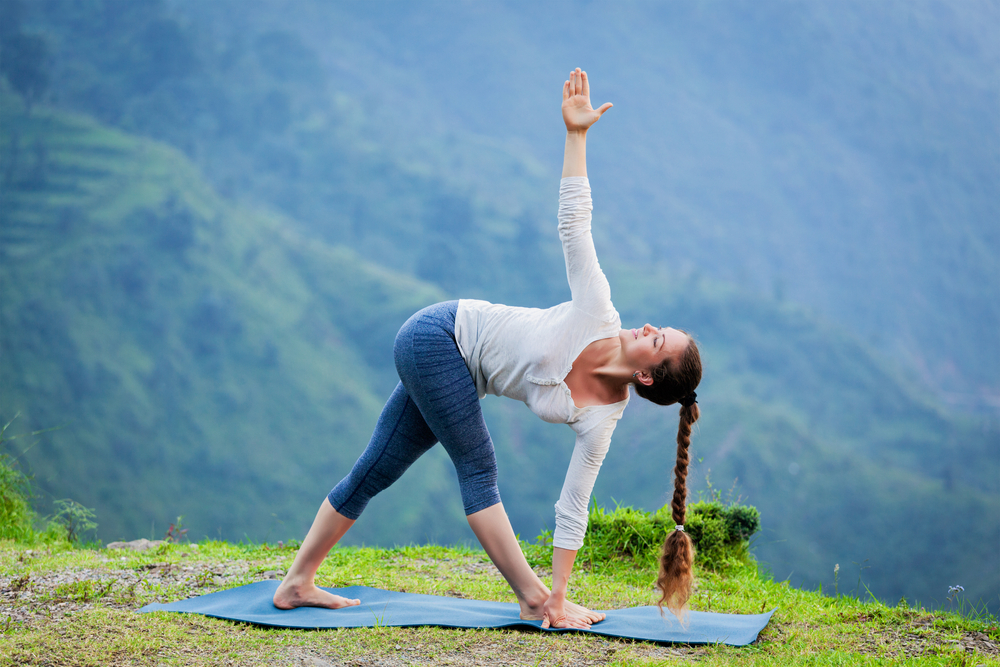
Triangle Pose (Trikonasana) – A pose that stretches the legs and muscles around the knee, ankle joints, hips, groin, hamstrings, calves, shoulders, chest, and spine.