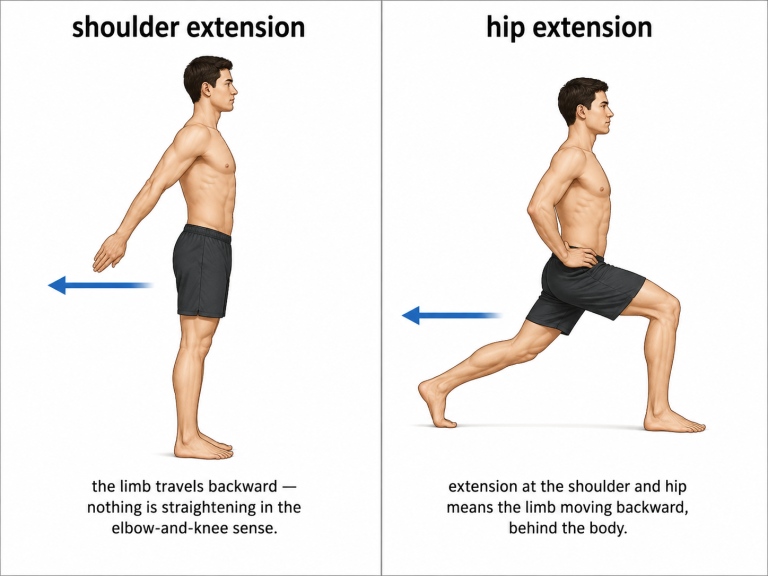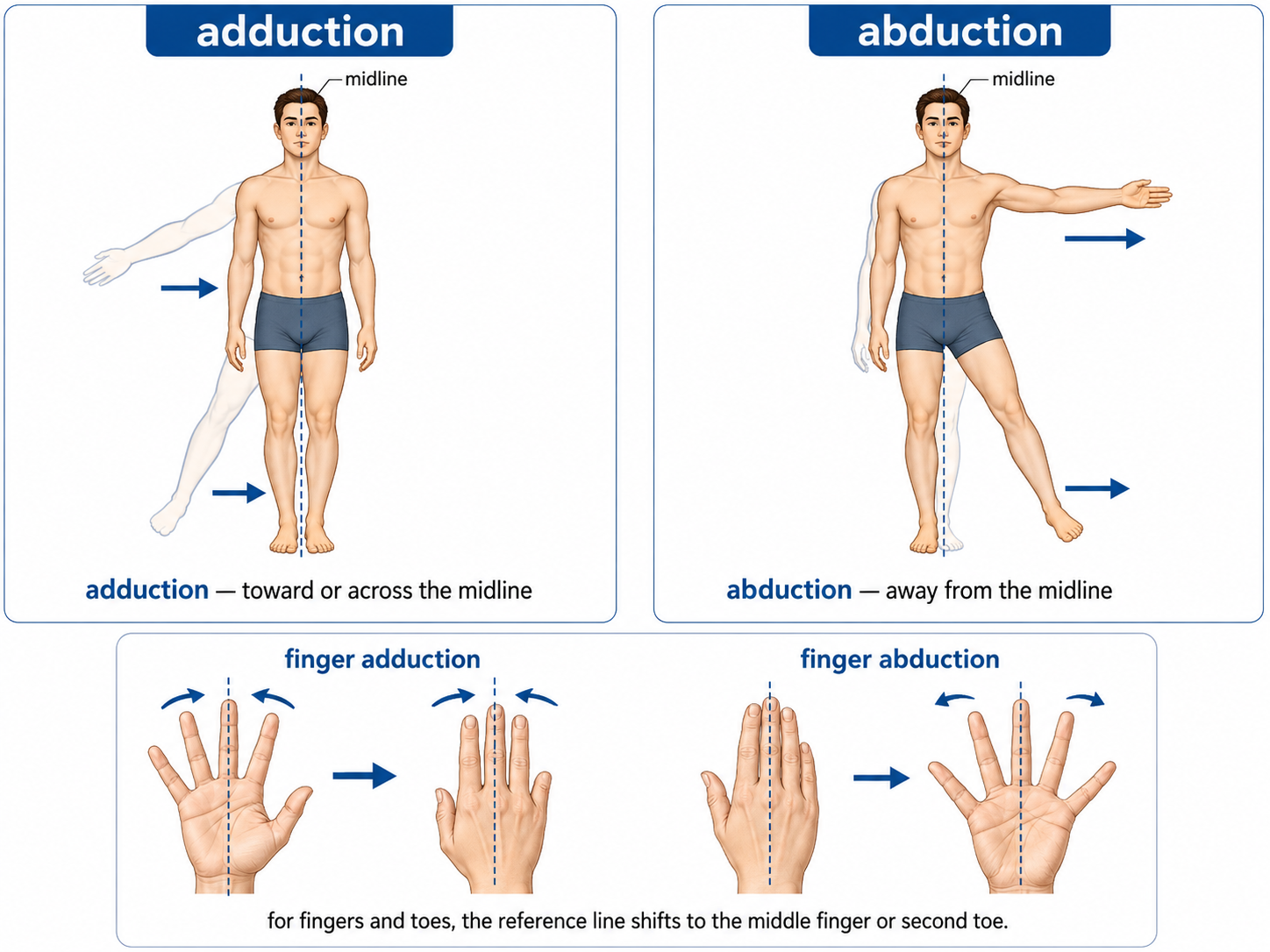
Adduction is the movement of a body part toward or across the midline of the body. The word comes from the Latin adducere, meaning “to lead toward.” Its opposite is abduction — movement away from the midline. These two movements work as a pair at every joint where they occur.
That is the definition. It’s accurate and complete. But it leaves out everything that makes adduction worth understanding beyond a vocabulary word.
Adduction is more functionally important than its clinical name suggests. The muscles that produce it — particularly at the hip — are among the most overlooked in training, among the most commonly injured in sport, and among the most consequential for how well you walk, balance, and stabilize your body during everything else you do. The definition is the starting point. The function is the reason to keep reading.
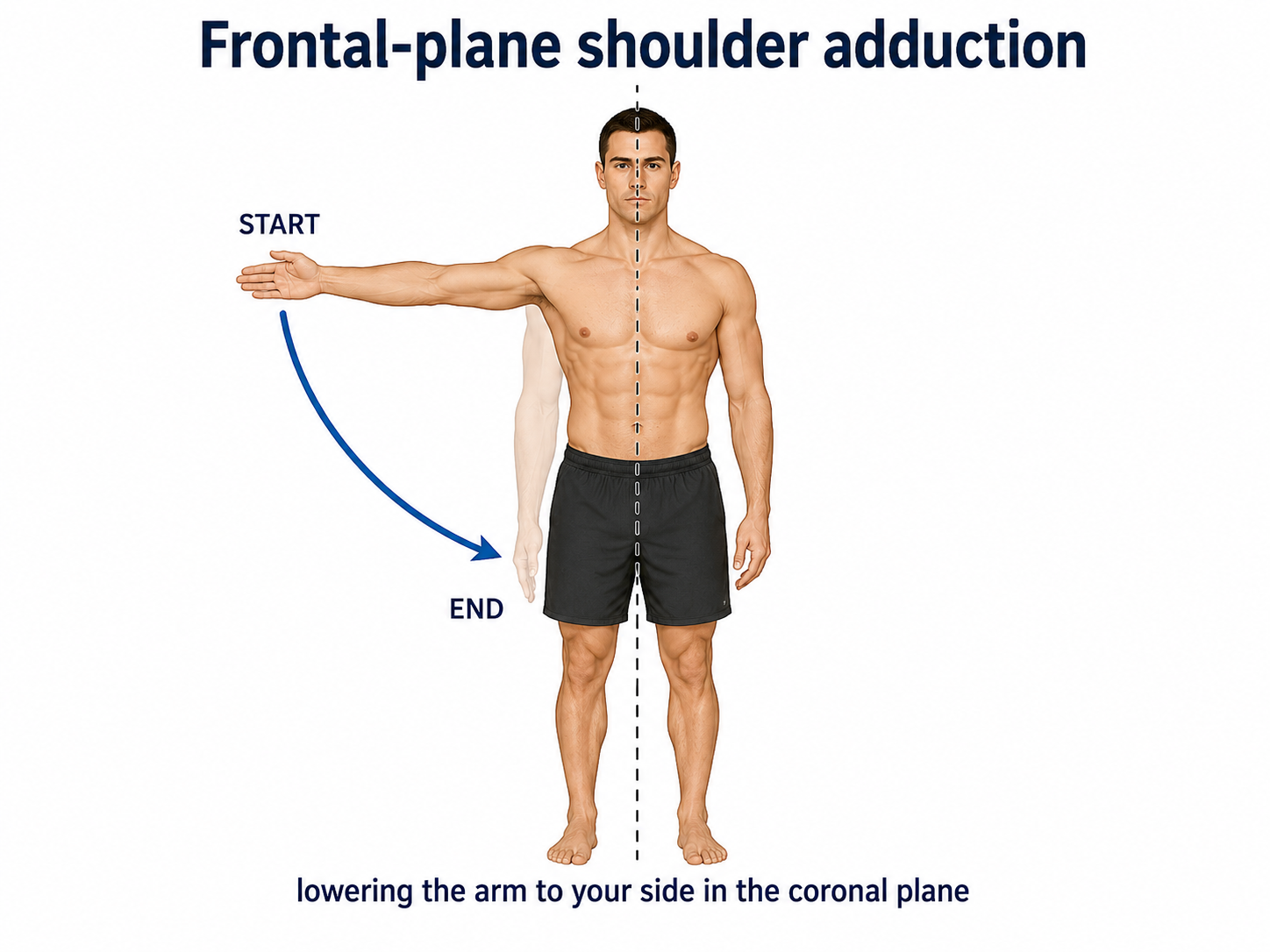
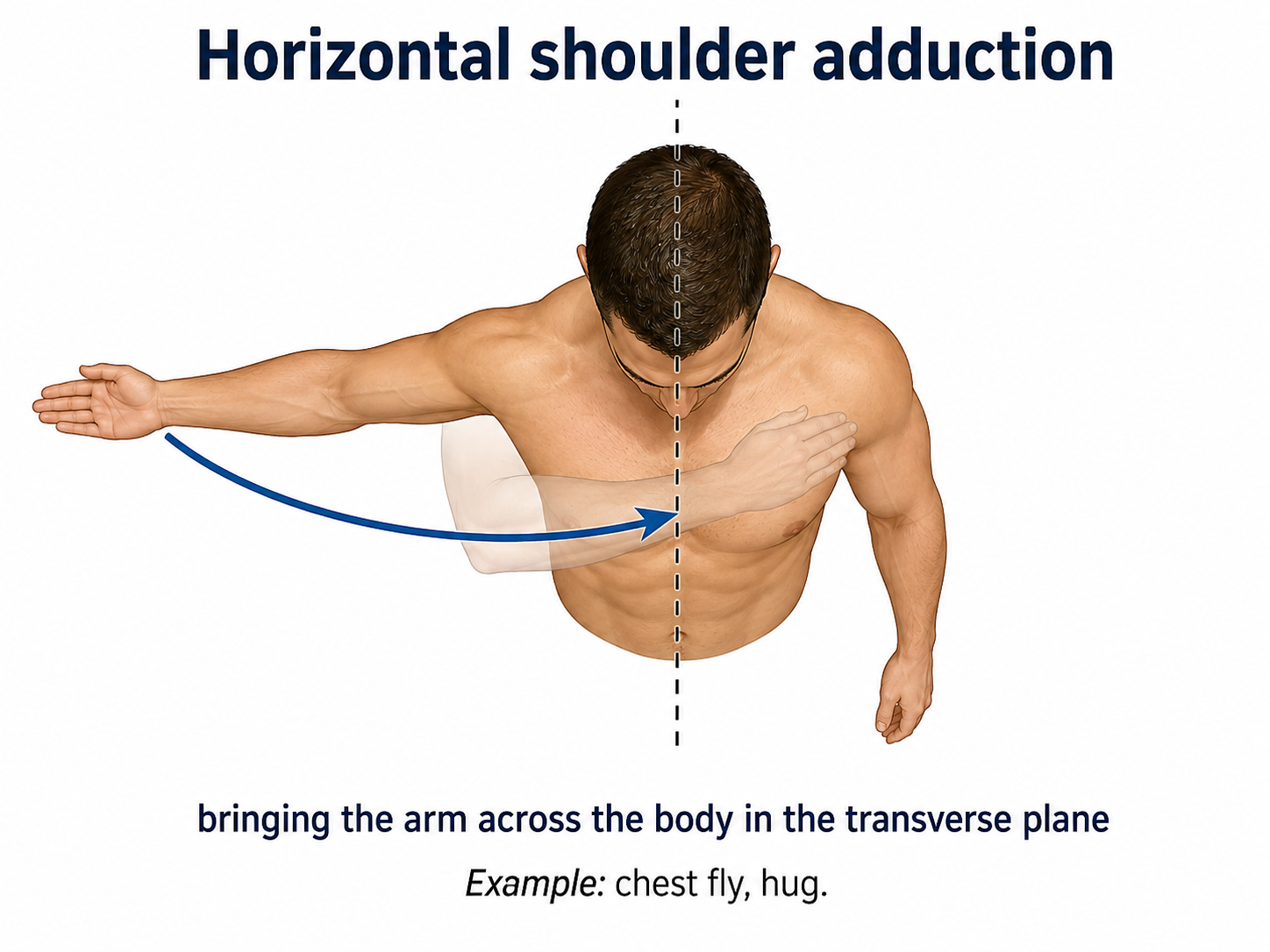
One way to remember the adduction definition is to imagine a line passing through the center of your body. When you move a part of your body toward this line, you are adducting — you are adding to this imaginary line. Imagine that your hands are stretched out to the side. There are infinite ways you can bring your hands toward the midline of your body. You can lower your arms to your side, which is called frontal-plane adduction. You can also bring your hands toward the midline of your body like seals clapping. This is called transverse-plane adduction.
What Adduction Looks Like in Your Body
Adduction occurs at multiple joints, and you’re already doing it constantly without knowing it has a name.
At the shoulder, adduction has two forms. The first is frontal-plane adduction: lowering your arm back to your side after raising it out to the side. This is the textbook version — movement directly toward the body in the coronal plane. The second is horizontal adduction: bringing your arm across your body toward the opposite shoulder, as in hugging someone or the inward phase of a chest fly. Horizontal adduction occurs in the transverse plane, not the frontal plane. Both are adduction — both move the limb toward or across the midline — but they load different muscles in different ways and happen in different planes. The distinction matters because most exercise references list chest flies and rows under “adduction” without noting that they’re horizontal adduction, which can confuse anyone trying to learn the anatomy.
At the hip, adduction is bringing the leg toward or across the midline. Squeezing your thighs together, crossing one leg over the other, the trail leg returning to center after a side step — all adduction. Walking includes small frontal-plane hip motions, and the adductors contribute to pelvic control during each stride. You can feel the muscles responsible for this on the inside of your thigh.
At the fingers, adduction brings spread fingers back together. The reference line shifts here — finger adduction moves toward the middle finger, not toward the body’s central midline. At the toes, the reference is the second toe. At the wrist, ulnar deviation — tilting the hand toward the pinky side — is a form of adduction.
Adduction also happens at the vocal cords. Closing the vocal cords for speech and swallowing is vocal cord adduction. Opening them for breathing is abduction. This isn’t a metaphor — it’s the same anatomical term applied to a different structure, and the movement follows the same principle: toward the midline.
The Muscles That Produce Adduction
Different muscles produce adduction at different joints. Here are the primary movers at each.
At the shoulder, frontal-plane adduction is produced primarily by the pectoralis major and the latissimus dorsi — two of the largest muscles in the upper body. The teres major, coracobrachialis, and long head of the triceps assist. For horizontal adduction, the pectoralis major and anterior deltoid are the primary drivers.
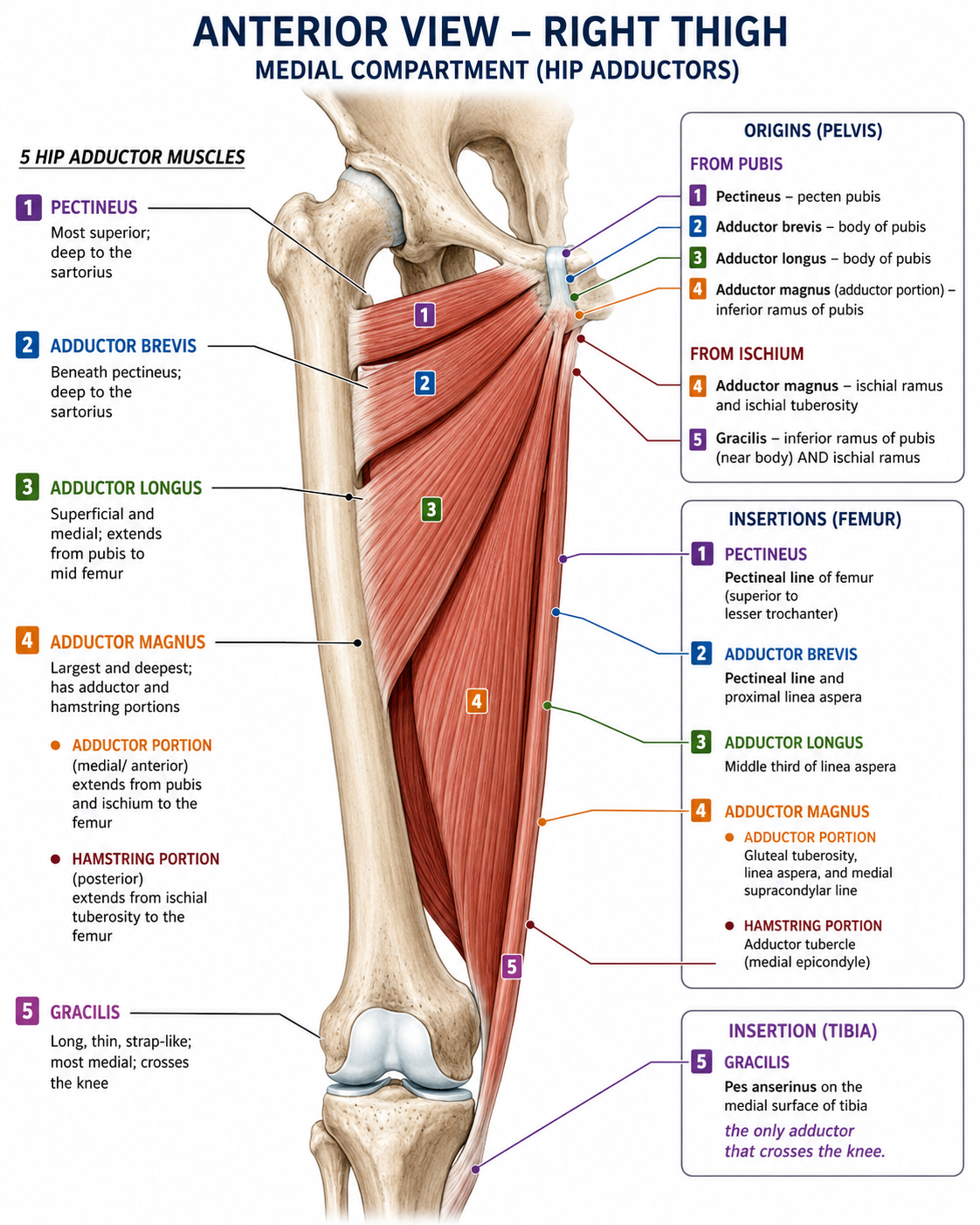
At the hip, adduction is produced by a group of five muscles in the medial compartment of the thigh, collectively called the adductor group: the adductor longus, adductor brevis, adductor magnus, pectineus, and gracilis. They originate from the pelvis — the pubis and ischium — and insert along the femur, except for the gracilis, which crosses the knee and inserts on the tibia. The adductor magnus is the largest and most complex, functioning as both an adductor and a partial hamstring. These five muscles are the ones people mean when they say “inner thigh muscles.”
At the fingers, the palmar interossei produce adduction — drawing the fingers toward the middle finger. At the toes, the plantar interossei and the adductor hallucis perform the equivalent movement.
At the scapula, pulling the shoulder blade toward the spine is also called adduction. The rhomboids, middle trapezius, and lower trapezius produce this movement. Scapular adduction is what happens when you “squeeze your shoulder blades together.”
Adduction vs. Abduction
Adduction moves toward the midline. Abduction moves away from it. They are opposite movements at every joint where they occur.
The simplest way to remember the adduction definition alongside its opposite: abduction takes the limb away (think “abduct” — to take away), and adduction brings it back.
But the relationship between adduction and abduction is more than a vocabulary pair. The muscles that produce these two movements work together to control side-to-side stability. At the hip, the adductors on the inside of the thigh and the abductors on the outside (primarily gluteus medius and gluteus minimus) form a partnership that controls how the pelvis moves in the frontal plane. When you stand on one leg — which is what every step of walking briefly is — both groups are working to keep the pelvis level and the trunk stable. Neither group does the job alone.
This partnership is where adduction stops being a definition and starts being something that matters in your body.
Why Adduction Matters Beyond the Definition
Three specific reasons, each grounded in how the body actually works.
The hip adductors contribute to pelvic stability during walking. Every step of walking involves a moment of single-leg stance. During that moment, the hip abductors — gluteus medius and gluteus minimus — are the primary muscles keeping the pelvis from dropping on the unsupported side. But the adductors aren’t passive. They work with the abductors to control the pelvis in the frontal plane, contributing to the fine-tuned side-to-side stability that keeps your gait smooth and your pelvis level. When the adductors are weak relative to the abductors, that coordination suffers — contributing to compensatory movement patterns, hip discomfort, and instability.
Adductor injuries are among the most common in sport. Groin strains — a familiar injury in sports that involve sprinting, cutting, and rapid direction change — are injuries to the hip adductor muscles, most commonly the adductor longus. In professional ice hockey players, research found that those with adductor strength below 80% of their abductor strength were 17 times more likely to sustain an adductor strain [Tyler et al., 2001]. The broader literature also links hip adductor strength deficits or asymmetries with groin problems in some field-sport populations, but evidence for the adductor-to-abductor ratio specifically is mixed.
Hip adductor and abductor strength is associated with fall status in older adults. A longitudinal study of community-dwelling older adults found that non-fallers had significantly greater hip adductor and abductor strength than those who experienced falls. When the researchers adjusted for multiple factors, the strongest protective findings were for hip abductor strength and hip flexor power — not adductor strength independently. But the overall pattern suggests that frontal-plane hip strength, including the adductors, is part of the picture. The evidence is still developing.
How Adduction Shows Up in Exercise
Many common exercises involve adduction, though people don’t always recognize the pattern.
Frontal-plane hip adduction — the textbook version — shows up in the seated adduction machine, side-lying adduction (lifting the bottom leg while lying on your side), Copenhagen adductor exercises (a plank variation with the top foot elevated), and ball squeezes between the knees. Wide-stance squats and lateral lunge returns also involve an adduction component as the legs come back together.
Horizontal adduction at the shoulder appears in chest flies and push-ups (the horizontal adduction component of pressing). These are transverse-plane movements — related to frontal-plane adduction but distinct.
Frontal-plane shoulder adduction — lowering the arm to the side — appears in lat pulldowns and the downward phase of a lateral raise. Pull-ups involve shoulder adduction combined with elbow flexion.
Recognizing which exercises involve adduction makes training more intentional. If clinical assessment has identified adductor weakness — through strength testing by a physical therapist or athletic trainer — you can look at your program and see whether any exercise is actually training the pattern. For many people, the answer is no.
If groin pain is sharp, recurrent, associated with a pop, bruising, swelling, limping, numbness, or pain that does not improve, get assessed before loading adduction exercises. Groin pain has many possible causes beyond adductor weakness, and the right response depends on what’s actually happening.
Adduction in Rehabilitation and Clinical Context
Adduction is not only a gym movement. It’s a clinical term with significance across medicine.
Hip adductor and flexor spasticity or contracture can contribute to hip displacement in children with cerebral palsy. Shoulder adduction contractures occur after stroke and spinal cord injury, pulling the arm against the body and limiting function. Vocal cord adduction dysfunction affects voice production and airway control.
In post-surgical rehabilitation — after hip replacement, knee reconstruction, or shoulder repair — physical therapists may assess adduction strength or range when relevant, but the specifics of adduction work depend on the procedure, the surgical approach, and the surgeon’s protocol. After some hip replacements, for example, adduction or crossing the midline may be restricted early in recovery.
This section exists not to make the reader a clinician, but to show the full scope of what adduction means. The same movement pattern that brings your legs together after a side step is the one a surgeon assesses after a hip replacement and a speech therapist evaluates in a patient with voice difficulty. The definition covers all of it.
The Definition and What Comes After It
Adduction is movement toward or across the midline. That’s the answer to the question that brought you here, and it’s correct.
But adduction is also the movement pattern that keeps your pelvis stable when you walk, that closes your hand around a glass, that brings your arm back to your side, that lets you cross your legs. The muscles that produce it at the hip are some of the hardest-working and least-trained muscles in the body. They get injured often, they matter for balance, and they do their work so quietly that most people never think about them until something goes wrong.
Now you know the adduction definition — movement toward or across the midline. More usefully, you know what it does.