How the shoulder moves degree by degree during a lateral raise — and what that means for your arm path, grip, range, and programming.
The dumbbell lateral raise looks like one of the simplest movements in the gym. Stand up, hold two dumbbells, lift them to the sides. But the shoulder joint performing this motion is not simple. It runs through a sequence of muscle handoffs, bony clearances, and rotational mechanics that most lifters never think about — and that sequence determines everything about how the exercise should be performed: where the arms travel, what the hands do, how high to go, and how much weight to use.
Understanding that sequence does not require a degree in anatomy. It requires knowing three things: which muscles fire and when, what the shoulder blade’s position on your ribcage means for your arm path, and how the dumbbell’s resistance profile interacts with the muscle you are trying to train. Those three things explain most of the practical decisions in the exercise, and most of the common mistakes.
In plain terms: raise slightly forward of your sides, keep a neutral or slightly thumbs-up grip, stop around shoulder height unless your shoulders tolerate more, and use a weight light enough that your shoulders do not shrug.
Which Muscles Fire During a Lateral Raise
A lateral raise is not a single muscle pulling an arm upward. It is a relay — a coordinated handoff between muscle groups that fire in sequence as the arm rises through its arc.
The relay begins with strong early contribution from the supraspinatus, a rotator cuff muscle that sits on top of the shoulder blade. In the first 0–15° of abduction — the initial lift of the arm away from the body — the supraspinatus helps initiate the movement and stabilize the head of the humerus (upper arm bone) against the glenoid fossa, the shallow socket of the shoulder blade. The deltoid is also active from the start, but the supraspinatus’s stabilizing role is critical: without it, the deltoid’s pull would tend to drive the humeral head upward into the acromion (the bony roof of the shoulder) rather than rotating it cleanly. The supraspinatus continues assisting the deltoid through approximately 90° of abduction, but its contribution is strongest early in the range.
From roughly 15° onward, the middle deltoid becomes increasingly dominant as the prime mover. This is the muscle the dumbbell lateral raise is designed to train — the lateral head of the deltoid, responsible for shoulder width when viewed from the front. The middle deltoid drives abduction through the main working range of the exercise, up to about 90° (arm parallel to the floor).
Above 90°, a second transition occurs. The scapula — the shoulder blade itself — must rotate upward to allow the arm to continue rising. This rotation is produced by a force couple involving the serratus anterior and the upper and lower trapezius. Without adequate scapular upward rotation, clearance under the acromion becomes more limited. This is why the movement above parallel feels different: the upper trapezius is now contributing substantially, which is also why lifters who raise too high with too much weight often feel the exercise in their traps rather than their delts.
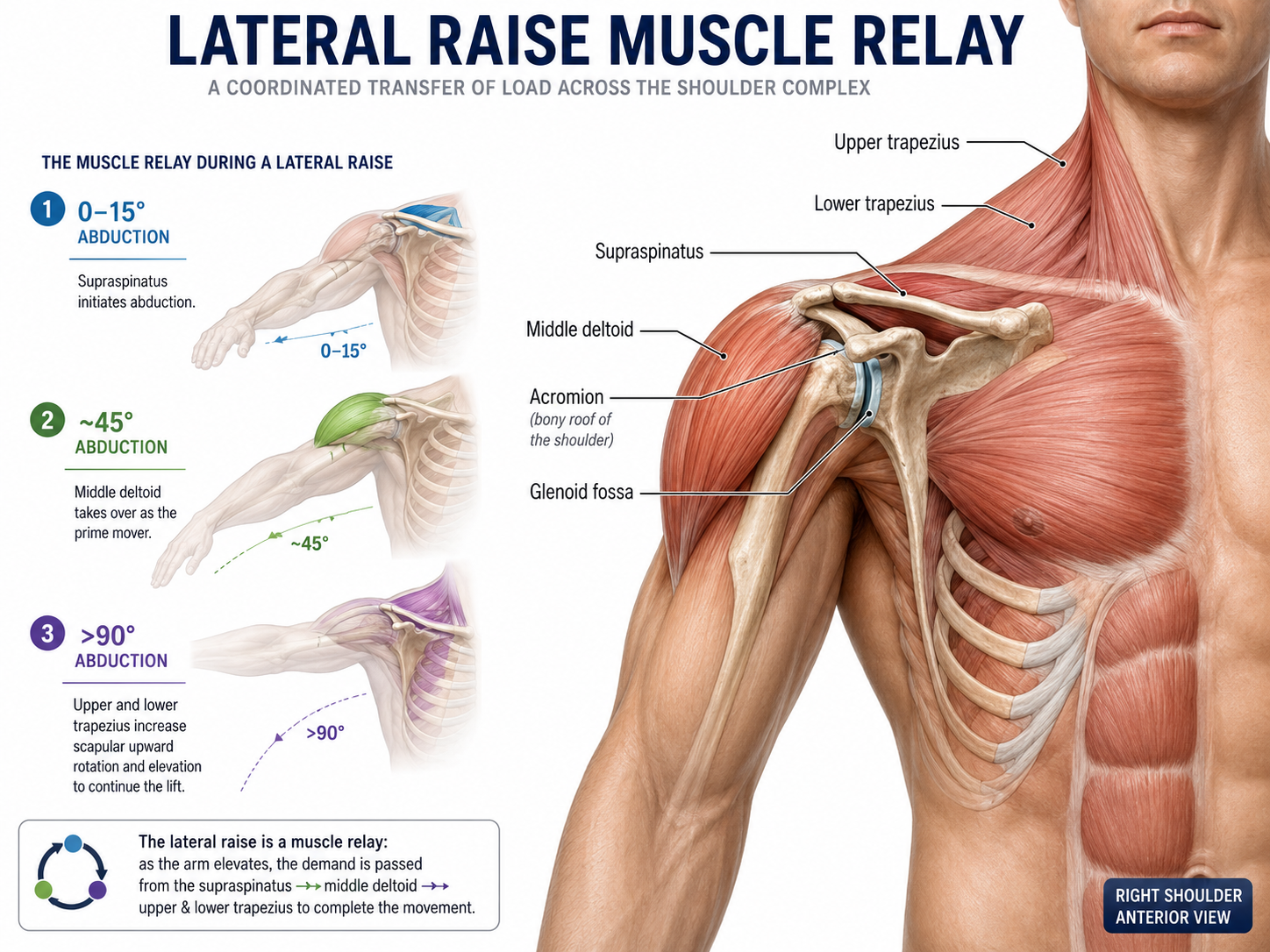
Throughout this entire arc, the shoulder follows what is called the scapulohumeral rhythm — a coordinated ratio of arm movement to scapular rotation. After the first approximately 30° of abduction, for roughly every 2° the arm moves, the scapula contributes about 1° of upward rotation. This is a simplified average, not a fixed ratio on every rep — it varies by person, plane, and range. But it is why the exercise rewards moderate load and deliberate tempo. Heavy weight can make it harder to maintain smooth shoulder-scapula coordination — the upper trapezius takes over before the middle deltoid has done its work, and the momentum that masks this takeover prevents the lifter from noticing.
Why the Arms Should Rise Forward, Not Sideways
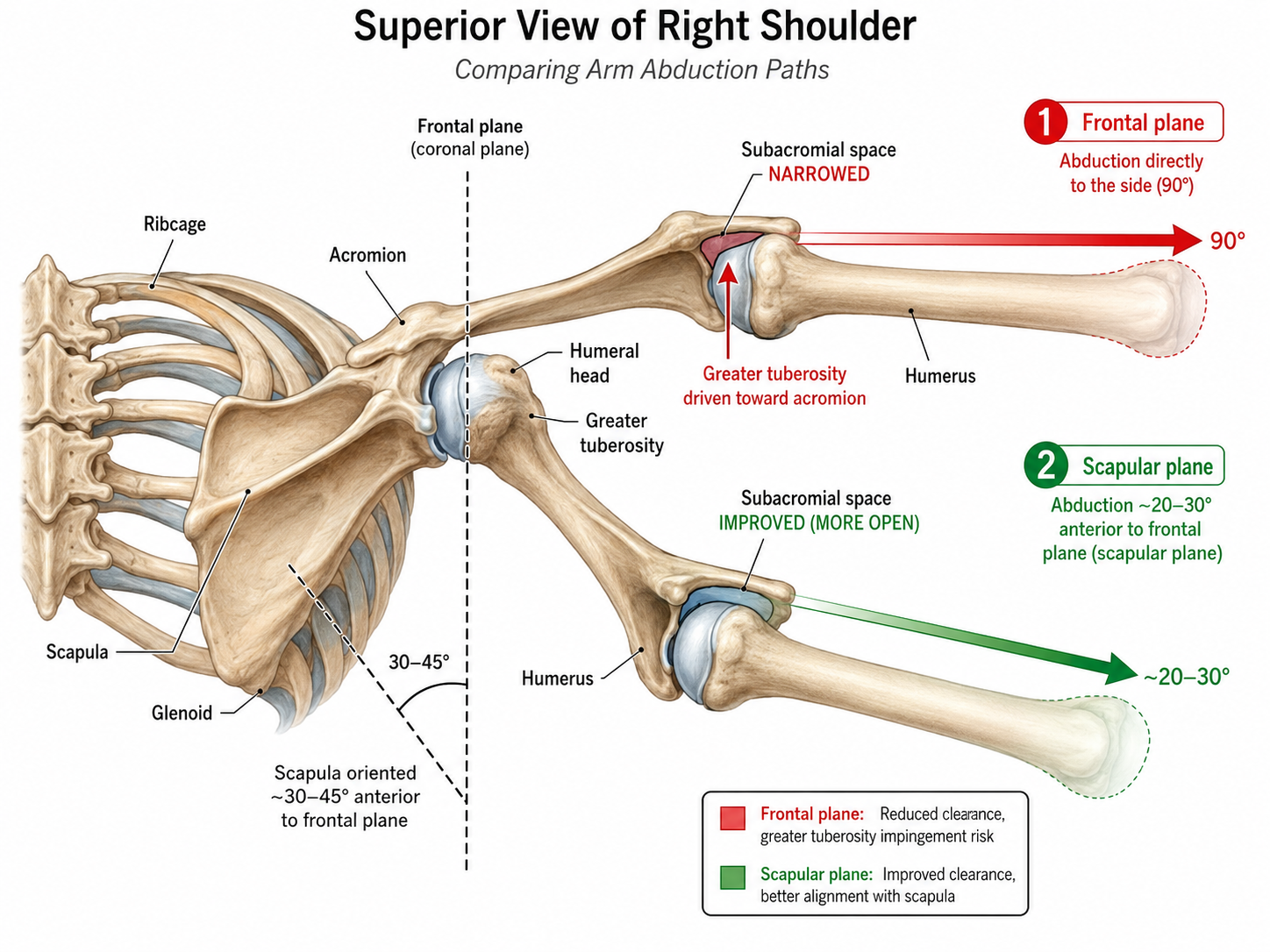
The shoulder blade does not sit flat against the back. It rests on the curved surface of the ribcage at an angle — approximately 30–45° forward of the frontal plane (the plane that would slice the body into front and back halves). This angle is called the scapular plane.
This matters for the lateral raise because the arm moves most naturally — and with the least joint stress — when it follows the plane of the shoulder blade. When a lifter raises the arms directly out to the sides, in the true frontal plane, the greater tuberosity of the humerus (a bony knob near the top of the upper arm bone) is driven toward the acromion. The space between them — the subacromial space — is where the rotator cuff tendons pass. Narrowing that space compresses those tendons, and repeated compression under load is one mechanism that may contribute to subacromial irritation or rotator cuff–related shoulder pain in susceptible lifters.
Shifting the arm path forward by about 20–30° as a practical cue — not an exact match to the anatomical angle, but enough to move out of the strict frontal plane — aligns the humerus more closely with the shoulder blade and can improve clearance in the subacromial space. This position is sometimes called “scaption” (a combination of “scapular” and “abduction”). The practical cue is straightforward: at the top of the rep, your arms should be slightly in front of your body, not forming a perfect T.
(
This forward shift does not sacrifice lateral deltoid activation. The lateral deltoid’s fibers originate along the lateral margin of the acromion, placing its line of pull slightly posterior to a purely lateral direction. A slight forward arm path accounts for this, keeping the resistance aligned with the muscle’s fiber orientation while potentially reducing joint compression.
What the “Pouring Water” Cue Does to Your Shoulder
One of the most persistent coaching cues in shoulder training is the instruction to rotate the dumbbells as if pouring water from a pitcher — tilting the thumb side down at the top of the rep. The idea is that this internal rotation isolates the lateral deltoid more effectively. The mechanics suggest otherwise.
An EMG study by Coratella et al. (2020) examined muscle activation across several lateral raise grip variations in competitive bodybuilders. Internal rotation (thumbs down) increased activation of the upper trapezius, posterior deltoid, and triceps compared to all other grip positions tested — making it a less targeted lateral deltoid variation, not a more targeted one. For the medial (lateral) deltoid specifically, a neutral grip — palms facing the body, thumbs forward — showed higher activation than external rotation, frontal raise, and bent-elbow variations.
Separately from the EMG picture, internal rotation has a mechanical consequence at the joint. Turning the thumb down rotates the greater tuberosity of the humerus toward the acromion, which can narrow the subacromial space. In individuals with certain acromion shapes (classified as Type II or Type III, which have a more curved or hooked underside), this narrowing increases the risk of tendon compression. The “pouring water” cue works against both the targeting goal and the joint-safety goal.
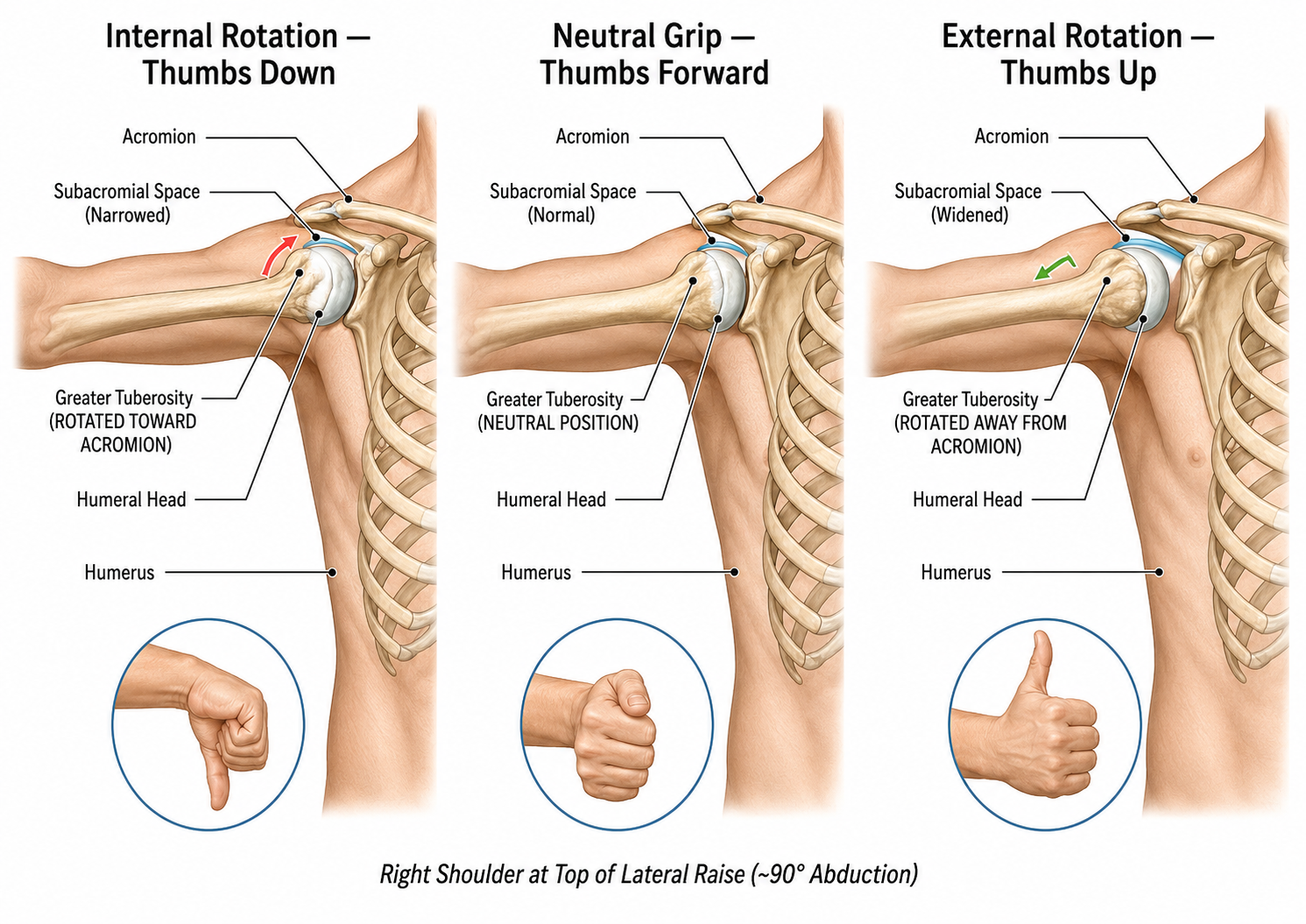
The practical recommendation: a neutral grip is the default for lateral deltoid emphasis. For lifters who feel a pinch or click at the top of the rep, slight external rotation — thumbs tilted slightly upward — may reduce compression in the subacromial space. This does increase anterior deltoid involvement, and the Coratella et al. data showed that neutral grip produced higher medial deltoid activation than external rotation. But for someone whose shoulder objects to the neutral position, external rotation is a worthwhile trade — it keeps the person training the movement rather than avoiding it.
How High Should a Lateral Raise Go?
The instruction to stop the dumbbell lateral raise at shoulder height — arms parallel to the floor — is a useful default. It is not a biomechanical law. What matters is understanding what happens at different heights so the lifter can make an informed decision.
Below about 60° of abduction, the exercise is mechanically easy with a dumbbell. The moment arm — the perpendicular distance between the shoulder joint and the line of gravity pulling on the dumbbell — is short, so the torque on the joint is low. The lateral deltoid is in a lengthened position here but under minimal external load. This is also the range where the supraspinatus is doing much of the early work.
Between roughly 60° and 90°, the moment arm is longest and dumbbell torque peaks. This coincides with high lateral deltoid activation. For most lifters, this is where the training stimulus of the exercise lives — the hardest portion of the rep, mechanically, aligned with the muscle’s strongest contribution.
Above 90°, the scapula must rotate upward for the arm to continue rising. Upper trapezius contribution often becomes more noticeable as the arm rises above parallel. The subacromial space also narrows as the arm elevates further, particularly if the arm path drifts into the true frontal plane rather than staying in the scapular plane.
For lifters with healthy shoulders and adequate scapular mobility, going moderately above parallel recruits additional upper trapezius and is not inherently dangerous. For lifters experiencing impingement symptoms — a pinch, click, or ache at the top of the rep — stopping at or slightly below parallel is a reasonable limit. The answer depends on individual shoulder structure: acromion shape (Type I, II, or III, which affects how much clearance the rotator cuff tendons have), rotator cuff health, and scapular mobility all play a role. Individuals with known rotator cuff pathology should consult a clinician before loading the shoulder in abduction.
Where the Dumbbell Lateral Raise Is Easiest and Hardest
A dumbbell lateral raise has an ascending resistance profile. When the arm hangs at the side, the dumbbell is directly below the shoulder joint — the moment arm is essentially zero, and the torque the lateral deltoid must produce is near nothing. As the arm rises toward 90°, the moment arm lengthens, and torque peaks when the arm is parallel to the floor.
The lateral deltoid’s length-tension relationship runs in the opposite direction. Research estimates that the lateral deltoid reaches the descending limb of its length-tension curve when the humerus is near the torso — meaning the muscle is in a lengthened position, past its optimal force-producing length, exactly where the dumbbell provides the least resistance. At 90°, where the dumbbell is hardest, the muscle is in a shortened position.
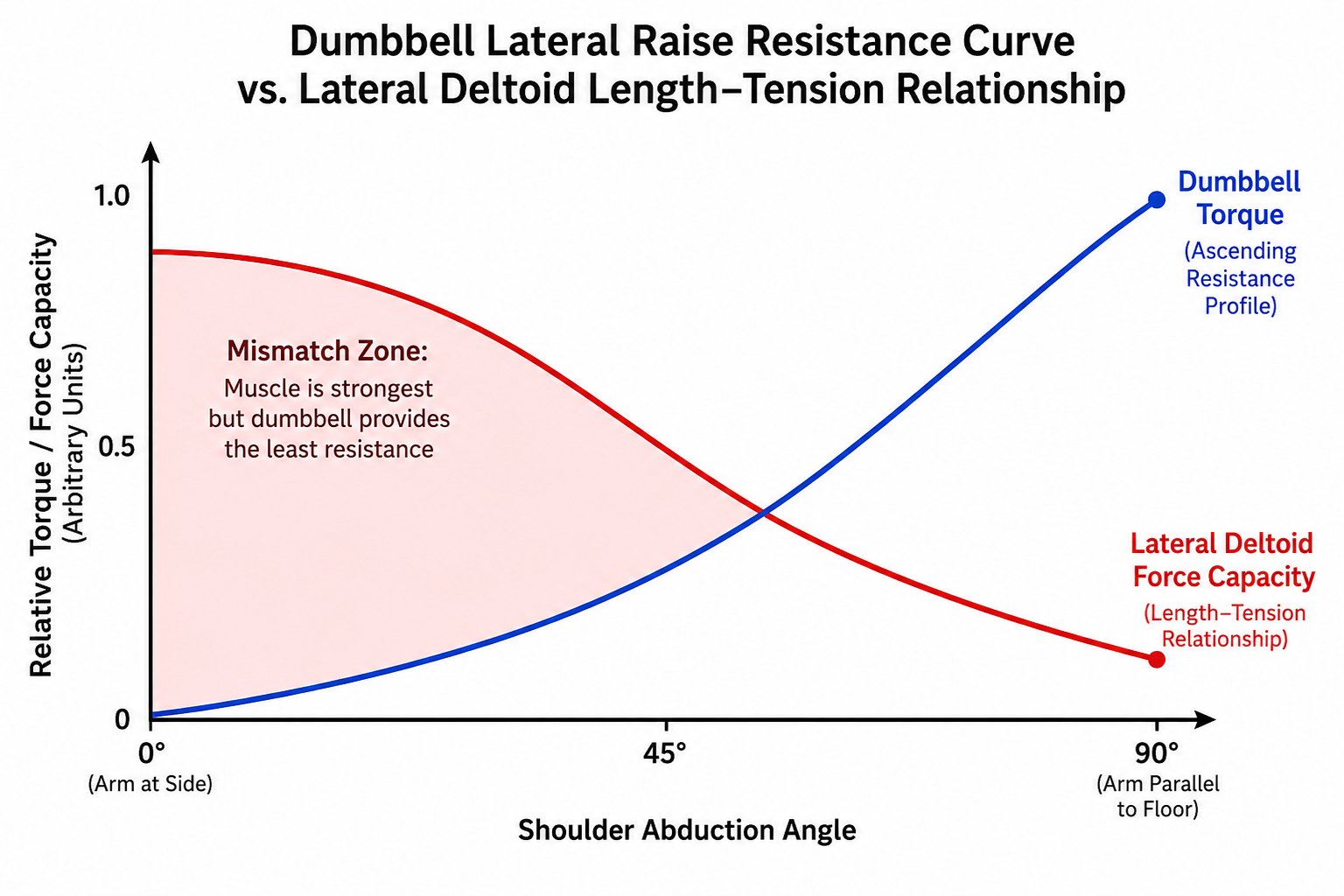
This is not a secret — it is a basic feature of how gravity-loaded abduction works. Cable lateral raises, particularly when the cable runs behind the body, and leaning lateral raises (holding a rack and leaning away) both address this mismatch by increasing tension at the bottom of the range, where the lateral deltoid is longest.
But the practical question is whether this mismatch actually limits muscle growth. Larsen et al. (2025), published in Frontiers in Physiology, compared dumbbell and cable lateral raises head-to-head over eight weeks in 24 resistance-trained men and women. Both groups trained twice per week, five sets to momentary failure, with range of motion standardized between conditions. Lateral deltoid muscle thickness increased by 3.3–4.6%, with no meaningful difference between groups. The Bayesian analysis provided moderate to extreme support for the conclusion that both tools produced equivalent hypertrophy.
The takeaway: the dumbbell lateral raise is not biomechanically inferior. Its resistance curve is a real mechanical feature worth understanding, but it does not prevent the exercise from building the lateral deltoid effectively. Cables and leaning variations are useful alternatives — particularly for lifters who want to emphasize the lengthened position — but they are alternatives, not corrections. Because this was an 8-week study in trained lifters with ultrasound measurements at two sites, it should not be treated as the final word on all lateral-raise variations — but it is the best direct comparison currently available.
Common Lateral Raise Form Mistakes and Their Causes
The most common form breakdowns in the lateral raise are not random. Each one follows a predictable mechanical pattern, and each one connects to the staging described in the earlier sections.
The shrug happens when the load is heavier than the lateral deltoid can manage through its working range. The upper trapezius — which is designed to rotate the scapula upward above 90° — gets recruited early to compensate. The visible sign is the shoulders rising toward the ears during the rep. The cue that addresses this directly: think about pushing the elbows away from the body, not lifting the hands toward the ceiling. If the shoulders still shrug, the weight is too heavy.
The swing is the body’s way of bypassing the bottom portion of the rep — the range where dumbbell torque is lowest but where initiating the movement still requires muscular effort from the supraspinatus and deltoid. Generating momentum from the hips and lower back eliminates the need for that initiation. The fix is either lighter weight or starting each rep from a dead stop — a brief pause with the dumbbells a few inches from the thighs, eliminating the stretch reflex and any stored momentum.
The wrist flip — the hand rising faster than the elbow — shifts the load toward the anterior deltoid. When the wrist leads, the movement drifts toward a partial front raise. The cue is to lead with the elbow: the elbow rises first, and the hand follows. At the top of the rep, the elbow should be at or slightly above the level of the hand.
Excessive elbow bend is a subtler compensation. A slight bend in the elbow — 10–20° — is standard and protects the elbow joint from unnecessary stress. But a deep bend, bringing the forearm significantly closer to the upper arm, shortens the lever arm. This allows heavier weight but reduces the mechanical demand on the lateral deltoid. The lifter moves more load while the target muscle does proportionally less work.
How Much Volume Does the Lateral Deltoid Need?
The lateral raise is an accessory exercise. It exists to train the lateral deltoid with more precision than compound pressing can provide. Programming it effectively means matching the rep range, volume, and frequency to the muscle group’s characteristics — and to the shoulder joint’s tolerance.
Rep ranges: 10–20 reps per set works well for most lifters. Higher reps with lighter loads are generally recommended for isolation exercises like this, where the muscle group is small and the shoulder joint’s susceptibility to impingement under heavy load favors controlled, moderate-weight sets. There is no need to train the lateral raise with sets of 3–5.
Sets per session: 2–4.
Weekly frequency: The lateral deltoid recovers relatively quickly from isolation work. Training it 2–3 times per week, with moderate volume per session, is a well-supported approach for hypertrophy. Lifters with active shoulder symptoms should start at the lower end and increase frequency based on tolerance.
Weekly volume: Approximately 8–20 sets per week across all exercises targeting the lateral deltoid, depending on training experience and recovery capacity. This range is drawn from general hypertrophy volume guidelines rather than studies on lateral deltoid volume specifically, so it should be treated as a starting framework and adjusted based on individual response.
Tempo: A controlled concentric phase (roughly 1–2 seconds up), a brief pause at the top, and a controlled eccentric (roughly 2–3 seconds down) is widely practiced. This is coaching convention, not a research-validated protocol for this specific exercise — but the principle behind it is sound: momentum negates the purpose of an isolation exercise.
Session placement: After compound pressing movements (overhead press, bench press). The lateral raise is most productive when the lateral deltoid is the limiting factor, not grip fatigue or systemic exhaustion from heavy compounds.
Progression: The dumbbell lateral raise is notoriously difficult to add weight to. A jump from 15 lb to 20 lb dumbbells is a 33% increase. Adding reps at a given weight before adding load is the more practical path. When the top of the rep range is consistently reached across all sets, the next weight increment is earned.
How to Use Lateral Raise Variations
Each variation of the lateral raise exists to address a specific limitation of the standard dumbbell version or to accommodate a specific need. Choosing between them is not about novelty.
Cable lateral raise (low pulley, cable behind the body): Provides tension at the bottom of the rep — the range where a dumbbell provides almost none. This trains the lateral deltoid in a more lengthened position, which some lifters find produces a stronger contraction and a different stimulus. Per the Larsen et al. (2025) data, it does not produce superior hypertrophy to dumbbells when effort and volume are matched, but it is a useful complement.
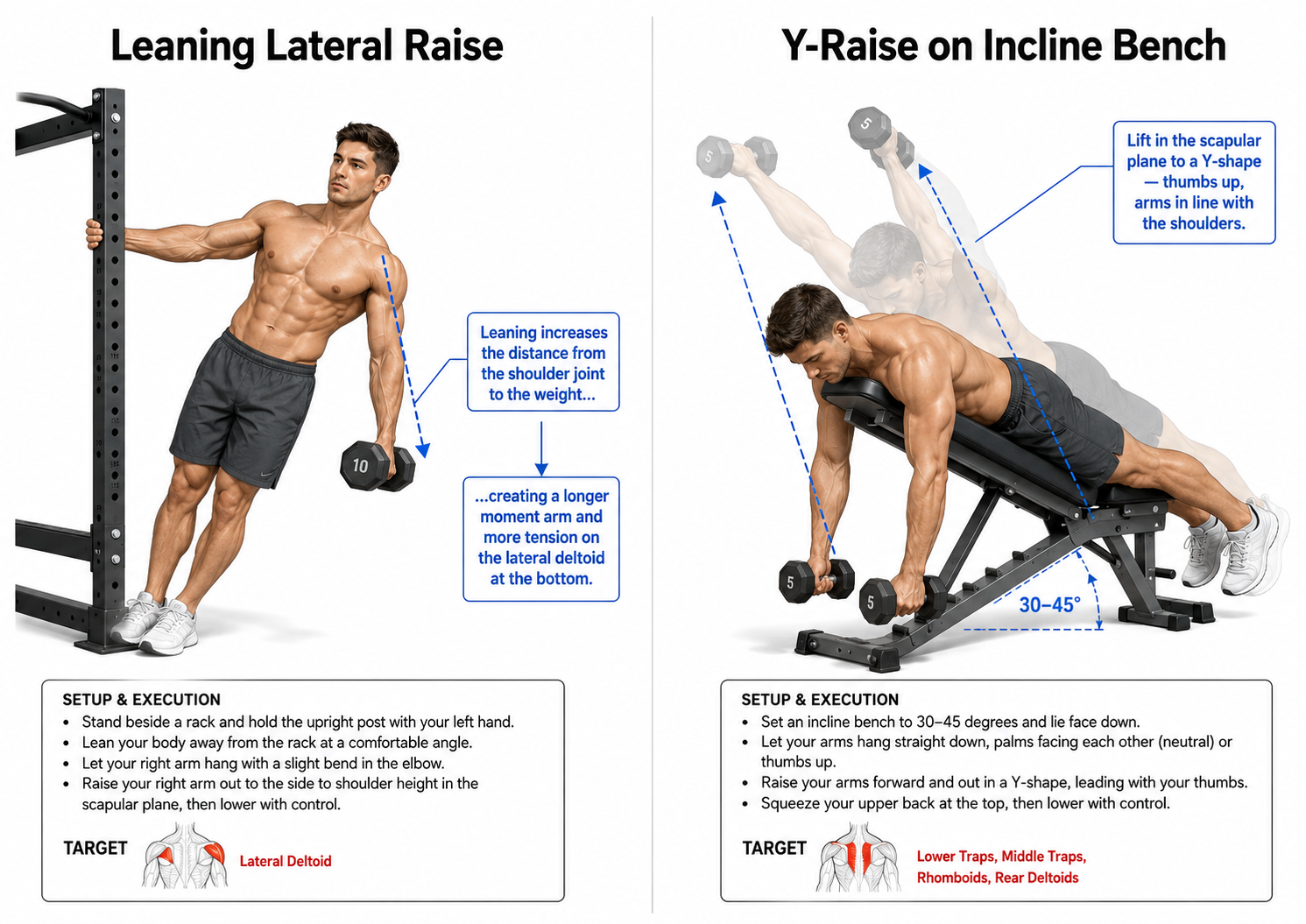
Leaning lateral raise: Holding a rack or post with one hand and leaning the body away from it increases the moment arm at the bottom of the rep — achieving a similar effect to the cable, using only a dumbbell. This is the simplest way to add lengthened-position tension without a cable machine.
Seated lateral raise: Removes the ability to generate momentum from the legs and lower back. For lifters who swing despite their best efforts to stay strict, sitting down eliminates the most common cheat. The trade-off is a slightly reduced range of motion at the bottom, since the dumbbells may contact the bench or seat.
Y-raise (prone on an incline bench): Primarily a scapular-control and lower/middle trapezius exercise rather than a direct lateral deltoid substitute. The prone position and the Y-shaped arm path position the shoulder more favorably through the range where impingement symptoms are most common, making this a shoulder-friendly accessory for lifters with sensitivity who still want to train abduction patterns.
Scapular-plane lateral raise with slight external rotation: Combining the forward arm path (scaption) with a slight thumbs-up rotation at the top may reduce compression in the subacromial space compared with a strict frontal-plane, neutral-grip raise. This is not a separate exercise so much as a combined modification for lifters who experience discomfort at the top of a standard raise. It does not replace the standard raise for those who tolerate it well.
Quick Reference: The Dumbbell Lateral Raise at a Glance
Setup: Stand with dumbbells at your sides, palms facing in (neutral grip), slight bend in the elbows (10–20°). Lean the torso forward about 10–15° — chest slightly ahead of hips.
Arm path: Raise the arms slightly in front of the torso (~20–30° forward of straight to the sides), following the scapular plane. Not a T — more of a soft V.
Grip: Neutral (thumbs forward) as the default. Slight external rotation (thumbs slightly up) if you feel a pinch at the top. Avoid internal rotation (thumbs down / “pouring water”).
Height: To approximately shoulder level (arms parallel to the floor) as a default. Moderately above if your shoulders tolerate it and you want additional upper trapezius work.
Cues: Lead with the elbows. Push them away from the body rather than lifting the hands toward the ceiling. Keep the shoulders down — if they shrug, the weight is too heavy.
Tempo: Controlled up (1–2 seconds), brief pause at the top, controlled down (2–3 seconds). No momentum.
Load: Light enough to control. This exercise punishes ego loading. Add reps before adding weight.
Sets and reps: 2–4 sets of 10–20 reps, 2–3 times per week.
When in a session: After compound presses.
If it hurts: Shift the arm path forward. Try slight external rotation. Reduce the weight. Reduce the height. If sharp or persistent pain continues, consult a clinician — do not train through it.

Introduction
The dumbbell lateral raise is a simple yet highly effective shoulder exercise that targets the lateral deltoid, helping you achieve broader, more defined shoulders. By lifting the dumbbells to the sides, this movement isolates the shoulder muscles, providing strength and sculpting benefits without requiring complex equipment. Whether you want to enhance your upper body strength or build better shoulder definition, the dumbbell lateral raise should be part of your routine.
Instructions
- Starting Position: Stand with your feet shoulder-width apart, holding a dumbbell in each hand at your sides with a slight bend in your elbows.
- Lifting Phase: Engage your core, keep your back straight, and slowly lift the dumbbells to the sides until your arms are parallel to the floor. Keep a slight bend in your elbows and avoid shrugging your shoulders.
- Lowering Phase: Slowly lower the dumbbells back to the starting position, controlling the movement as you do so.
- Repetitions: Aim for 3 sets of 10–15 repetitions, resting 30–60 seconds between sets.
Performance Tips
- Control the Movement: Don’t swing the dumbbells. Use controlled movements to ensure your shoulders are doing the work.
- Maintain Posture: Avoid leaning back or forward. Keep your back straight throughout the exercise.
- Light Weights for Form: Start with light weights and focus on proper form before increasing the load.
- Breathe: Exhale as you lift the dumbbells and inhale as you lower them.
Pros
- Targets Shoulders: Focuses on the lateral deltoids for more defined shoulders.
- Improves Posture: Strengthens shoulder muscles that contribute to better posture.
- Low Impact: Easy on the joints and accessible for most fitness levels.
- Minimal Equipment: Only requires a pair of dumbbells.
Cons
- Risk of Injury: Poor form or heavy weights can strain the shoulders.
- Limited Muscle Engagement: Mainly targets the lateral deltoids, so other shoulder muscles might need separate exercises.
- Requires Control: Without proper control, momentum can take over, reducing effectiveness.