Decline Bench Sit-Ups: The Spinal Tradeoff Worth Understanding
The exercise loads your abs and your lumbar spine — here’s what the research says about that tradeoff and how to decide if it belongs in your program
Decline bench sit-ups are one of the most common core exercises in commercial gyms. The bench is standard equipment. The movement is intuitive — lie back, curl up, repeat. The basic setup, muscles, and form cues are straightforward.
A fuller discussion also needs to address that prominent researchers in spinal biomechanics have spent two decades studying whether loaded spinal flexion — the movement category sit-ups belong to — carries a mechanical cost to the lumbar spine. The findings don’t condemn the exercise. They don’t clear it either. They raise a question worth understanding before deciding how — or whether — to include it.
This article covers the exercise directly: what it does, what the research says about the forces it produces, who should avoid it, how to perform it with the tradeoff in mind, and what alternatives exist for those who make a different choice.
What Happens During a Decline Bench Sit-Up
The decline positions the torso below the hips, which increases gravitational resistance compared to a flat sit-up. That’s why the exercise feels harder — the abs and hip flexors are working against a longer moment arm.
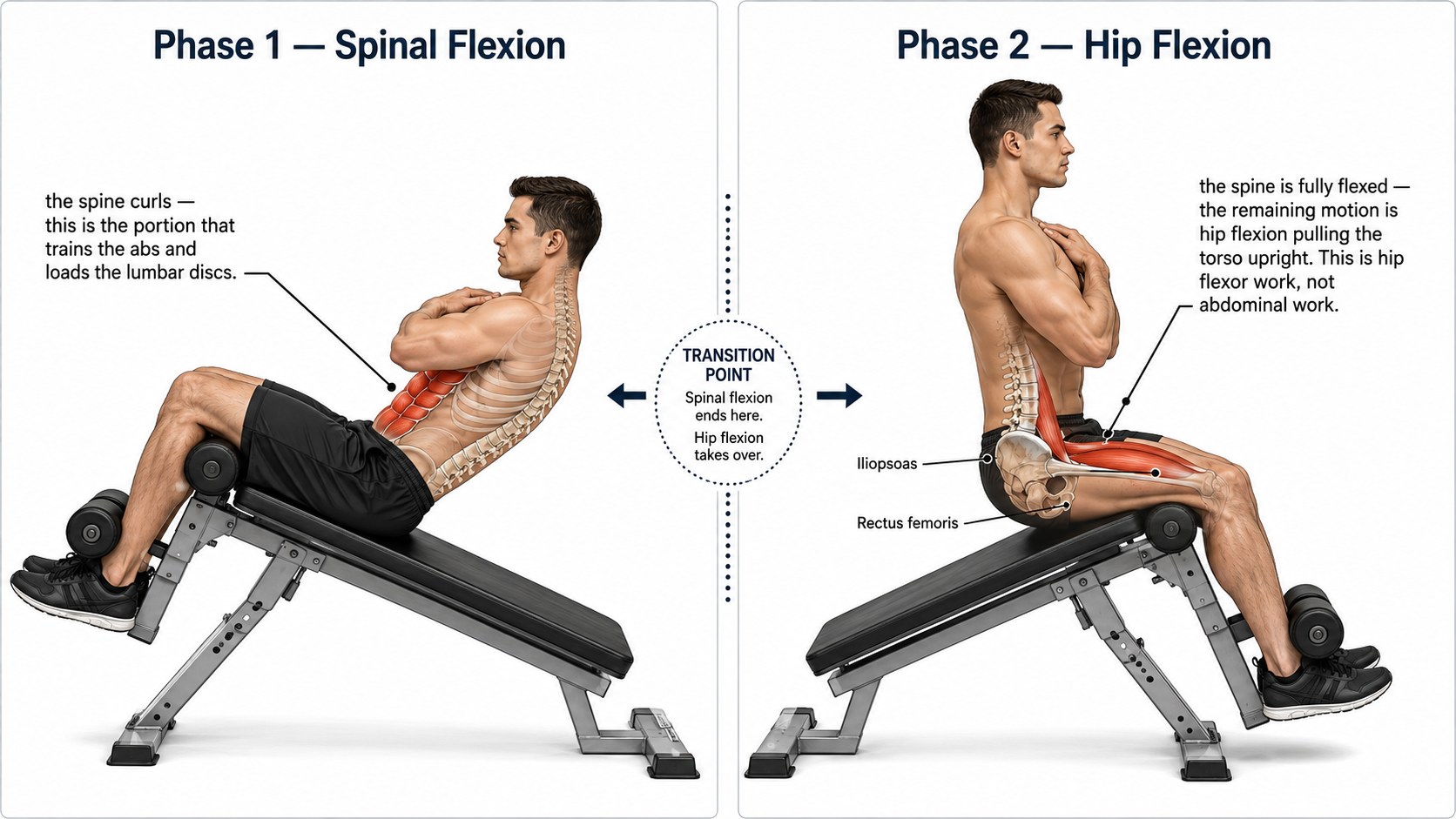
The movement has two overlapping demands, and understanding how the emphasis shifts as the rep progresses changes how you think about the exercise.
The first demand is spinal flexion. The rectus abdominis contracts to curl the upper back off the bench, rounding the spine forward. This is the portion of the movement that directly trains the abs. It’s also the portion that loads the lumbar discs.
The second demand is hip flexion. As the torso rises and spinal flexion reaches its practical limit, the emphasis shifts toward the hip flexors, primarily the iliopsoas and rectus femoris, pulling the torso upright. This phase is less direct dynamic abdominal work — the hip flexors become the primary movers while the abdominals continue to stabilize. And in many people, particularly at steeper decline angles, the hip flexors contribute more to the total movement than most exercisers realize.
The obliques stabilize the trunk throughout both phases. The abdominals and hip flexors eccentrically control the descent, with the spinal extensors contributing to trunk stiffness and control.
This distinction matters because the exercise is often treated as a pure ab movement. It isn’t. It’s a combined spinal flexion and hip flexion exercise, and the ratio between the two shifts depending on the angle of the bench, the speed of the movement, and how the person initiates the rep.
Many adjustable decline benches offer settings from a shallow decline to a steep one. A 15–20° decline is a conservative starting point.
What the Research Says About Spinal Flexion Under Load
This is the key tradeoff to understand before programming decline bench sit-ups.
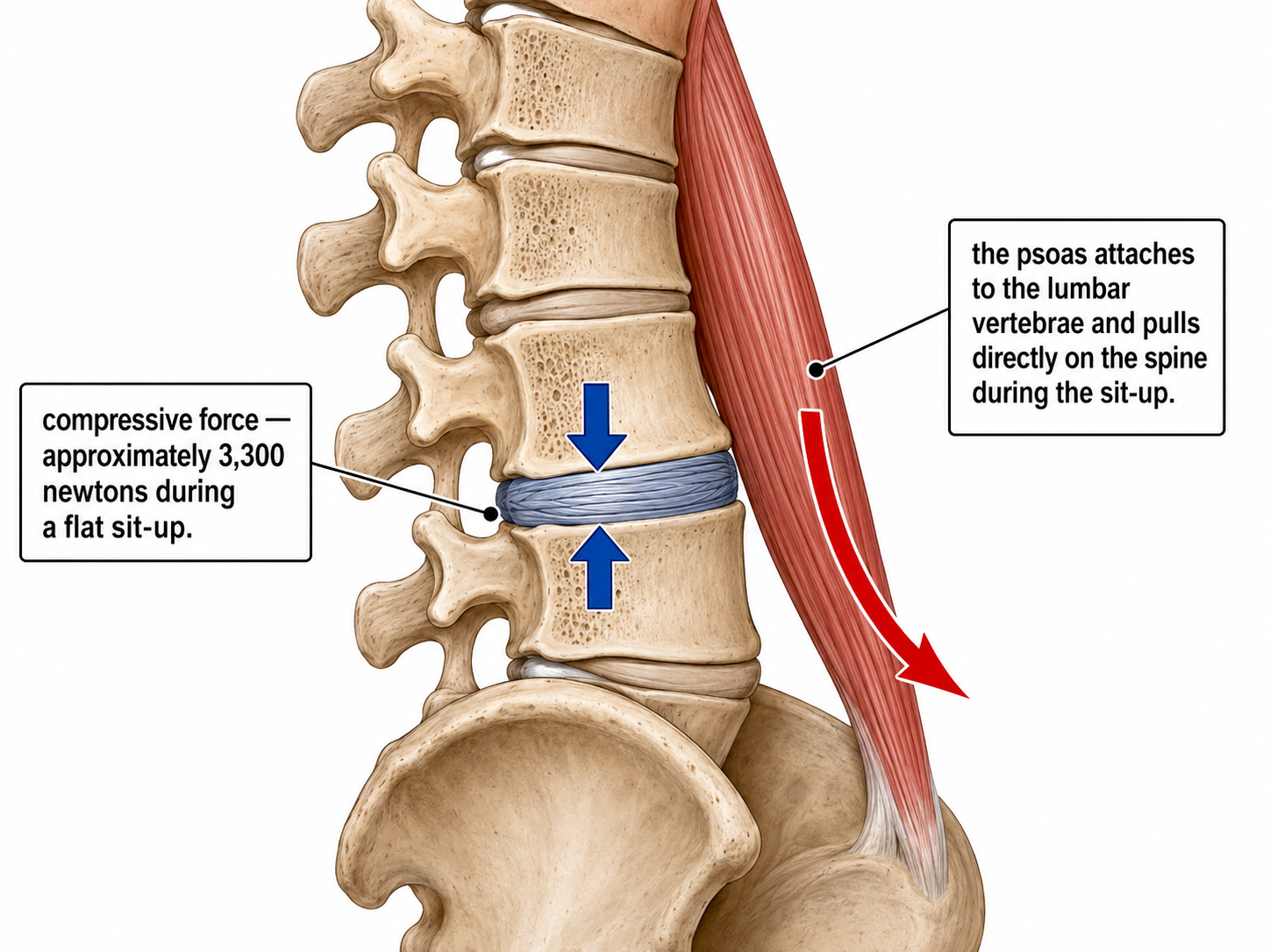
Stuart McGill, a professor of spine biomechanics at the University of Waterloo, conducted some of the most cited research on spinal loading during core exercises. His laboratory work demonstrated that standard flat sit-ups generate approximately 3,300 newtons of compressive force on the lumbar spine. For context, this is close to the 3,400-newton compression criterion used in the NIOSH lifting-equation literature for occupational low back risk. The psoas likely contributes meaningfully to this load because it attaches to the lumbar spine and is active during sit-ups, pulling on the vertebrae during the upward phase.
In a frequently referenced in-vitro study, Callaghan and McGill (2001) subjected porcine spines to repeated flexion-extension cycles under compressive load. Over many cycles, the disc nucleus migrated posteriorly through the annular fibers, eventually producing herniation. This was an in-vitro animal model using repeated cycles far beyond typical exercise volume, so it supports a plausible mechanism rather than proving that ordinary sit-up programming causes herniation in humans. In a U.S. Army trial (Childs et al., 2010), replacing traditional sit-up training with core-stabilization work did not increase injury incidence and showed marginal evidence of fewer low-back work-restriction days, while preserving sit-up test performance.
These findings are real and worth taking seriously. They are also not the full picture.
Contreras and Schoenfeld (2011) published a peer-reviewed evidence review examining the risks of spinal flexion exercises and raised important qualifications. The porcine models use cadaveric tissue — tissue that cannot remodel, adapt, or recover the way living human tissue does. Living discs are hydrophilic; they undergo fluid exchange during loading and unloading cycles, which cadaveric tissue does not. Compressive forces and lumbar flexion occur in many common activities and sports, not only in sit-ups. Greg Lehman’s analysis of the available epidemiological data notes that sports involving significant spinal flexion have not consistently shown higher rates of low back pain than sports performed in more neutral spinal positions — though this observation represents his synthesis of multiple sources, not a single definitive study.
The evidence does not prove that sit-ups will herniate a disc. It also does not prove they are safe for everyone at any volume. The honest position is that repeated loaded spinal flexion can carry a cumulative mechanical cost, especially when volume, load, timing, or existing spinal sensitivity are unfavorable.
What does this mean for decline sit-ups specifically? The decline does not inherently increase the range of lumbar spinal flexion. What changes is the gravitational resistance during the spinal flexion phase, because the torso starts below horizontal and works against a longer moment arm. The total range of motion also increases through additional hip flexion. This means the compressive forces during the spinal flexion portion are likely higher than in a flat sit-up, though specific force measurements for the decline variation have not been published to my knowledge.
Who Should Avoid Decline Bench Sit-Ups
Some situations make this exercise clearly inappropriate.
People with symptomatic or clinically relevant disc herniations, disc bulges, active low back pain, osteoporosis, or a history of spinal surgery should not perform decline bench sit-ups without clearance from a clinician. People with diastasis recti should seek clinical guidance before performing any loaded spinal flexion exercise.
During pregnancy, the combination of spinal flexion, abdominal loading, and supine positioning — which may compress the vena cava especially after about 20 weeks of gestation — makes this exercise inappropriate without clinical clearance.
High-volume protocols increase cumulative loading risk. Military fitness testing, where sit-ups are performed at maximum volume under time pressure, represents the high end of that exposure. There’s a difference between three controlled sets of ten and a two-minute max-rep test.
Timing matters too. Performing spinal flexion exercises first thing in the morning, when the discs are maximally hydrated and the annular fibers are under greater stress, increases risk. McGill’s research specifically supports this concern. Waiting at least an hour after waking before performing loaded flexion exercises is a straightforward precaution.
One factor worth considering: many desk workers accumulate long-duration seated flexion exposure, especially in slouched postures. Adding loaded flexion exercise at the gym increases total daily flexion exposure. This doesn’t make the exercise forbidden, but it’s relevant information for people deciding how much spinal flexion work to include.
Anyone who experiences pain during the exercise — particularly pain that radiates into the leg, numbness, or tingling — should stop and seek assessment from a clinician or physical therapist. These symptoms may indicate nerve involvement that a form correction will not resolve.
How to Perform Decline Bench Sit-Ups
For readers who have the information above and choose to include the exercise, here’s how to do it with the tradeoff in mind.
Set the bench at a moderate decline — 15 to 20 degrees. Steeper angles increase gravitational resistance and likely increase compressive force on the spine. A steeper angle is not automatically better. Secure your feet under the pads.
Cross your arms over your chest. Placing hands behind the head encourages pulling on the cervical spine during the effort phase, which strains the neck and adds nothing to the abdominal work.
Initiate the movement by curling the spine — not by jerking the torso upright. Think about bringing the ribcage toward the pelvis, one vertebra at a time. This keeps the rectus abdominis as the primary driver during the first phase. Once the spine is fully flexed, the hip flexors will take over to bring you upright. That’s the natural mechanics of the movement — the goal isn’t to eliminate hip flexion but to make sure the abs do their work first.
Control the eccentric phase. Lower yourself back to the bench slowly, resisting gravity throughout the descent. Dropping back onto the bench wastes the eccentric loading that contributes to both strength and control, and it removes the muscular braking that protects the spine.
Keep volume moderate. Given the compressive loading this exercise produces, it benefits from lower-rep, controlled sets rather than high-rep endurance circuits. Two to three sets of eight to twelve controlled repetitions is a reasonable starting point.
Breathe out as you curl up. Breathe in as you lower. With heavier loading (weighted variations), holding a brace through the hardest portion and exhaling near the top gives the spine more stability.
If your lower back aches during or after the exercise, that is information. It may mean the form needs correction — often the initiation is too fast or the angle is too steep. It may also mean the exercise is not appropriate for your spine at this volume or angle. Pain is not a cue to push harder. It’s a cue to reassess.
Progression: increase the decline angle only when you can complete the current angle with controlled movement, no lower back discomfort, and without the hip flexors dominating the movement from the start. Adding external load — a weight plate held at the chest — increases both the training stimulus and the compressive force. Add weight conservatively and only at moderate angles. If adding angle or weight produces lower back symptoms, that is information about your spine’s tolerance, not a challenge to work through.
Alternatives That Train the Core With Less Repeated Lumbar Flexion
For readers who read the evidence and decide the tradeoff isn’t favorable — or who want options to rotate alongside decline bench sit-ups — several exercises train the rectus abdominis and the broader core with less repeated lumbar flexion.
The McGill curl-up is the most directly relevant alternative. Popularized by McGill as a way to train the abdominal wall while limiting lumbar motion and compression, it uses partial spinal flexion with one knee bent and the hands placed under the lumbar spine to maintain the natural curve. The range of motion is small. The abdominal activation is not.
Dead bugs train anti-extension — the ability to resist the spine from arching under load — while the limbs move through hip and shoulder flexion. The spine stays neutral throughout. This is a fundamentally different demand than a sit-up, and it trains a core function (resisting unwanted movement) that sit-ups don’t address.
The Pallof press trains anti-rotation — resisting a lateral pull without letting the trunk twist. Again, the spine stays neutral while the core works.
Ab wheel rollouts are anti-extension under progressive load. As the wheel rolls forward, the core has to prevent the spine from collapsing into extension. The loading can be significant, but it doesn’t involve the repeated flexion-extension cycles that the sit-up concern is built around.
Hanging leg raises are hip-flexion dominant and keep the spine closer to neutral — but with an important caveat. If the pelvis posteriorly tilts at the top of the movement to bring the legs higher, the spine will flex. Limiting the range to below 90 degrees of hip flexion can help keep lumbar motion lower if the pelvis stays controlled and neutral. Going beyond that reintroduces the same loading pattern the reader may be trying to avoid.
These are not consolation exercises. Each trains a core function that the decline sit-up does not: anti-extension, anti-rotation, or abdominal activation with controlled spinal position. A program that includes these alongside or instead of sit-ups produces a more broadly capable core than one built on flexion alone.
Making the Decision
The decline bench sit-up is not a categorically dangerous exercise. It is not a risk-free exercise either. It loads the rectus abdominis through spinal flexion and the hip flexors through hip flexion, and it places compressive force on the lumbar spine that likely increases with steeper decline angles and added weight.
Whether that tradeoff is acceptable depends on your spinal health, your training history, how much flexion your day already involves, the volume you plan to do, and whether alternatives that train the same muscles with less repeated lumbar flexion would serve you equally well.
The decline bench sit-up is often treated as a straightforward ab exercise, but mechanically it is more complex. Now you have both sides, and the decision is yours.

Quick Reference — At the Bench
Do Not Use If: You have active low-back pain, symptomatic disc issues, osteoporosis, recent spinal surgery, pregnancy without clinical clearance, or radiating pain/numbness/tingling.
Setup
- Set the bench to 15–20 degrees. Steeper angles likely increase spinal loading because they increase the resistance demand.
- Secure your feet under the pads.
- Cross your arms over your chest. Do not place your hands behind your head.
Performing the Sit-Up
- Curl the spine first — bring the ribcage toward the pelvis, one vertebra at a time. This is the ab work.
- As you rise, the emphasis shifts from spinal flexion toward hip flexion. That transition is normal.
- Lower back to the bench slowly, resisting gravity the entire way. Do not drop.
Breathing
- Exhale as you curl up.
- Inhale as you lower.
- With added weight: hold the brace through the hardest portion and exhale near the top.
Volume
- 2–3 sets of 8–12 controlled repetitions.
- This is a strength exercise under spinal load. Keep reps moderate.
- Avoid loaded spinal flexion first thing in the morning; wait at least an hour after waking.
Mistakes to Avoid
- Jerking the torso upright instead of curling the spine first.
- Using momentum or swinging the arms.
- Letting the hip flexors dominate the movement from the start — if you feel the work only in the front of your hips, reduce the angle.
- Performing high-rep sets. Volume increases cumulative spinal loading.
Progression
- Increase decline angle only when you can complete the current angle with control, no lower back discomfort, and without hip flexors taking over from the start.
- Add weight (plate held at chest) conservatively and only at moderate angles.
- If adding angle or weight produces lower back symptoms, treat that as your current tolerance limit — not a challenge to push through.
Stop Immediately If
- Pain radiates into the leg.
- You feel numbness or tingling.
- Lower back pain sharpens during the exercise, or symptoms worsen afterward.
- Do not resume if symptoms persist, radiate, or include numbness/tingling until assessed by a clinician or physical therapist.