In Tree Pose (Vrikshasana), balance isn’t stillness — it’s constant, invisible corrections, and tree pose trains every one of them. You stand on one leg, place your foot, find your gaze point, and for three seconds everything is fine. Then the wobble starts. Your ankle twitches. Your hip shifts. You fall out. You step back up, and it happens again.
The pose looks calm from the outside. In your body it feels like controlled panic. Most people’s relationship with tree pose is this cycle of brief stillness followed by perceived failure — a test you keep taking and keep not quite passing.
But the wobble isn’t the failure. The wobble is the exercise.
Understanding why — understanding what your body is actually doing when it stands on one leg — turns tree pose from a frustrating test into one of the most useful practices yoga offers.
What Balance Actually Is
Here is the thing that changes everything about how you practice this pose: balance is not stillness. It is constant, active, invisible movement.
Even standing on two feet with your eyes open, your body is making continuous micro-corrections — small shifts at the ankle, tiny adjustments in the trunk — to keep your center of mass over your base of support. You can feel this for yourself right now. Stand up. Close your eyes. Notice the sway you never noticed before. That sway is not a problem. It is your balance system working.
In tree pose, you’ve removed one foot from the ground, reduced your base of support to a single foot, and shifted your center of mass sideways. The corrective work the body has to do increases dramatically. The wobble you feel is that work becoming large enough for you to notice. It’s not a sign of failure. It’s the sound of the system training.
The Three Systems That Keep You Upright
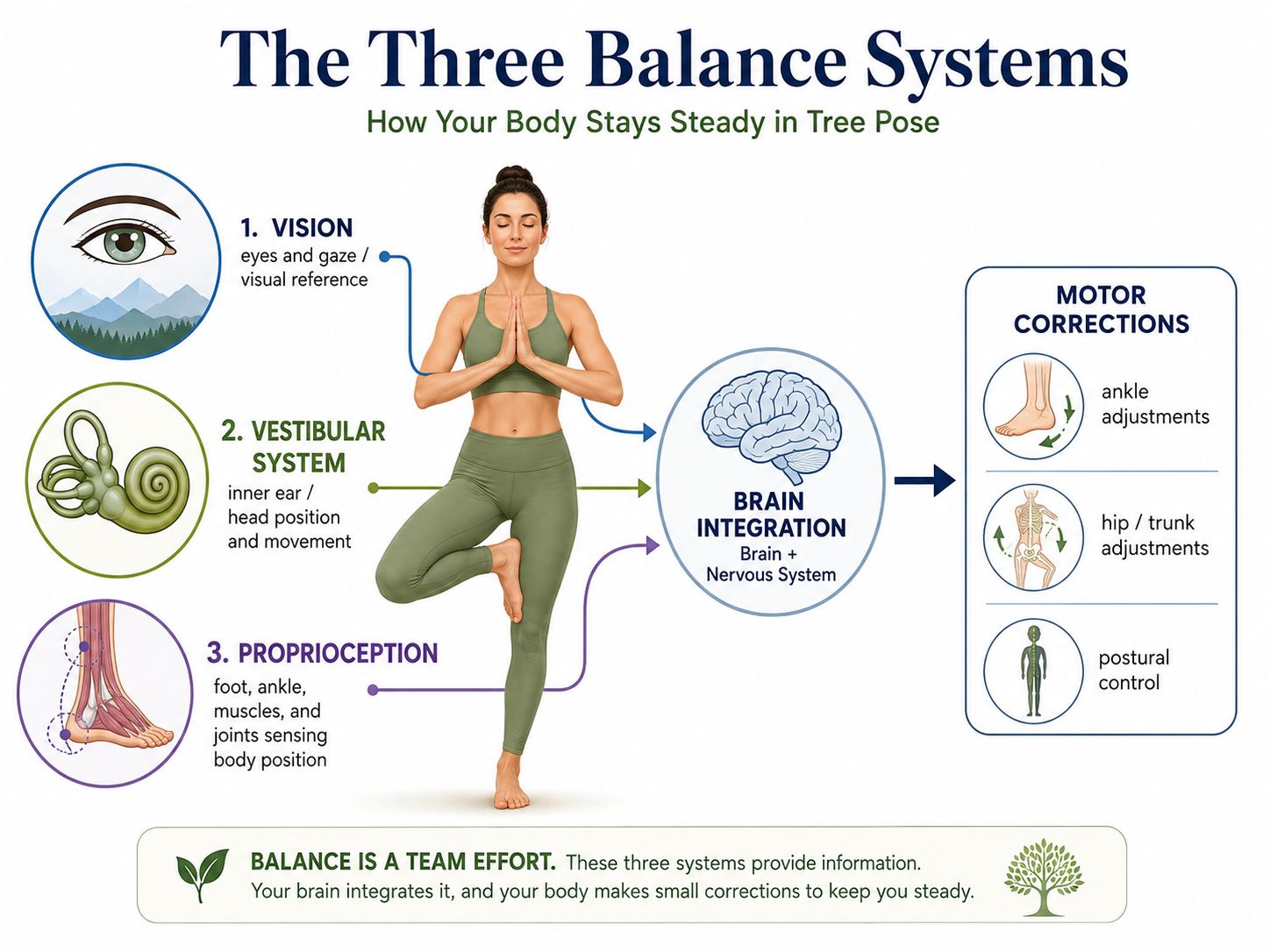
Your body maintains balance through three parallel inputs, and understanding them is the key to understanding everything that happens in tree pose.
The first is vision. Your eyes report where you are relative to the environment — the walls, the floor, the horizon. This is why staring at a fixed point helps you balance, and why looking around makes you wobble.
The second is the vestibular system. Fluid-filled structures in your inner ear detect head position and acceleration. They tell your brain which way is up and whether you’re tilting, even in the dark.
The third is proprioception. Sensors in your muscles, tendons, and joints report where your body parts are in space without you needing to look at them. Your standing ankle is loaded with proprioceptors, and they’re providing continuous sensory feedback in tree pose — reporting the angle of the joint, the pressure under the foot, the direction of sway, all in real time.
Your brain integrates all three inputs to produce the corrective responses that keep you standing. In two-legged standing, the system runs comfortably — the base is wide, the three inputs agree, and corrections are tiny. In tree pose, the system is under real demand. The base is a single foot, the center of mass has shifted, and the corrections have to be faster, larger, and more accurate. This is why tree pose trains balance — not because standing still on one leg is inherently virtuous, but because it demands more from these three systems than most stationary activities in your day.
The Ankle Strategy — Where Most of the Work Happens
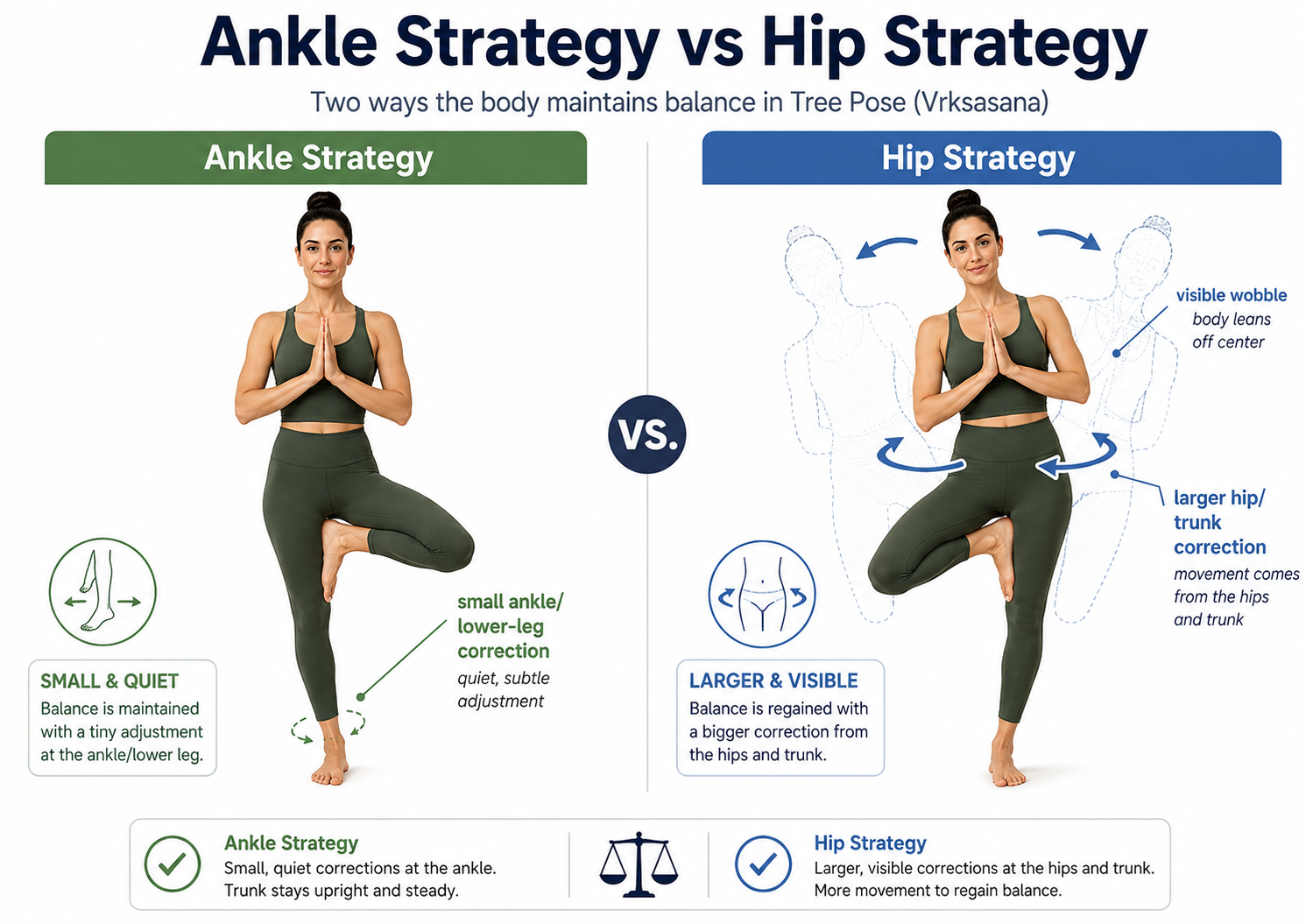
In balance science, the common mechanism for maintaining standing balance during small perturbations on a firm surface is called the ankle strategy. The muscles of the lower leg — particularly the calf muscles and the muscles along the shin — make rapid, small adjustments to shift your center of pressure forward and back under your foot. These corrections are continuous and largely automatic, running below conscious awareness. You don’t decide to make them. Your nervous system handles it.
In tree pose, the ankle strategy is a major contributor — but because the base of support is a single foot and the demands are high, the body also recruits hip and trunk corrections more than it would in ordinary two-legged standing. The ankle musculature is making constant corrections to keep the center of mass over the standing foot, but the hips and trunk are contributing too, especially as fatigue sets in or the wobble gets larger.
When the perturbation gets too large for the ankle to handle alone — a bigger sway, a shift you can’t recover from at the ankle — the body shifts to what’s called a hip strategy. This is a larger, more visible correction involving trunk and hip movement. That bigger wobble you sometimes feel in tree pose, the one where your whole body adjusts, is the hip strategy kicking in when the ankle corrections weren’t enough.
Neither is wrong. Neither means you’re failing. Both are your balance system doing exactly what it’s designed to do, at different scales of challenge.
Why Closing Your Eyes Makes Everything Harder
This is where the three-system model becomes practical.
When you close your eyes in tree pose, you remove one of the three balance inputs entirely. Vision is gone. The vestibular system and proprioception have to do the work that three systems were sharing. The result is immediate and dramatic — the wobble increases, the corrections get larger, the pose gets much harder. If you’ve ever tried closing your eyes in tree pose and been shocked by how quickly you fell out, now you know why. You didn’t suddenly lose your balance. You lost one of the three inputs your balance system was relying on — and the remaining two had to pick up the work without preparation.
This is also why a steady gaze point — what yoga calls a drishti — helps so much. A fixed visual reference gives the visual system a stable anchor to report against, making the brain’s integration job easier. A moving target, a wandering gaze, or a gaze point too close to your face all degrade the quality of that input and make the pose harder.
Many common modifications in tree pose can be understood through this lens. Closing your eyes removes vision. Looking around disrupts it. Standing on a soft surface challenges proprioception by making the ground less predictable. Each one selectively loads a different input, forcing the remaining systems to compensate. Not every modification works this way — using a wall for hand support, for example, adds a stability input rather than removing one — but the principle holds for a wide range of the pose’s variations. Once you see this, you can design your own progression: start with eyes open and a fixed gaze, then soften the gaze, then close the eyes. Each step is a deliberate, targeted increase in difficulty.
How to Practice Tree Pose — With the Mechanism in Mind
Start in mountain pose. Stand with your feet together or hip-width apart. Feel the sway — it’s there, even on two feet. That’s your baseline.
Shift your weight onto one foot. Before you even place the other foot, pause here. Feel the corrections increase. The standing ankle is already working harder. This transition — the weight shift — is where many people rush, and it’s worth slowing down.
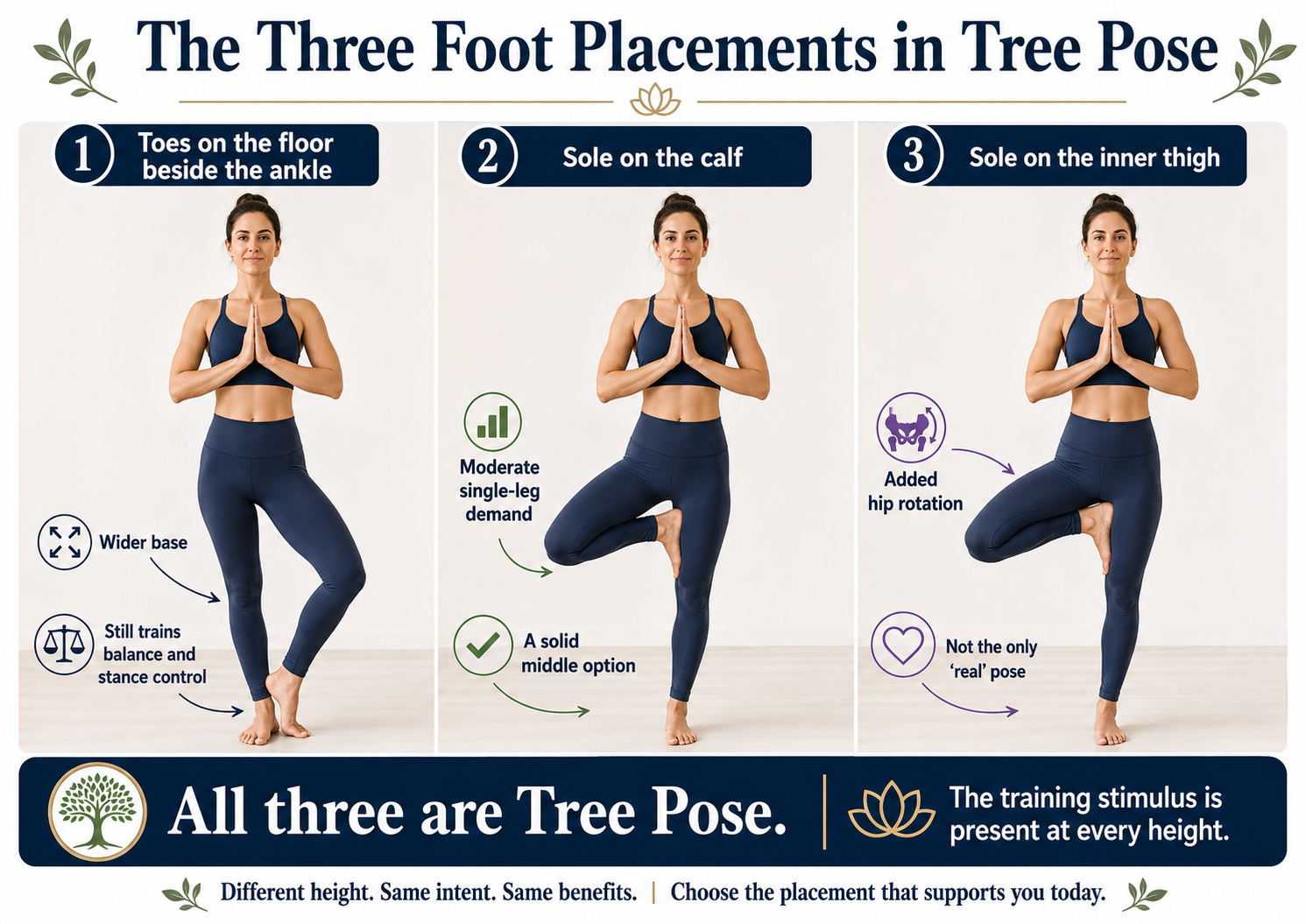
Now place your other foot. There are three honest positions, and all of them are tree pose: toes on the floor beside the standing ankle with the heel resting against it, sole of the foot against the inner calf, or sole of the foot against the inner thigh. Never on the knee — the lateral pressure on a joint designed primarily for flexion and extension is biomechanically unfavorable, and avoiding it is a widely taught precaution across yoga traditions.
Find a fixed gaze point — something stationary, about six to ten feet in front of you, roughly at eye level or slightly below.
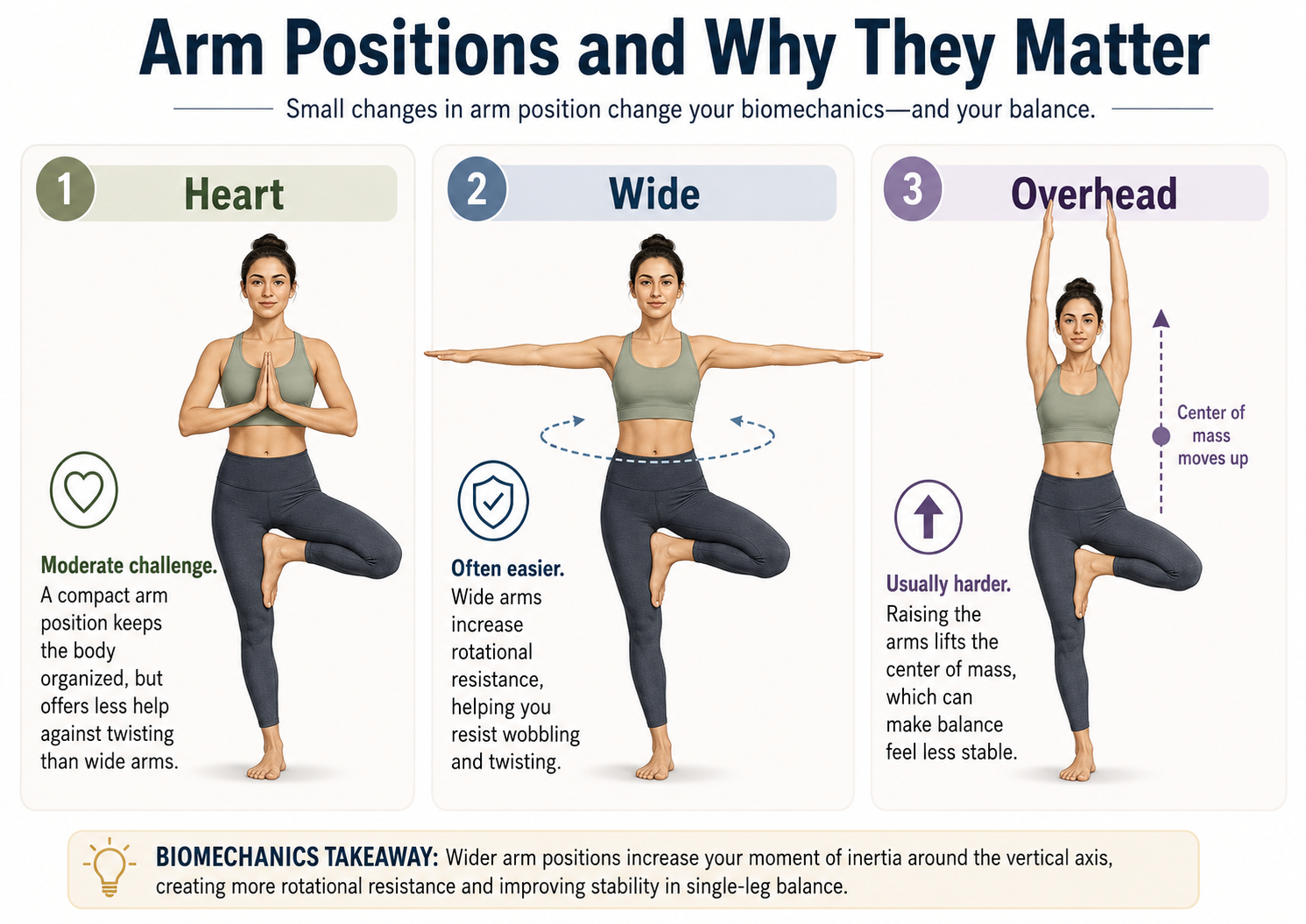
Hands at the heart, out to the sides, or overhead. Each position changes the balance demand. Arms wide increase your rotational resistance — like a tightrope walker’s pole — which can help with stability. Arms overhead raise the center of mass and ask more of the ankle. Pressing the palms together at the heart is the most common starting point.
Press the foot into the leg and the leg into the foot. This mutual resistance helps create stability in the pose — it’s one of the most effective cues for feeling steadier, and it works immediately for most people.
Keep the standing knee active and slightly engaged, not locked or pushed into hyperextension. Breathe steadily. Hold for five to ten breaths, then step back to mountain pose and repeat on the other side.
And when you wobble — you will — don’t treat it as a mistake. Feel the correction happening at the ankle. Feel the hip strategy kick in if the wobble gets bigger. That correction is the practice. The pose is working.
Why the Foot Placement Matters Less Than You Think
The foot-on-thigh version is the one on every magazine cover. But the foot-on-calf version and the toes-on-the-ground version train the same three balance systems. The training stimulus is present at every height.
A foot on the thigh adds a hip external rotation demand and raises the center of mass slightly, increasing the difficulty. It also requires more hip mobility — if you force the knee out to the side past what the hip allows, the pelvis twists and balance gets harder, not better. A foot on the calf keeps the hip demand simpler and lets you focus on the balance work. Toes on the ground provides a wider effective base and is a legitimate starting point, not a consolation prize.
All three are tree pose. Your balance system is being challenged regardless of where the foot lands — the challenge scales, but it doesn’t disappear. Choosing the foot position that lets you hold the pose with a steady breath, an active standing leg, and an open chest is a better practice than forcing a thigh placement that has you falling out every three seconds.
When to Modify and When to Stop
Tree pose is accessible, but a few situations call for care.
The foot-on-knee placement is a precaution to avoid. The lateral pressure on a joint designed for flexion and extension is biomechanically unfavorable. Above or below the knee, never on it.
If you have ankle or knee pain that sharpens in the pose, come out. People with dizziness, vertigo, or vestibular conditions should practice near a wall or with a hand on a chair — the balance challenge is still present, and the support prevents falls. Anyone experiencing acute vestibular symptoms — room spinning, sudden onset dizziness, nausea with head movement — should not practice balance poses until cleared by a clinician. Those with low blood pressure should transition in and out of the pose carefully to avoid lightheadedness. People with spinal disorders or active joint inflammation should work with a qualified teacher who can modify the pose appropriately.
People with peripheral neuropathy — reduced sensation in the feet — face a specific challenge in tree pose: the proprioceptive input the pose relies on is already impaired. Practice near a wall or with a chair, and work with a physical therapist who understands the condition. Anyone recovering from recent ankle, knee, or hip surgery, or anyone with severe balance instability, should get clearance from a clinician or physical therapist before attempting single-leg balance work.
If you practice the eyes-closed variation, do so near a wall or stable support. Removing visual input dramatically increases fall risk, and what feels like a gentle wobble with eyes open can become a full loss of balance with eyes closed.
High blood pressure: traditional yoga teaching advises keeping arms at heart level rather than overhead. This is widely repeated guidance; whether it applies to you is a question for your clinician. Migraine and insomnia are also traditionally listed as precautions for this pose — the clinical basis is unclear, but the caution is worth noting if either affects you.
Pregnancy: use wall support for stability.
Older adults stand to gain from including tree pose in a broader balance practice. Systematic reviews of yoga programs that include single-leg balance postures have found evidence of improved balance outcomes in healthy populations, though study quality varies and the evidence does not prove that tree pose alone prevents falls. If you’re in this group, practicing near a wall or stable support is a smart default.
People with glaucoma should be aware that the main yoga-related evidence concerns head-down positions that can temporarily increase intraocular pressure — upright tree pose is not among them. However, if glaucoma or any visual-field loss affects your balance, practice near a wall or support and ask your eye clinician about any yoga restrictions. People with other chronic conditions or recent injuries not covered above should consult a clinician before practicing. And the broader point: yoga practice is not a substitute for medical evaluation for persistent pain, radiating symptoms, numbness, tingling, dizziness, or chest symptoms.
What the Wobble Was Always Telling You
The wobble was never the enemy. It was the whole point.
Tree pose doesn’t test whether you can stand perfectly still. Nothing in your body is ever perfectly still. It trains the speed, accuracy, and coordination of the three systems that keep you upright every minute of every day — vision, the vestibular system, and proprioception. Every second you spend in the pose, those systems are working, adapting, getting better at the job.
The quieter the pose looks from the outside, the faster the corrections are happening inside. Stillness is not the absence of movement. It’s the presence of very fast, very small movement that you’ve trained so well it becomes invisible.
And the only way to train that is to stand on one leg and let the wobble do its work.

Tree Pose (Vrikshasana) – A balance pose that strengthens the thighs, calves, ankles, and spine while helping with balance and focus.