The deltoid does the smallest share of the work exactly where the lateral raise begins — and that one fact explains nearly every cue you’ve ever been given
You do lateral raises to build the side of your shoulders. You feel them in your neck.
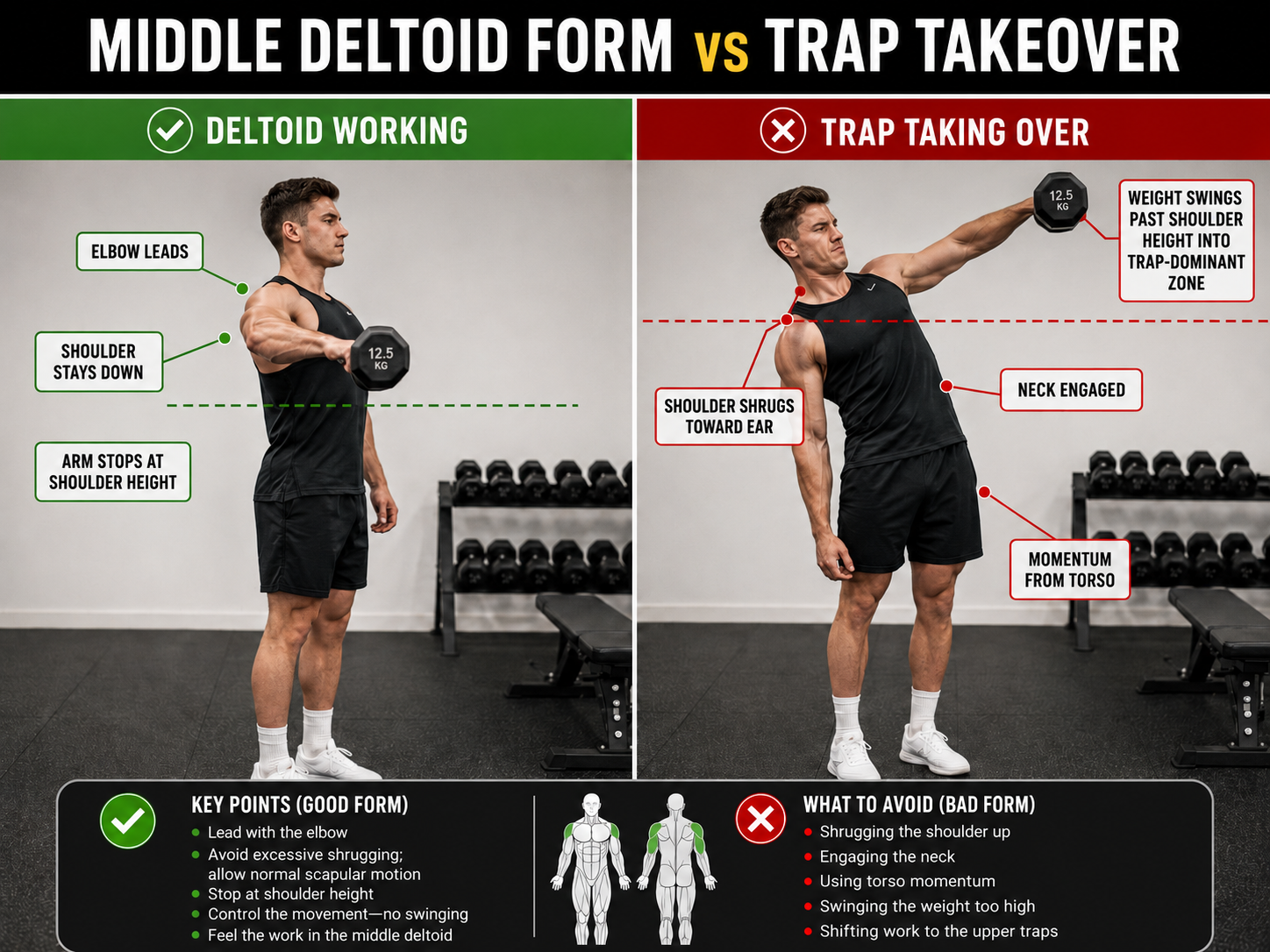
The weight goes up, your upper traps light up, and the muscle you were actually trying to train — the round cap on the side of your shoulder — feels like a bystander. Someone has told you to “lead with your elbow” and “stop shrugging,” and it helps a little, but the pull toward your traps never fully goes away. Add a few pounds and it comes right back.
The reason isn’t that you lack discipline. It’s that the middle deltoid has a mechanical property almost no article explains, and once you understand it, the whole confusing list of lateral raise cues collapses into a single, obvious principle. This is an article about that one fact — what the middle deltoid actually does, where it’s strong, where it isn’t, and why the traps step in exactly where they do.
What the Middle Deltoid Is
The deltoid is the muscle that caps your shoulder and gives it its rounded shape. It has three heads: the anterior (front), the middle (also called the lateral or acromial head), and the posterior (rear). They share a common insertion point on the side of the upper arm bone — the deltoid tuberosity — but they originate in different places and do different jobs.
The middle deltoid originates on the acromion, the bony shelf at the top of the shoulder blade. Of the three heads, it’s the largest and strongest, and it’s a multipennate muscle — its fibers are arranged in multiple feathered rows, an architecture built for producing force rather than moving through a long range. Its primary job is shoulder abduction: lifting the arm out to the side, away from the body. It’s also the head most responsible for shoulder width, which is why everyone who wants broader shoulders ends up training it.
That’s the anatomy that matters here. The rest — innervation by the axillary nerve, the seven neuromuscular segments researchers have identified within the deltoid, the blood supply — is real and interesting, but it isn’t what determines why your lateral raise goes wrong. This does.
The Fact That Changes Everything
Here is the property almost no training article explains: the deltoid does not initiate abduction, and it does the smallest share of the work exactly where the lateral raise begins.
Two separate things are going on at the bottom of the movement, and both push the work away from the side delt.
First, the start of abduction belongs to a different muscle. The supraspinatus — a small rotator cuff muscle sitting deep at the top of the shoulder — initiates roughly the first 15 to 30 degrees of abduction before the deltoid takes over as the prime mover. The side delt isn’t even the lead muscle at the very beginning of the lift.
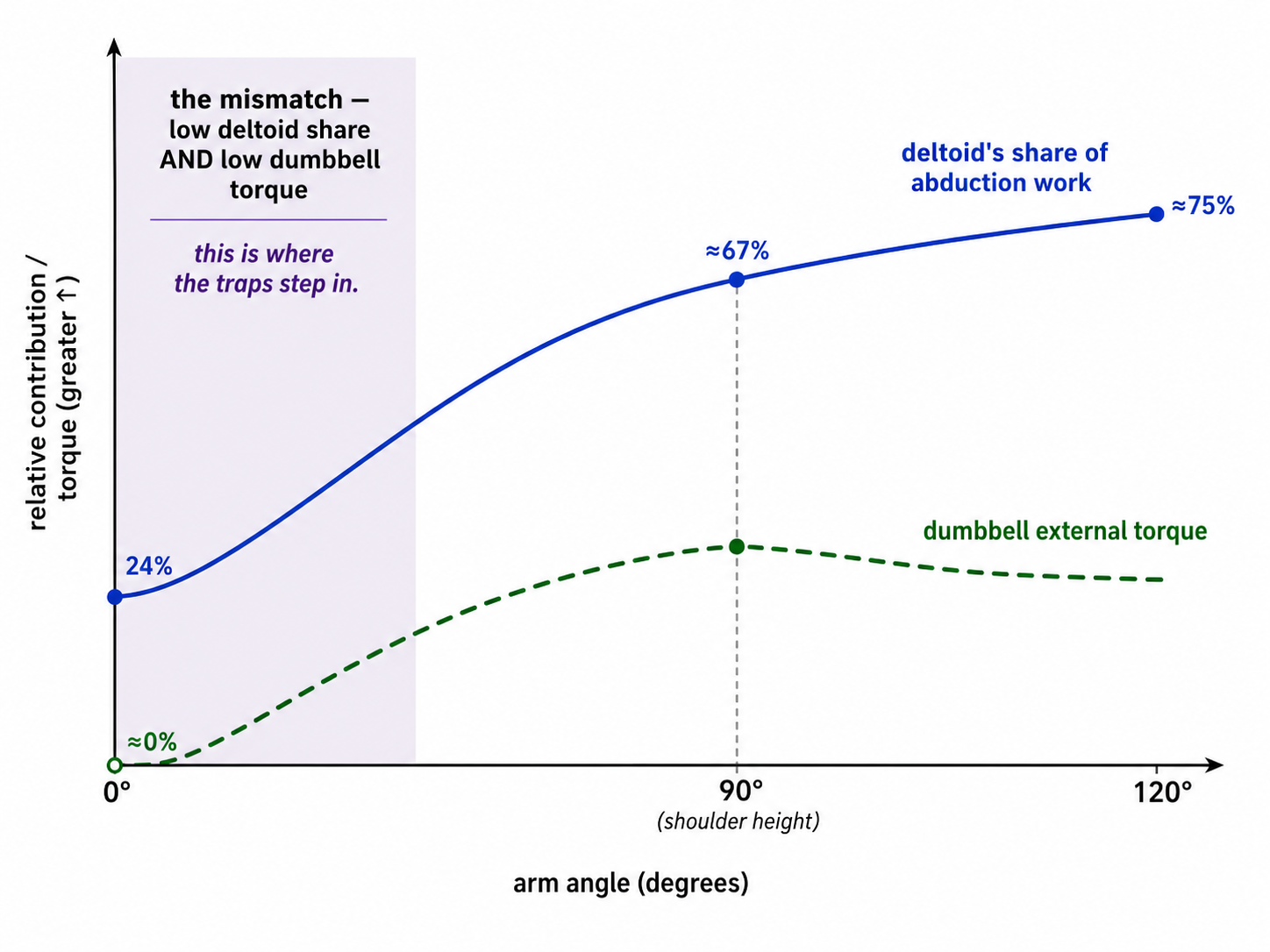
Second, and more important, the deltoid’s share of the abduction work changes dramatically through the range. When researchers measured how much each muscle contributes to shoulder strength at different angles, the deltoid as a whole — all three heads combined — contributed about 24% of abduction strength at the bottom and about 75% at 120 degrees, with roughly two-thirds at shoulder height. Since the middle head is the primary abductor among the three, it carries a large portion of that share — but the figures describe the whole deltoid, not the middle head in isolation. The principle holds: at the bottom of the range, the deltoid is doing the smallest share of the work, and as the arm rises, its share climbs steeply. The bottom of the raise is where the delt is least responsible for the movement.
A clarification, because this is where many explanations get sloppy: the middle deltoid is not a weak muscle, and it doesn’t lack leverage. Measured across the full range, the middle deltoid has one of the largest abduction moment arms — the largest leverage for lifting the arm — of any muscle crossing the shoulder. The point is not that it’s weak. The point is that the deltoid as a whole carries the smallest proportion of the abduction load at the bottom of the range, and the body has other tissues ready to cover the difference.
Why Your Traps Take Over — It’s Not a Discipline Problem
Now the payoff. When a muscle is doing only a quarter of the work at the bottom of a movement, and you load that movement, the body recruits whatever else can help move the weight from that position. For the lateral raise, the most available helper is the upper trapezius.
The upper trap upwardly rotates the scapula — it turns the shoulder blade so the socket tilts upward — and that action can contribute to getting the arm up. It engages most noticeably at the top, above shoulder height, where the scapula’s rotation demand is highest. But many lifters also feel the trap fire at the very bottom — likely to help break the weight away from the side when the deltoid is carrying its smallest share. The shrug you’ve been told to eliminate is the body routing around the delt’s lowest-contribution zone with a muscle that’s well-positioned to help.
This reframes the entire problem. You are not failing to control your traps through weak willpower. You’re working against a real distribution of labor in your own shoulder — and the fixes that work all work by changing where and how the side delt gets loaded, so that the part of the movement you’re loading is the part where the delt is actually doing the work.
The Dumbbell Makes It Worse — Here’s Why
There’s a second mechanical problem stacked on top of the first, and it comes from the dumbbell itself.
A dumbbell only pulls in one direction: straight down. The resistance a muscle has to overcome depends on the horizontal distance between the weight and the joint it’s rotating around — the moment arm. At the bottom of a lateral raise, your arm hangs nearly straight down, almost parallel to the pull of gravity. The horizontal distance from the weight to your shoulder is tiny, so the actual resistance on the side delt is close to zero. As your arm rises toward horizontal, that horizontal distance grows, and the resistance grows with it, peaking when your arm is parallel to the floor.
This is the dumbbell lateral raise’s defining feature: it is so difficult at the top that pausing there with anything but a light weight is nearly impossible, and almost weightless at the bottom. Combine this with the contribution curve from the last section and you get the core mismatch: the dumbbell provides its least resistance exactly where the deltoid is already doing its smallest share, and its most resistance where the delt is finally carrying the load. The earliest portion of every dumbbell raise carries close to zero external torque on the delt — and it rises continuously from there, which is why so many people swing the weight up through the low-torque zone with momentum and a shrug to reach the part where it finally bites.
Every Lateral Raise Cue, Explained by One Principle
Once you understand the contribution curve and the dumbbell’s resistance curve, the standard list of cues stops being arbitrary rules and becomes a set of consequences. Each one is solving the same problem from a different angle.
Use a lighter weight than you think you need. Because the side delt does so little at the bottom, a heavy dumbbell can only be started with help — and the trap is what helps. Lighten the load and the delt can manage the movement without recruiting the neck to break it off your side.
Lead with your elbow, not your hand. Keeping the elbow leading keeps the load aligned with the delt’s pull and stops the raise from drifting forward into a front raise, which shifts the work to the anterior deltoid.
Don’t lift much above shoulder height. The scapula upwardly rotates throughout the entire range of abduction, but past roughly 90 degrees its contribution becomes more dominant, and the traps must work harder to produce that rotation. Going higher isn’t “cheating” in a moral sense — it’s anatomy — but it does shift more of the work to the traps and away from the side delt, so if the side delt is the target, shoulder height is a reasonable ceiling.
Try a slight forward arm path, in the plane of the scapula. Raising the arms slightly in front of the body — in the scapular plane rather than straight out to the side — puts the shoulder in a more comfortable, lower-impingement position. The honest trade-off: it brings in slightly more front delt. Many people with cranky shoulders find this worth it.
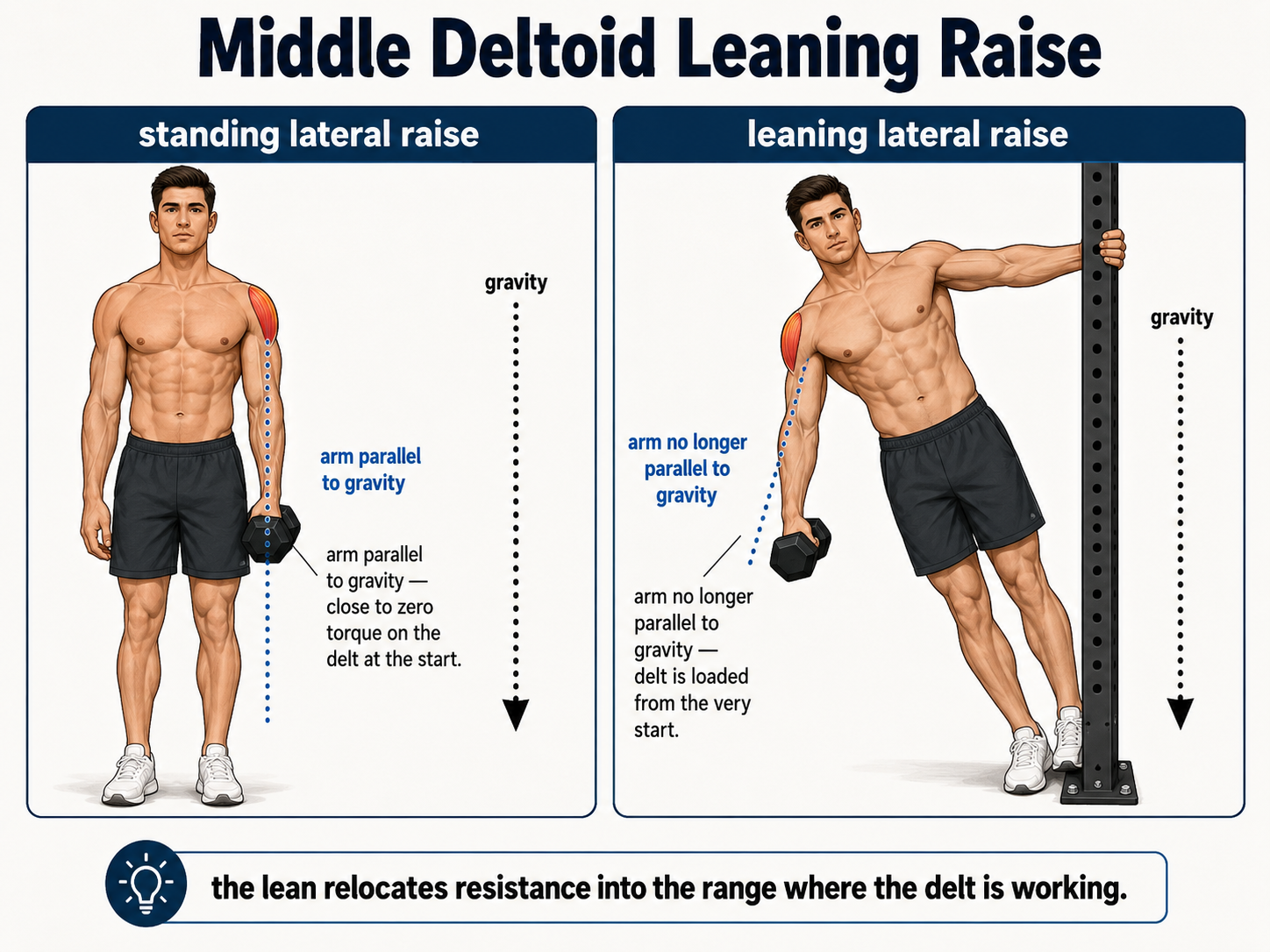
Try the leaning lateral raise. Hold a support with one hand and lean your torso away from the working arm. Now, even at the bottom of the rep, your arm is no longer parallel to gravity — so the side delt is loaded from the very start instead of through empty space. This is the single most useful adjustment the leverage principle predicts: it relocates the resistance into the range where the delt is working, and it makes a light dumbbell feel far heavier. (One caveat from the biomechanics literature: leaning shifts the hardest point of the movement higher in the range, so the peak resistance lands above 90 degrees. It’s a real improvement on the dead-zone problem, not a perfect resistance match.)
The Cue That Conflicts — Where the Sources Disagree
There’s one popular cue I won’t pretend is settled, because the sources genuinely disagree.
Some coaches tell you to tip the front of the dumbbell down at the top — “pour out the jug” — to bias the middle deltoid. Others warn that this same internal rotation drives the head of the upper arm bone toward the acromion and narrows the space the rotator cuff tendons pass through, raising impingement risk.
Both are partly right. Turning the thumb down does bias the middle delt, and it does narrow the subacromial space. Whether that trade is worth it depends on your shoulders. If you have a history of shoulder impingement or pain at the top of the raise, the safer choice that several sources converge on is a neutral grip with the thumb level or slightly up, working in the scapular plane. If your shoulders are healthy and you feel no pinch, the thumb-down bias is a tool you can use carefully. There isn’t a single correct answer here, and anyone who tells you there is hasn’t looked at both sides.
How to Actually Train It
Putting the principle to work:
Keep the load light to moderate and the reps higher — the side delt responds well to clean tension and controlled repetition, not to heavy weight muscled up with momentum. Lower slowly; the lowering phase is where a dumbbell raise still has tension to offer, and rushing it throws away half the rep.
Choose your tool for where it puts the tension. A cable, a resistance band, or a leaning dumbbell raise all keep tension on the delt at the bottom of the range, where a standard standing dumbbell raise gives you almost nothing. Worth being honest here: a recent training study found that dumbbell and cable lateral raises produced comparable lateral deltoid growth over eight weeks despite their different resistance curves — so the cable isn’t a magic bullet for hypertrophy. What the cable and the lean reliably do is change where the work happens, which matters most if the standing dumbbell version sends you straight to your traps or bothers your shoulder.
Avoid excessive shrugging while allowing normal scapular motion — the shoulder blade needs to upwardly rotate as the arm rises, so locking it down rigidly defeats the purpose. The goal is to prevent the trap from dominating, not to prevent the scapula from moving. Pause briefly at the top, where the delt is finally carrying the load, before lowering under control.
Where it fits in a program: train the middle delt after your pressing, as the isolation work that pressing alone won’t cover. Overhead and bench pressing recruit the front delt far more than the middle, so the side of the shoulder is the part most people under-develop and the part that most needs direct, dedicated work.
When the Trap Takeover Is a Problem, and When It’s Fine
Some trap involvement is normal and necessary. The upper trapezius is supposed to help rotate the scapula, especially as the arm goes overhead. The goal was never zero trap activity — that’s neither possible nor desirable. The goal is keeping the side delt as the primary worker through the range where it has the leverage and the load to be the primary worker.
What’s worth paying attention to is the difference between effort and warning. Fatigue and a burn in the side of the shoulder is the exercise working. A sharp pinch at the top of the raise is not — shoulder pain at the top of abduction can have several causes, including but not limited to the rotator cuff compressing under the acromion, and the risk is higher for people with a naturally hooked (Type III) acromion. A pinch doesn’t diagnose anything by itself, but it’s a clear signal to stop, reduce the load, and have the shoulder assessed if it persists. The range between roughly 60 and 120 degrees of abduction is known as the painful arc — the zone where the supraspinatus tendon is most likely to compress under the acromion. If you consistently feel a pinch in that range, stay below it, switch to a scapular-plane path, or substitute with a Y-raise until you’ve had the shoulder assessed.
If you have an existing rotator cuff tear, a history of shoulder dislocation, or active impingement, the lateral raise may need to be modified or replaced. The same applies to post-surgical shoulders, adhesive capsulitis (frozen shoulder), known labral pathology, or cervical radiculopathy that produces arm symptoms — these are all reasons to work with a clinician or physical therapist before loading the shoulder through abduction.
If you experience sudden weakness, visible deformity, numbness or tingling down the arm, or acute traumatic pain during a raise, stop immediately and seek medical assessment. These are not training signals — they’re injury signals.
And regardless of shoulder history: warm up before loading the lateral raise. Light band external rotations and scapular wall slides activate the rotator cuff and scapular stabilizers before the delt takes load. A few reps at very light weight before working sets is not optional — it’s the preparation the joint needs.
Pain rather than fatigue, a catch at a specific point in the range, or neck pain that lingers after training are all signals to reduce the load, check your form, and — if they persist — see a clinician who works with shoulders. Pressing or raising through shoulder pain doesn’t build the muscle; it builds the injury.
The Curve Was the Answer All Along
The middle deltoid is the muscle that makes your shoulders wide — and it lives inside a deltoid that does the smallest share of the abduction work at the exact point where the most common exercise for it begins. The most common tool for training it, the dumbbell, offers its least resistance at that same point. Those two facts, stacked, are why the load drifts to your traps. Not weakness. Not bad discipline. A distribution of labor and a resistance curve that both happen to bottom out in the same place.
Once you stop fighting that and start loading the muscle where it actually works — lighter, lower in the range, with a tool that keeps tension where the delt is doing the job — the lateral raise stops being a trap exercise and becomes what it was meant to be. The cues were never a random list of rules. They were all describing the same curve.

Middle deltoid
Origin: Superior surface of the acromion process
Insertion: Deltoid tuberosity of humerus.
Action: Abduction of the humerus at the shoulder.
Synergists: Anterior and posterior deltoid as well as supraspinatus.