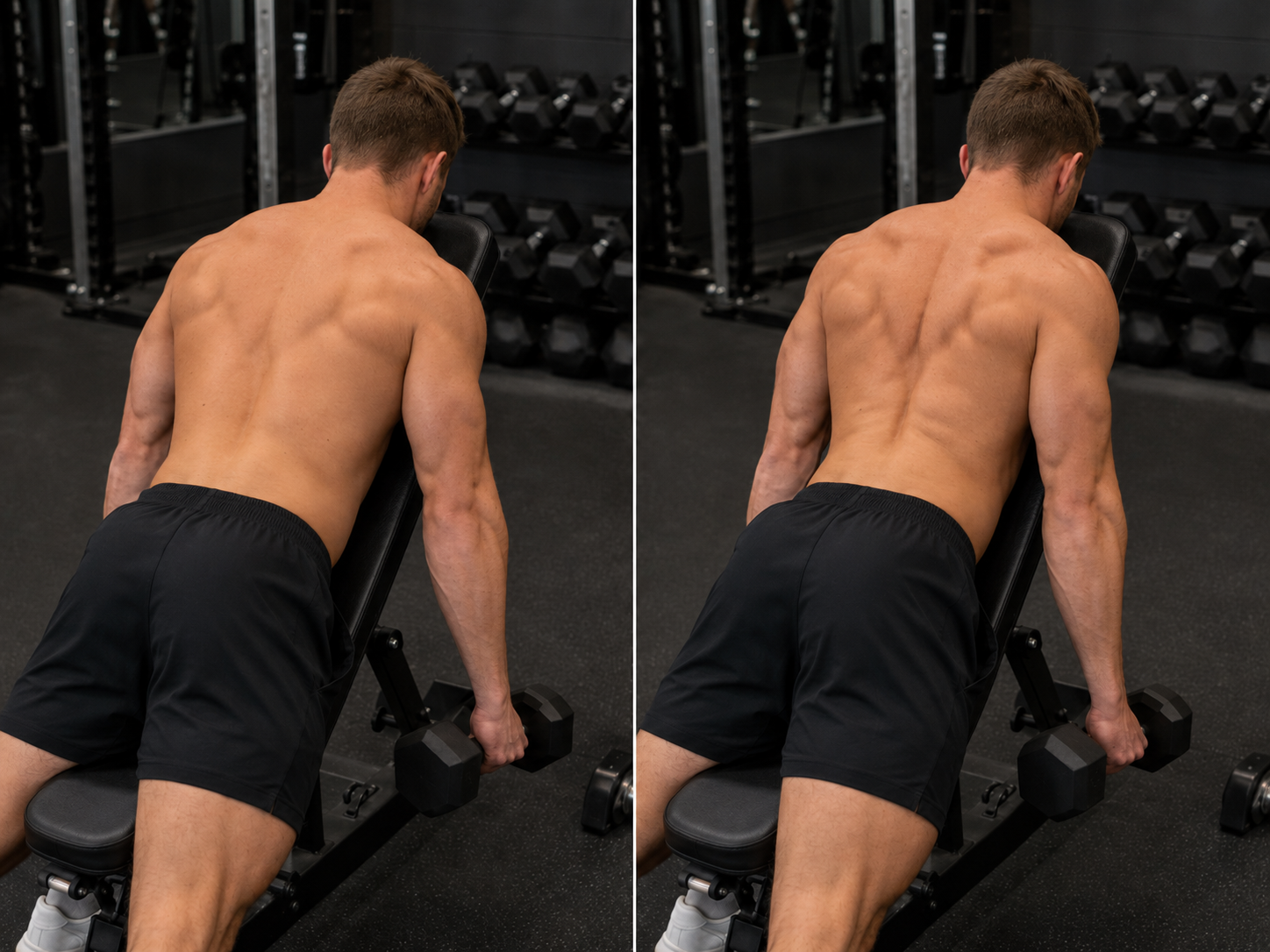
How grip orientation, elbow path, and torso angle turn the same dumbbell into different tools for different parts of your back.
A routine built from dumbbell back exercises can look varied on paper and still repeat the same movement pattern underneath. If every row uses the same grip, the same elbow path, and the same torso angle, you are not training ten different exercises — you are training one pull ten different ways. The exercises change, but the main pulling pattern — and much of the muscular emphasis — stays the same. Parts of your back can stay undertrained even as you add more sets.
The fix is not more exercises. It is understanding the three variables — grip orientation, elbow path, and torso angle — that change which muscles a row actually loads. Once those variables make sense, exercise selection stops being a list and starts being a decision.
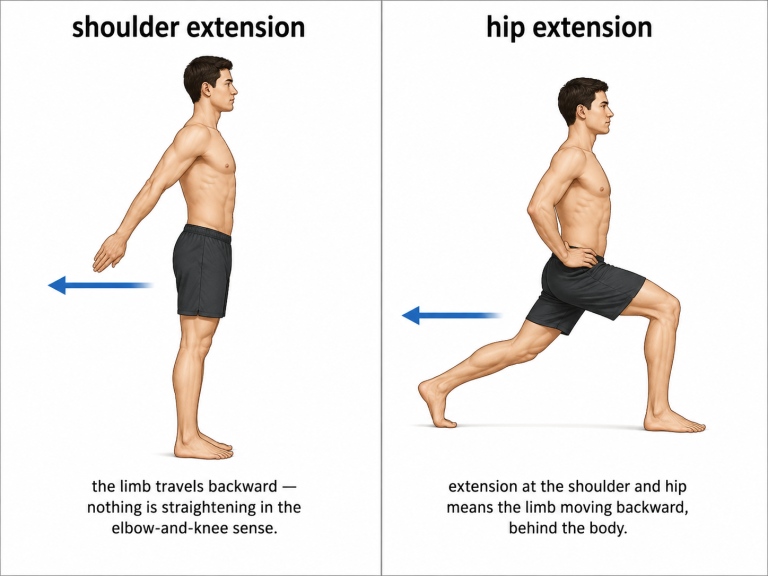
To make that decision, you need to know what your back is built from. Your back has several layers of muscle, each performing a different action. The lats sweep from the thoracolumbar fascia, pelvis, and lower ribs up to the upper arm. Their major training-relevant action is shoulder extension — pulling the elbow back toward the hip, especially from a flexed or abducted arm position — but they also contribute to shoulder adduction and internal rotation. The rhomboids and middle traps sit between your shoulder blades and pull them together — scapular retraction. The lower traps run diagonally from the lower thoracic spine toward the medial end of the scapular spine and work with the serratus anterior to upwardly rotate the scapulae; they also help control posterior tilt and depress the shoulder blade. The erector spinae run vertically along the spine itself and extend or stabilize it under load. The rear delts cap the back of the shoulder and perform shoulder horizontal abduction — moving the upper arm backward in the transverse plane when the arm is raised in front of the body.
How much each layer contributes to a given exercise depends on joint angles, moment arms, loading, range of motion, intent, and individual anatomy — not just line of pull. But line of pull is the variable you control most directly, and the sections that follow show you how to use it.
Three Variables That Change Which Muscles a Dumbbell Row Trains
Every dumbbell row involves pulling a weight from a hanging arm up toward the body. What changes — and what largely determines which muscles do the work — is how the arm travels. Three major variables influence this. They are not the only factors — individual anatomy, fatigue, and intent all play roles — but they are the ones the reader can adjust deliberately.
Grip orientation is the first. Grip does not directly determine back-muscle emphasis — what it does is facilitate a particular elbow path. When you hold the dumbbell with a neutral grip (palms facing each other) and keep your elbows tucked close to your torso, the rowing motion stays in the sagittal plane. The shoulder extends — the elbow travels back toward your hip — and the lats are usually a major contributor. When you switch to a pronated grip (palms facing behind you) and let the elbows flare out, the shoulder moves into horizontal abduction (also called horizontal extension) — the elbow travels out and away from the body. This tends to increase posterior deltoid and upper-back demand, while the external rotators (teres minor, infraspinatus) contribute to shoulder control during the movement. The wider elbow path also increases demand on the rhomboids and middle traps to retract the scapulae at the top of the row, though scapular retraction is a separate action at the shoulder blade, not at the glenohumeral joint. A supinated grip (palms facing forward) often increases biceps contribution.
A detailed breakdown of how shoulder abduction angle mediates this shift — and why it matters more than grip per se — is available in Cameron Gill’s analysis for Stronger By Science. The key finding: it is the degree of shoulder abduction (how far the elbow sits from the body) that determines whether a row is dominated by shoulder extension or horizontal abduction. Grip width and grip orientation influence that angle, but they do not directly determine muscle activation. The article also cautions that EMG activation during an exercise does not reliably predict which muscles will grow from that exercise — a useful reminder to treat activation cues as starting points rather than guarantees.
Elbow path relative to the torso is the second variable. Pulling the elbow toward the hip keeps the movement in shoulder extension and emphasizes the lats. Pulling the elbow out and toward the shoulder shifts toward horizontal abduction and emphasizes the rear delts and upper back. The elbow’s trajectory largely dictates which joint action dominates, regardless of what the exercise is called. A single-arm row can emphasize the lats or the mid-back depending largely on where the elbow travels.
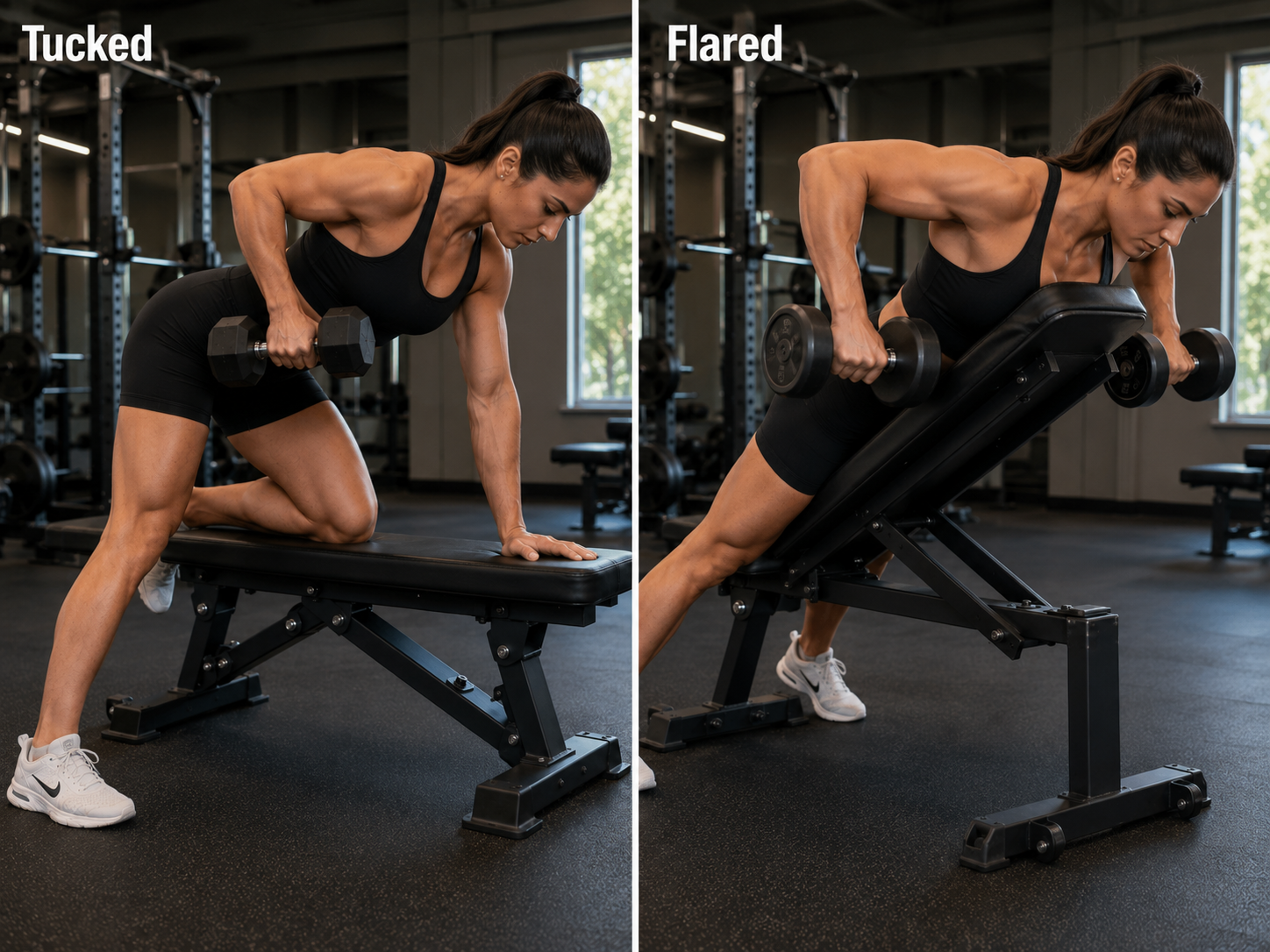
Torso angle is the third. Torso angle changes the line of resistance relative to the torso and can alter where the row feels hardest, but the resistance profile depends on arm path, elbow bend, and dumbbell position relative to the shoulder — not just how far the lifter bends forward. Limb position relative to the torso also changes the effective moment arm, so torso angle is not the only factor, but it is the most visible one to adjust. A more upright torso may shift emphasis toward the upper traps and a shrug-like pattern, especially if the lifter elevates the shoulders or turns the row into a shrug, since the vertical component of the pull increases relative to the horizontal.
These three variables are the reason the same dumbbell can function as a different tool depending on how you hold it and where you pull it. The sections that follow organize dumbbell back exercises by the joint action they emphasize, so you can see which layer each exercise trains and why.
Dumbbell Exercises That Train the Lats: Rows and Pullovers
The lats are the widest muscle in the human body, with fibers originating as low as the pelvis and as high as the bottom of the shoulder blade. A major training-relevant action is shoulder extension — pulling the upper arm from an overhead or forward position back toward the body, especially from a flexed arm position. Any dumbbell exercise that keeps the elbow tucked and pulls it toward the hip is training the lats through this action.
The single-arm dumbbell row is the most direct lat-focused dumbbell exercise when performed with a neutral grip and the elbow traveling close to the torso, finishing near the hip rather than flaring out to the side. The bench under the non-working hand removes the lower back as a limiting factor, which can make it more likely that the lat fatigues before the spine does — though grip and biceps can also become limiting factors. This is a meaningful advantage over bilateral bent-over rows for isolating the lats — the bench handles much of the stabilization, which can make lat-focused pulling easier to emphasize.
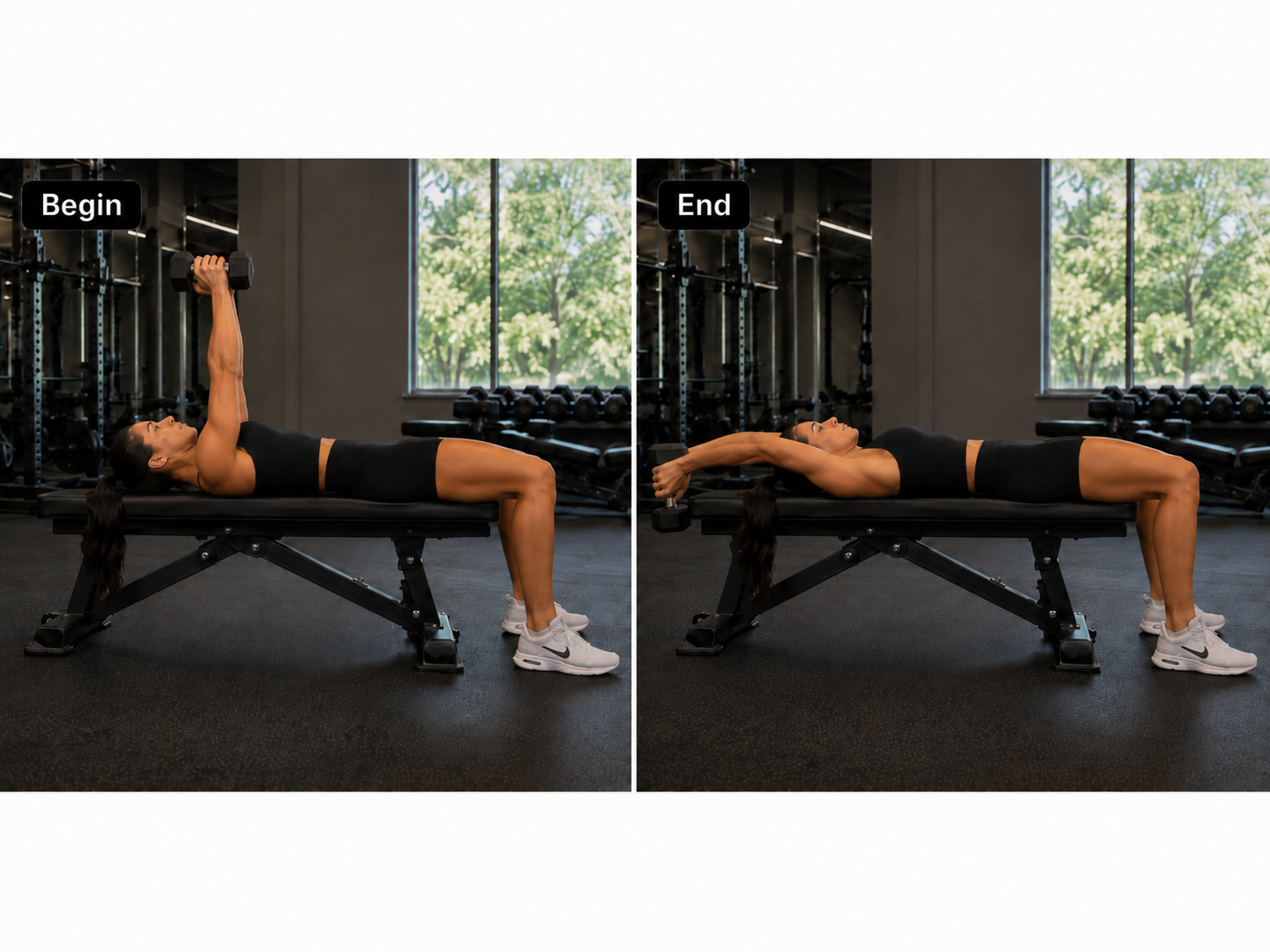
The dumbbell pullover trains shoulder extension from an overhead, stretched position — a range of motion that rows do not typically provide. It involves the lats, pectoralis major (particularly the sternocostal head, which assists extension of a flexed arm), teres major, and the long head of the triceps. EMG research on barbell pullovers (Marchetti & Uchida, Journal of Applied Biomechanics, 2011) found greater pectoralis major activation than latissimus dorsi activation, so the pullover should not be presented as a reliably lat-dominant exercise — it is a multi-muscle shoulder-extension movement, and individual form, load, and anatomy influence which muscles contribute most. Keeping the arc behind the head and using controlled loads may help keep the movement focused on shoulder extension rather than turning it into a press, but both muscles can contribute meaningfully regardless. Because the dumbbell travels over the face and behind the head, grip security matters: use a controlled load, keep both hands locked around the handle or under the top plate, and avoid maximal-effort attempts — losing control of the weight in the stretched position risks injury. Readers with current shoulder pain, a history of impingement or labral issues, recent shoulder trauma, a suspected rotator cuff tear, post-surgical shoulders, or any instability should avoid this exercise or seek professional guidance before attempting it — the overhead stretched position places the shoulder in a vulnerable range.
The bent-over dumbbell row performed bilaterally with a neutral grip is a heavier loading option. Because both arms work simultaneously and no bench supports the torso, the erector spinae must hold the spine in position isometrically throughout the set. This makes the exercise more systemically fatiguing than a single-arm row, but it also limits how much weight the lats can handle — the set may end when the lower back fatigues rather than when the lats do. For readers who want heavy lat loading without the lower-back ceiling, the single-arm row with bench support is the better choice.
Training the Mid-Back: Chest-Supported Rows, Reverse Flys, Y-Raises
If you have been rowing with a neutral grip and elbows tucked for months and your mid-back still looks flat between the shoulder blades, the issue is not effort. It is direction. The rhomboids and middle traps respond to scapular retraction — pulling the shoulder blades together — and the rear delts respond to shoulder horizontal abduction. Both actions receive relatively less emphasis in a row that keeps the elbow pinned to the side.
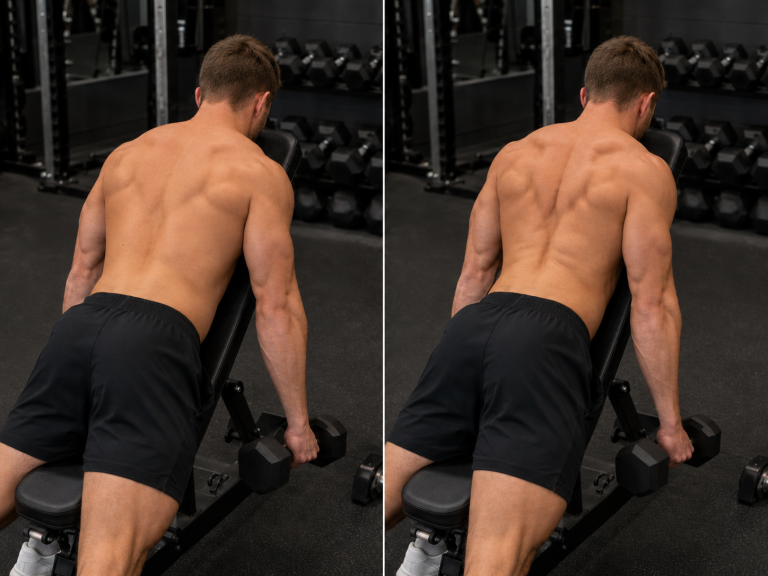
The chest-supported dumbbell row with a pronated or neutral grip and elbows flared is one of the most controlled ways to shift the work into the mid-back. Lying face-down on an incline bench removes the erector spinae from the movement, which allows the lifter to focus on retracting the scapulae and pulling the elbows outward without spinal fatigue limiting the set. Adjusting the bench angle changes the line of pull: a shallower angle (around 30°) increases the horizontal component; a steeper angle (around 45°) adds a more vertical pull that may bring the traps into the movement more. Both are effective — the choice depends on which portion of the mid-back feels underserved.
The reverse fly, either bent-over or chest-supported, emphasizes the rear delts and the rhomboids with lighter loads, though middle and lower traps, infraspinatus, and other scapular stabilizers also contribute depending on form. From a programming standpoint, many coaches treat this as a contraction-focused exercise — the value is in the squeeze toward end range, where the shoulder blades are retracted and the rear delts are shortened, though the exact end range varies by shoulder angle and individual scapular mechanics. Higher reps (12–20) with controlled tempos often work well for this movement, because the target muscles are small and fatigue quickly under heavy load. That said, lower rep ranges with heavier loads are not inherently wrong — they simply shift the training stimulus toward strength rather than time under tension.
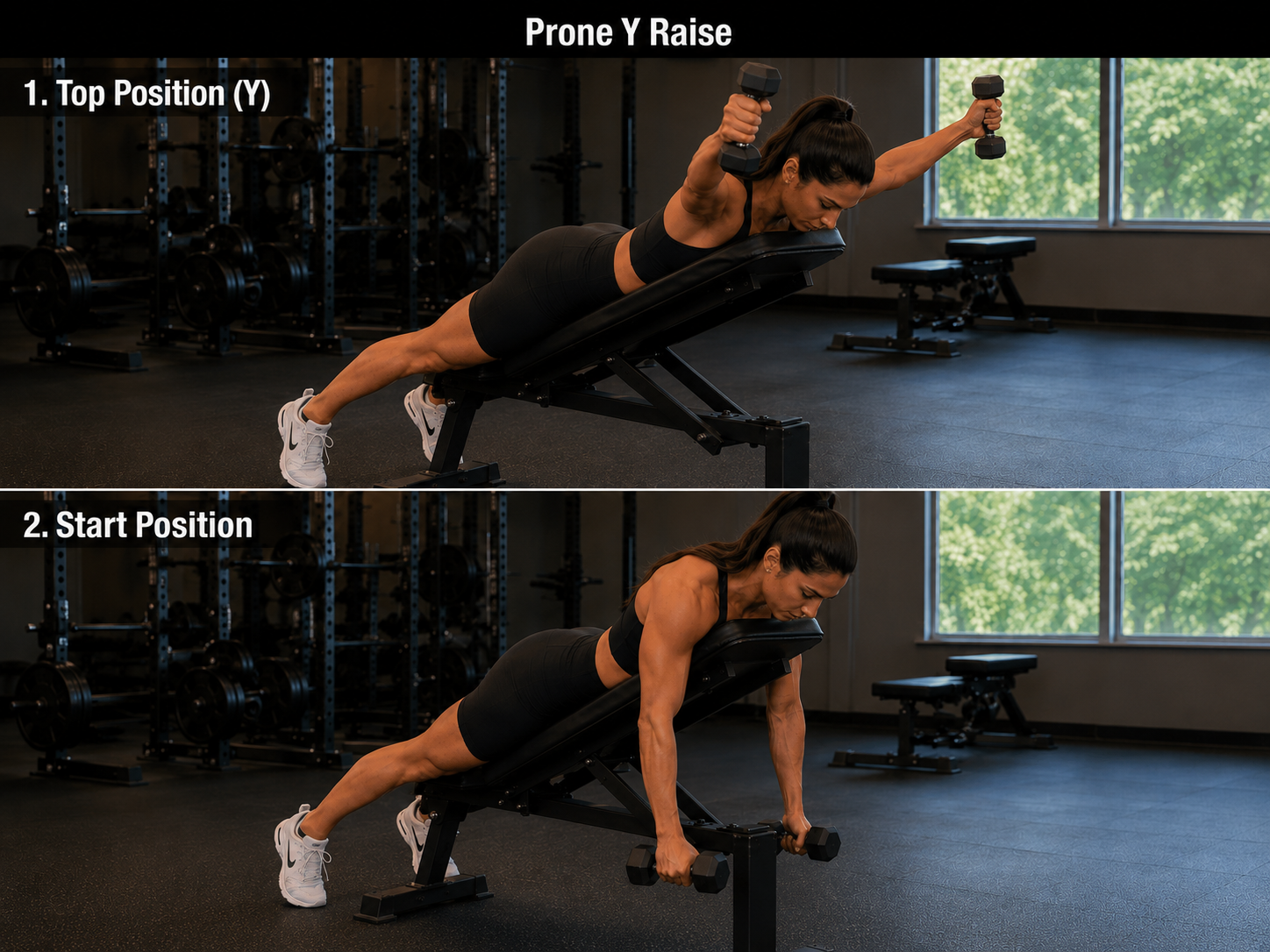
The prone Y-raise is the exercise in this group that most readers have never tried, and it addresses a muscle that many dumbbell-only rowing programs underemphasize: the lower traps. The lower traps work with the serratus anterior to upwardly rotate the scapulae and contribute to posterior tilt — actions that keep the shoulder blade tracking properly during overhead and pulling movements. The Y-raise loads these fibers by having you raise your arms into a Y position while lying face-down on a bench, using very light dumbbells or even just body weight. It is a low-load scapular-control exercise, not a mass builder. For readers who sit at a desk for most of the day, the Y-raise contributes to addressing one component of forward-shoulder posture, though that posture is multifactorial — tight pecs, thoracic kyphosis, and habitual positioning all play roles alongside lower trap weakness — and no single exercise reliably corrects it on its own. Readers with previous shoulder pathology, particularly impingement, should test this movement with body weight only and stop if it provokes pain in the overhead position.
Three Dumbbell Hinge Exercises and How They Load the Lower Back
Most dumbbell back exercises that involve a hinge — bending forward at the hips and returning upright — load the erector spinae. But the erectors can work in two different ways: as stabilizers, holding the spine rigid while other muscles produce movement, or as prime movers, actively extending the spine. The distinction matters for programming because the load, the rep range, and the risk profile change depending on which role the erectors are playing.
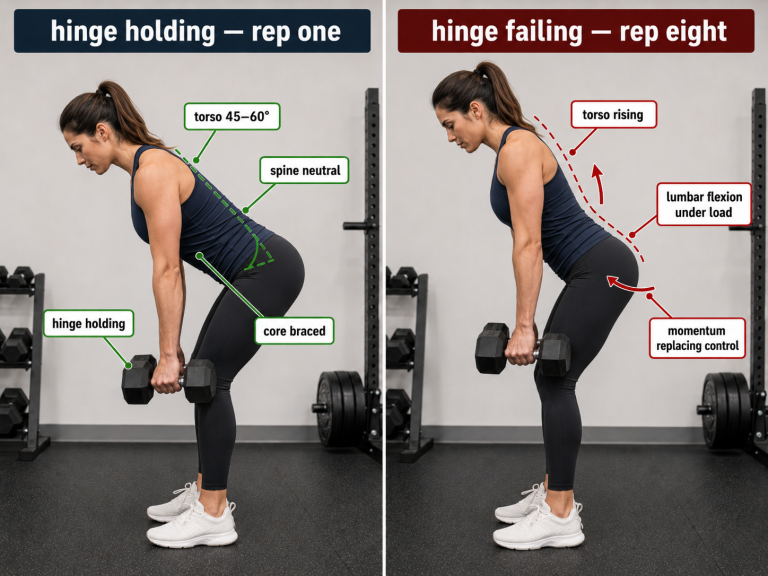
In the dumbbell Romanian deadlift, the erectors are stabilizers. The hamstrings and glutes produce the hip extension that drives the movement; the erectors hold the spine in a neutral position under load. The dumbbell version often allows a slightly greater range of motion than a barbell version because the weights can travel around the knees rather than being blocked by them, though individual anthropometry affects this. It is also more accessible for home setups where a barbell is not available. The key form cue is maintaining a relatively neutral spine throughout. Some degree of lumbar flexion under load is normal and not inherently dangerous — the spine is built to flex — but a sudden loss of position under heavy load changes the demand on the erectors significantly, and exceeding one’s current load tolerance in a flexed position increases risk. Readers who notice their back rounding at a particular weight should treat that as a load-tolerance boundary, not a failure to “use good form.”
In the dumbbell good morning, the dumbbells are racked on the shoulders — one end of each dumbbell in front of the shoulder, one end behind — or a single dumbbell is held horizontally across the upper back with both hands. Only use this exercise if the dumbbells can be held securely in position; if the setup feels unstable, use a lighter front-held variation or skip the movement in favor of the RDL. The erector role depends on coaching style. In a neutral-spine hip-hinge version — which is how most coaches teach it — the erectors stabilize isometrically, similar to the RDL, but with the load positioned at the shoulders rather than hanging from the arms, which lengthens the lever and increases the demand on the erectors at the same weight. In versions where spinal flexion and extension are deliberately allowed, the erectors work through a larger range of motion and face greater demand in their extensile role, which increases both the training stimulus to the erectors and the technique sensitivity of the movement. Either way, the good morning requires lighter weights and deliberate control, and is not appropriate for beginners without coaching. It is also not the right tool for people whose symptoms are reliably provoked by loaded forward bending — if hinging under load brings on pain, choose a different exercise and seek assessment.
The single-leg dumbbell Romanian deadlift hinges on one leg while the other extends behind for balance, with a dumbbell held in the hand opposite the standing leg. The erectors work the same stabilizing role as the bilateral RDL, but the single-leg stance adds a lateral-stability demand — with the weight held opposite the standing leg, the trunk and pelvis must resist being pulled toward the loaded side. A 2023 sEMG study on dumbbell and flywheel single-leg RDL variations found that opposite-hand (contralateral) loading significantly increased activity in the dominant-side erector spinae and in gluteal stabilizers compared with same-side loading; the external oblique showed no significant difference between the two positions. This makes it a lighter-load exercise that trains spinal and pelvic stability in a way the bilateral version does not. It is also useful for identifying and addressing left-right imbalances. The balance demand means it should be learned with body weight or a very light dumbbell before loading, and readers who cannot yet hinge cleanly on two legs should master the bilateral RDL first.
All hinge exercises load the lumbar spine. Sharp pain during any hinge movement is a stop signal, not something to push through. Mild discomfort may respond to technique modification or load reduction, but if pain is sharp, worsening, recurrent, radiating, or not resolved by adjusting technique and load, the appropriate next step is professional assessment. For readers new to hinge movements, progressive loading — starting light and adding weight gradually over weeks — allows the spine and its supporting muscles to adapt. Individual tolerance varies widely, and what one person handles comfortably may exceed another person’s current capacity.
Scapular Movement During Rows: Two Approaches and What Each Changes
Every dumbbell row involves two joints working together: the shoulder joint moves the arm, and the scapulothoracic joint moves the shoulder blade. Most coaching cues focus only on the arm — “pull the elbow back,” “squeeze at the top” — and treat the shoulder blade as a fixed platform. But the shoulder blade is not fixed. It moves, and how it moves determines whether the mid-back muscles (rhomboids, middle traps) actually work through a full range or stay locked in one position throughout the set.
One widely recommended approach is to allow the scapulae to protract — spread apart — at the bottom of a row, and retract — squeeze together — at the top. This gives the rhomboids and middle traps a full contraction-to-stretch cycle on every rep. When the scapulae stay pinned back throughout the row, the arm still moves, but the shoulder blades do not. The row’s range of motion shortens, and the rhomboids and traps work isometrically — they hold position rather than contracting through range. The muscles still produce force, but the dynamic scapular work is reduced.
On the other end, when the scapulae never retract at all — when the row ends with the elbow back but the shoulder blades still apart — the movement may reduce dynamic mid-back contribution and feel more arm-dominant. The lats and teres major still contribute to shoulder extension, but the reader may feel the row primarily in the arms rather than the back.
Some coaches prefer maintaining scapular retraction throughout a row to keep constant tension on the mid-back. This is a legitimate alternative model, and for some lifters it produces a stronger contraction. The point is not that one approach is universally correct, but that the scapulae can move during rows and that the choice is worth making deliberately rather than by default.
The reader who has never thought about scapular movement during rows can test both approaches on their next back day: one set allowing the shoulder blades to spread at the bottom and squeeze at the top, one set keeping them pinned back throughout. Where they feel the difference will tell them which approach serves their goals.
One Exercise Per Pulling Direction: A Workout Framework
The framework is simple: pick one exercise from each pulling direction, and you have covered the major back-training targets.
The first category is a shoulder-extension movement for the lats. This is a row with the elbows tucked — a single-arm dumbbell row or a bilateral bent-over row with a neutral grip. The dumbbell pullover also trains shoulder extension from a stretched position, but it involves the pecs, teres major, and triceps long head substantially, so it works better as a supplementary movement than as the session’s primary lat exercise. One exercise from this group is generally enough for most sessions.
The second category is a horizontal-abduction or scapular-retraction movement for the mid-back. This is a chest-supported row with elbows flared, a reverse fly, or a prone Y-raise. Pick one or two: the chest-supported row for load, the reverse fly or Y-raise for accessory work and end-range contraction.
The third category is a hip-hinge movement for the erector spinae and posterior chain. This is a dumbbell RDL, a dumbbell good morning, or a single-leg dumbbell RDL. One is generally enough — the hinge taxes the lower back significantly, and doubling up increases fatigue without proportionally increasing stimulus.
Rep ranges depend on the goal. For strength, work in the 3–6 rep range with heavier loads on compound movements (rows, RDLs). For hypertrophy, the traditional recommendation is 8–12 reps with moderate loads, though a meta-analysis by Schoenfeld and colleagues (Journal of Strength and Conditioning Research, 2017) found similar whole-muscle growth across a wide spectrum of loads when sets are taken close to failure — roughly 30% of one-rep max and above, which corresponds to a range of about 5–30 reps. For endurance and accessory work — particularly the reverse fly and Y-raise — the 12–20 range with lighter loads allows the small muscles to work through their full range without compensation.
Sequencing follows a general principle: compound before isolation, heavier before lighter. Start with the heaviest row or RDL, move to the mid-back work, and finish with isolation or accessory exercises. The exception is if a particular muscle group is lagging — warming up the weaker area with a light isolation set before the compound work can help the reader feel it working during the main movement.
A sample session might look like this: single-arm dumbbell rows for the lats (3 sets of 8–10), chest-supported rows with elbows flared for the mid-back (3 sets of 10–12), reverse flys for the rear delts (2 sets of 15), and dumbbell RDLs for the posterior chain (3 sets of 8–10). That is four exercises covering three pulling directions, completed in under forty-five minutes.
Four Errors That Reduce Back Stimulus in Dumbbell Rows
The mistakes that matter most with dumbbell back exercises are not the ones that look dramatic from the outside. They are the subtle ones — the patterns that feel like they are working but are not producing the stimulus the reader expects.
Rowing with a fixed torso angle but no scapular movement is the most invisible of these. The elbow moves, the arm bends, the weight goes up and comes down. It looks like a row. But if the shoulder blades never retract at the top and never protract at the bottom, the dynamic scapular work is reduced and more of the load falls on the arm flexors. The reader who feels rows primarily in the biceps should check whether their shoulder blades are actually moving.
Using the same grip and elbow path for every row variation is the programming version of this mistake. If every row is performed with a neutral grip and elbows tucked, the lats receive the majority of the stimulus and the mid-back — rhomboids, middle traps, rear delts — receives relatively less. A flat mid-back after months of consistent rowing may have several causes — training volume, effort level, genetics, and progression all contribute — but grip and elbow path are worth examining before adding more volume.
Choosing a weight that requires momentum to move is a loading mistake that reduces control through the two most valuable phases of the rep: the stretch at the bottom and the contraction at the top. If the dumbbell must be heaved upward to start moving, the bottom stretch — where many exercises place significant tension on the muscle in a lengthened position — is rushed through. And if the weight is so heavy that the top must be cut short to control it, the full contraction is lost too. The resistance profile varies by exercise, so the point of greatest tension is not always at the bottom, but in general the back muscles only benefit from the portions of the rep the lifter controls. Momentum reduces the muscular work the lifter can control.
Neglecting the eccentric phase — the controlled lowering of the dumbbell after each rep — discards a meaningful component of the training stimulus. The eccentric provides mechanical tension through the muscle’s lengthening range, which contributes to both strength and hypertrophy alongside concentric and isometric work. Letting the weight drop rather than lowering it under control reduces the time the muscle spends under load, though tempo is one factor among many — proximity to failure, total volume, and progressive overload matter as well. A two-to-three second lowering tempo on every rep is a simple change worth experimenting with.
Quick Reference: Dumbbell Back Exercises by Pulling Direction
For the lats (shoulder extension — elbow toward hip, grip neutral, elbows tucked): single-arm dumbbell row, bent-over dumbbell row (bilateral, neutral grip). The dumbbell pullover also trains shoulder extension from a stretched position but involves the pecs, teres major, and triceps long head substantially — treat it as a multi-muscle exercise rather than a lat isolation movement.
For the mid-back (horizontal abduction and scapular retraction — elbows flared, pronated grip): chest-supported dumbbell row, reverse fly, prone Y-raise.
For the erector spinae and posterior chain (hip hinge — spine stabilizing or extending under load): dumbbell Romanian deadlift, dumbbell good morning, single-leg dumbbell Romanian deadlift.
Rep ranges by goal: strength 3–6, hypertrophy roughly 5–30 in many practical programs (assuming sets are taken close to failure; 8–12 is a common starting point), endurance/accessory 12–20.
Sequencing: compound before isolation, heavier before lighter, one exercise per pulling direction is generally enough for most sessions.
A note on sourcing: The anatomical descriptions in this article (muscle origins, insertions, and joint actions) reflect standard functional-anatomy references such as Kendall’s Muscles: Testing and Function and general kinesiology consensus. The specific EMG, hypertrophy, and rowing-mechanics claims are cited inline and referenced below. The safety guidance — contraindications for hinge exercises, pain-response advice, and shoulder cautions for overhead movements — reflects general strength-and-conditioning and clinical practice rather than a single trial, and is not a substitute for individual assessment by a qualified professional. Readers with existing injuries or chronic pain should consult a sports physical therapist or qualified movement professional before programming these exercises.
References
- Marchetti, P.H. & Uchida, M.C. (2011). Effects of the pullover exercise on the pectoralis major and latissimus dorsi muscles as evaluated by EMG. Journal of Applied Biomechanics, 27(4), 380–384. DOI: 10.1123/jab.27.4.380
- Schoenfeld, B.J., Grgic, J., Ogborn, D. & Krieger, J.W. (2017). Strength and hypertrophy adaptations between low- vs. high-load resistance training: a systematic review and meta-analysis. Journal of Strength and Conditioning Research, 31(12), 3508–3523. DOI: 10.1519/JSC.0000000000002200
- Gill, C. (2022). Does your rowing grip actually affect back development? Stronger By Science. https://www.strongerbyscience.com/rowing/
- Mo, R.C.Y., Ngai, D.C.W., Ng, C.C.M., Sin, K.H.S., Luk, J.T.C. & Ho, I.M.K. (2023). Effects of loading positions on the activation of trunk and hip muscles during flywheel and dumbbell single-leg Romanian deadlift exercises. Frontiers in Physiology, 14, 1264604. DOI: 10.3389/fphys.2023.1264604